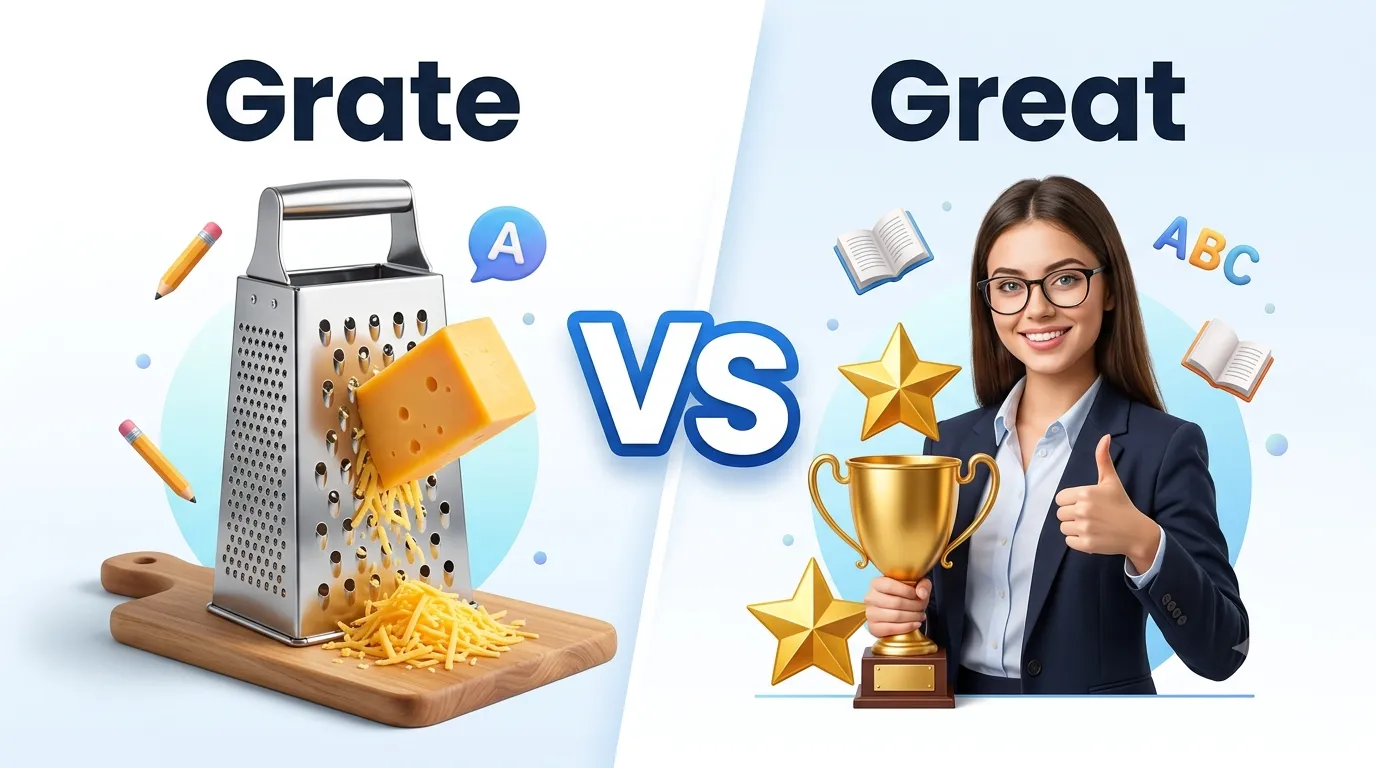
Grate means to shred food or make a harsh scraping sound. Great means something is wonderful, huge, or famous.
I used to make silly writing mistakes. Years ago, I wrote an email to my boss about a great idea. I accidentally typed grate idea instead.
My boss sent back a joke. He asked if my idea was covered in shredded cheese!
I felt so embarrassed. I realized then how easy it is to mix up these two words. They sound the same, but they mean completely different things.
Many people confuse grate or great every day. You hear both words used all the time. But typing the wrong one can look bad.
It can confuse your readers fast. That is why so many people search for help online.
This guide will fix that problem for you today. You will learn the clear meanings and simple tricks for both words.
You will never mix them up again. Let us dive in and clear up the confusion right now!
Grate or Great: Quick Answer
Grate is a verb or a noun. It means to rub food against a sharp tool or to cause annoyance. It can also mean a metal frame over a fireplace.
Great is an adjective. It describes something that is very good, large, or important.
- Correct: I need to grate the cheese for the pizza.
- Correct: You did a great job on your project!
The Origin / Background of Grate or Great
These two words have very different histories. Knowing where they come from helps you remember them.
The word grate comes from an old French word grater. That old word means to scrape or scratch.
That makes sense because you scrape cheese to shred it! A harsh noise also scrapes against your ears.
The word great comes from an old English word great. It meant coarse, thick, or large.
Over hundreds of years, people started using it for good things too. Today, we use it when something impresses us.
They sound alike because of changes in how people spoke long ago. But their roots stay totally separate.
Grate or Great Explained: Key Differences or Variations
It helps to see how both words work side by side. One is about action or metal bars. The other is about quality or size.
The table below breaks down the main ways to use each word.
| Term | Meaning | When to Use | Region/Context |
|---|---|---|---|
| Grate | To shred food or make a harsh sound | Cooking, annoying noises, or metal frames | Global / Everyday |
| Great | Very good, large, or important | Praising someone, big sizes, or famous people | Global / Everyday |
Look at how they work in real sentences.
You use grate when you are in the kitchen. “Please grate the carrots for the salad.”
You also use grate when a noise bothers you. “That loud voice starts to grate on my nerves.”
You use great to compliment a friend. “That was a great movie we saw!”
You use great for big things. “The Great Wall of China is very long.”
Which Version / Approach Should You Use?
Choosing the right word depends entirely on what you want to say. Here is simple advice based on your needs.
For Cooking and Kitchen Tasks
Use grate every time. You shred cheese, ginger, or lemon peel.
For Giving Compliments
Use great always. You want to tell someone they did a good job.
For Expressing Annoyance
Use grate. A bad sound or habit grates on your nerves.
For Global and Neutral Writing
Always double-check your sentence. Ask yourself if you mean “good” or “shred.”
If you mean good, pick great. If you mean shred, pick grate.
Common Mistakes with Grate or Great
People make mistakes with these words because they sound identical. Here are four common errors and how to fix them easily.
Mistake 1: Complimenting someone with the wrong spelling
- Wrong: You did a grate job today!
- Correction: You did a great job today!
- Why it happens: People type fast and pick the first word in their head.
Mistake 2: Writing a recipe with the wrong word
- Wrong: Please great the Parmesan cheese.
- Correction: Please grate the Parmesan cheese.
- Why it happens: Cheese tastes great, so people confuse the words.
Mistake 3: Describing an annoying sound incorrectly
- Wrong: That sound really greats on my nerves.
- Correction: That sound really grates on my nerves.
- Why it happens: People forget that grate means to annoy.
Mistake 4: Talking about historical monuments
- Wrong: We visited the Grate Pyramids.
- Correction: We visited the Great Pyramids.
- Why it happens: Writers mix up the letters a and e.
Grate or Great in Real-World Examples
Seeing these words in everyday context makes them stick in your mind.
In a Professional Email
“Thank you for the great presentation yesterday. The team loved your clear ideas.”
In a News Headline
“Local Chef Shows How to Grate Fresh Garlic Fast”
In a Social Media Post
“Had a great time at the beach today! Perfect weather and fun times.”
In a Formal Report
“The company achieved great success in the fourth quarter. Sales rose sharply.”
Grate or Great: Data, Trends & Usage
Search engine data shows thousands of people search for grate or great every month.
Students and non-native English speakers search for this topic the most. They want to avoid embarrassing spelling errors in their writing.
This search intent is purely informational. People want a quick check to build their writing confidence.
Getting this right matters today more than ever. Digital communication moves fast.
Clear writing shows you are careful and smart. A simple typo can distract from your real message.
Mastering basic words makes your writing look clean and polished.
Comparison of Terms
Here is a simple standalone guide you can save for later. It shows all the differences clearly.
| Term/Variant | Meaning | Region/Context | Best Used When |
|---|---|---|---|
| Grate (Verb) | To rub food into tiny pieces | Cooking & Recipes | Preparing ingredients like cheese or vegetables |
| Grate (Verb) | To annoy or irritate someone | Emotional / Sensory | Describing an annoying noise or bad habit |
| Grate (Noun) | A metal frame over an opening | Home & Construction | Talking about fireplaces or street drains |
| Great (Adjective) | Wonderful, fantastic, or excellent | General / Daily | Giving compliments or praise |
| Great (Adjective) | Large in size or scope | History & Description | Describing big structures, areas, or events |
Frequently Asked Questions
Q: What does grate mean in simple terms?
A: Grate means to shred food into small pieces using a tool. It can also mean to annoy someone or refer to a metal cover for a fireplace.
Q: How do you use great correctly in a sentence?
A: Use great when you want to describe something wonderful or large. For example, you can write, “We had a great time at the park today.”
Q: Grate vs great: what is the main difference?
A: Grate is usually an action about shredding food or making a harsh sound. Great is a descriptive word that means awesome or very big.
Q: Is great acceptable in formal writing?
A: Yes, great is correct in formal writing when describing size or importance. However, words like excellent or significant can sometimes sound more professional.
Q: Which version is correct: “grate job” or “great job”?
A: “Great job” is the only correct version. “Grate job” is a spelling mistake unless you are making a funny pun about cheese.
Q: Where does the word grate come from?
A: Grate comes from an old French word that means to scrape or scratch. That is why it connects to shredding food and scraping sounds.
Q: Can grate be used as a noun?
A: Yes, grate can be a noun. It refers to a metal grid that holds wood in a fireplace or covers a drain on the street.
Conclusion
Mastering grate or great is easy once you know the core rules.
First, remember that grate is about cooking cheese or scraping metal. Second, remember that great is about big sizes or wonderful things.
Third, use simple word association to keep them straight. Just picture a cheese grater in your kitchen!
Now you possess the knowledge to write both words with total confidence. You will never mix them up in emails, papers, or posts again.
Bookmark this guide so you never second-guess grate or great again!

I have been writing about English spelling and word usage for the past five years. My goal is to give readers a clear answer without overwhelming them with complicated rules. At WordsCombo, I focus on making everyday English easier for everyone.