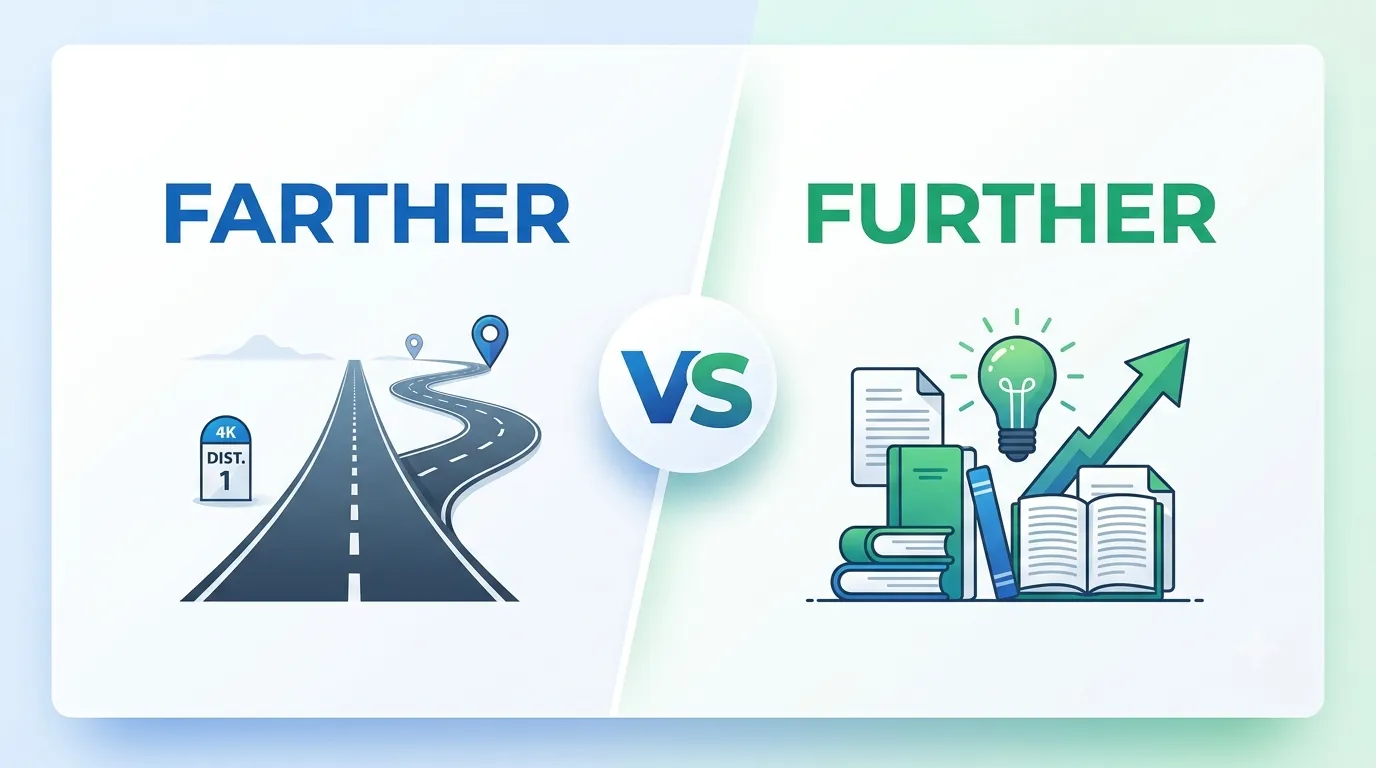
Farther refers to a physical distance, while further usually means a greater degree, additional amount, or figurative distance. A simple rule: farther = measurable distance, further = everything else.
I still remember grading a student’s essay years ago. The writing was excellent, but one sentence caught my eye: “We need to look farther into this issue.” The idea was clear, yet the word choice felt slightly off. That small mistake led to a great classroom discussion because almost everyone had the same question: Should it be farther or further?
You have probably faced the same confusion. Maybe you’re writing an email, finishing homework, or checking a report before sending it. Both words look similar. They sound almost the same. Many dictionaries even say they can overlap. So how do you know which one is right?
The good news is that the difference is much simpler than most grammar guides make it seem.
By the end of this guide, you’ll know exactly when to use farther and further, why they became confusing, common mistakes to avoid, and simple tricks to remember the difference forever.
Farther or Further
The easiest rule is this:
- Farther = physical distance
- Further = additional, more, or figurative distance
Examples
- We walked farther than we planned.
- Let’s discuss this further tomorrow.
- The hotel is five miles farther away.
- I have no further questions.
Although many style guides accept further in almost every situation, using farther for measurable distance makes your writing clearer.
The Origin and Background of Farther or Further
The words farther and further have shared a long history.
Both come from the Old English word feor, meaning “far.” Over hundreds of years, English speakers developed different spellings and pronunciations. Eventually, farther became closely linked with actual distance, while further took on broader meanings like “additional” or “more.”
This change happened naturally. No single grammar rule created it.
Today, many native speakers use the words interchangeably in casual conversation. However, professional writers, teachers, editors, and style guides usually keep the traditional distinction because it makes sentences easier to understand.
That is why you often see both forms in books, newspapers, and business writing.
Farther or Further Explained: Key Differences
The easiest way to remember the difference is to think about distance.
Use Farther for Physical Distance
Choose farther when you can measure the distance.
Examples:
- The school is farther than the library.
- She threw the ball farther than anyone else.
- We drove farther into the mountains.
Use Further for Figurative Meanings
Choose further when talking about ideas, time, progress, or extra information.
Examples:
- We need further research.
- Do you have any further questions?
- His education helped him go further in life.
Comparison Table
| Term | Meaning | When to Use | Region/Context |
|---|---|---|---|
| Farther | Greater physical distance | Roads, miles, walking, travel | Preferred in American English |
| Further | Additional, more, figurative progress | Education, discussion, research, time | Used worldwide in formal writing |
Which Version Should You Use?
The answer depends on your audience.
For Students
Use farther for measurable distance.
Example:
- The finish line is farther away.
Use further for essays and ideas.
Example:
- We need further evidence.
For Business Professionals
Use further in emails, reports, and meetings.
Examples:
- Please contact us for further details.
- We need further discussion.
For Journalists and Editors
Follow the traditional rule.
- Farther = measurable distance
- Further = figurative meaning
For Global English
If you’re unsure, further is usually accepted almost everywhere.
Still, using farther for physical distance makes your writing more precise.
Common Mistakes with Farther or Further
These mistakes appear often.
| Mistake | Correct Version | Why |
|---|---|---|
| We need to look farther into the issue. | We need to look further into the issue. | The meaning is figurative. |
| The park is two miles further away. | The park is two miles farther away. | The distance is measurable. |
| Any farther questions? | Any further questions? | Questions are not physical distance. |
| We walked further than yesterday. | We walked farther than yesterday. | Walking distance is measurable. |
| We need farther information. | We need further information. | Information is additional, not physical. |
Why These Mistakes Happen
- Both words sound alike.
- Many speakers use them interchangeably.
- Some dictionaries accept both in certain situations.
- Modern English is becoming more flexible.
Farther or Further in Real World Examples
Professional Email
Please send any further documents before Friday.
News Headline
Scientists travel farther into the Arctic to study climate change.
Social Media Post
Every small step takes you further toward your goals.
Formal Report
Further investigation is recommended before making a final decision.
Farther or Further: Data, Trends & Usage
People search for farther or further because it is one of the most common English grammar questions.
Search Intent
Informational
Most readers want a quick answer and simple examples.
Who Searches Most?
- English learners
- Students
- Teachers
- Writers
- Bloggers
- Business professionals
- Job seekers
Regions Where It’s Common
- United States
- United Kingdom
- Canada
- Australia
- India
- Countries where English is taught as a second language
Why It Matters Today
More people write emails, blog posts, social media updates, and reports every day. Choosing the right word improves clarity and builds credibility.
Standalone Comparison Table
| Term/Variant | Meaning | Region/Context | Best Used When |
|---|---|---|---|
| Farther | Physical distance | Mostly American English | Talking about miles, roads, travel, or measurable distance |
| Further | Additional, more, figurative progress | Worldwide | Talking about ideas, research, education, discussion, or extra information |
Frequently Asked Questions
Q: What does farther or further mean?
A: Both words relate to distance. Farther usually refers to physical distance, while further refers to additional information, progress, or figurative distance.
Q: How do you use farther correctly?
A: Use farther when talking about something you can measure. Think of miles, kilometers, walking, driving, or flying.
Q: Farther vs further what’s the difference?
A: Farther describes physical distance. Further describes additional ideas, progress, or non physical distance. Many writers use further in both cases, but the traditional distinction improves clarity.
Q: Is further acceptable in formal writing?
A: Yes. Further is widely accepted in formal writing. It is especially common in reports, academic papers, legal writing, and business communication.
Q: Which version is correct farther or further?
A: Both are correct. The right choice depends on the meaning. Use farther for measurable distance and further for everything else.
Q: Where do farther and further come from?
A: Both words developed from the Old English word feor, meaning “far.” Their meanings gradually separated over time through common usage.
Q: Can further be used for physical distance?
A: Yes. Many modern dictionaries accept further for physical distance. However, farther remains the clearer and more traditional choice when the distance can be measured.
Conclusion
The difference between farther and further is easier than it first appears. Remember these simple rules:
- Farther is best for physical distance.
- Further is best for additional information, progress, and figurative meaning.
- Both words are correct, but choosing the right one makes your writing clearer.
- When you talk about miles or measurable distance, farther is usually the safest choice. For reports, emails, conversations, and discussions, further is almost always the better fit.
English has many word pairs that seem confusing at first, but small patterns like this make them much easier to master. The more you notice them in books, articles, and everyday writing, the more natural they will feel.
Now you know exactly how to use farther and further. Try using them in your next email, essay, or conversation. Bookmark this guide so you never second guess farther or further again, and share it with someone who has asked the same question.
Read more: Who or Whom: The Complete Easy Guide to Using Them Correctly

I have a background in academic writing and spent several years as a proofreader for digital publications. Spotting differences between easily confused words became second nature to me. At WordsCombo, I share that knowledge so readers can write with confidence.