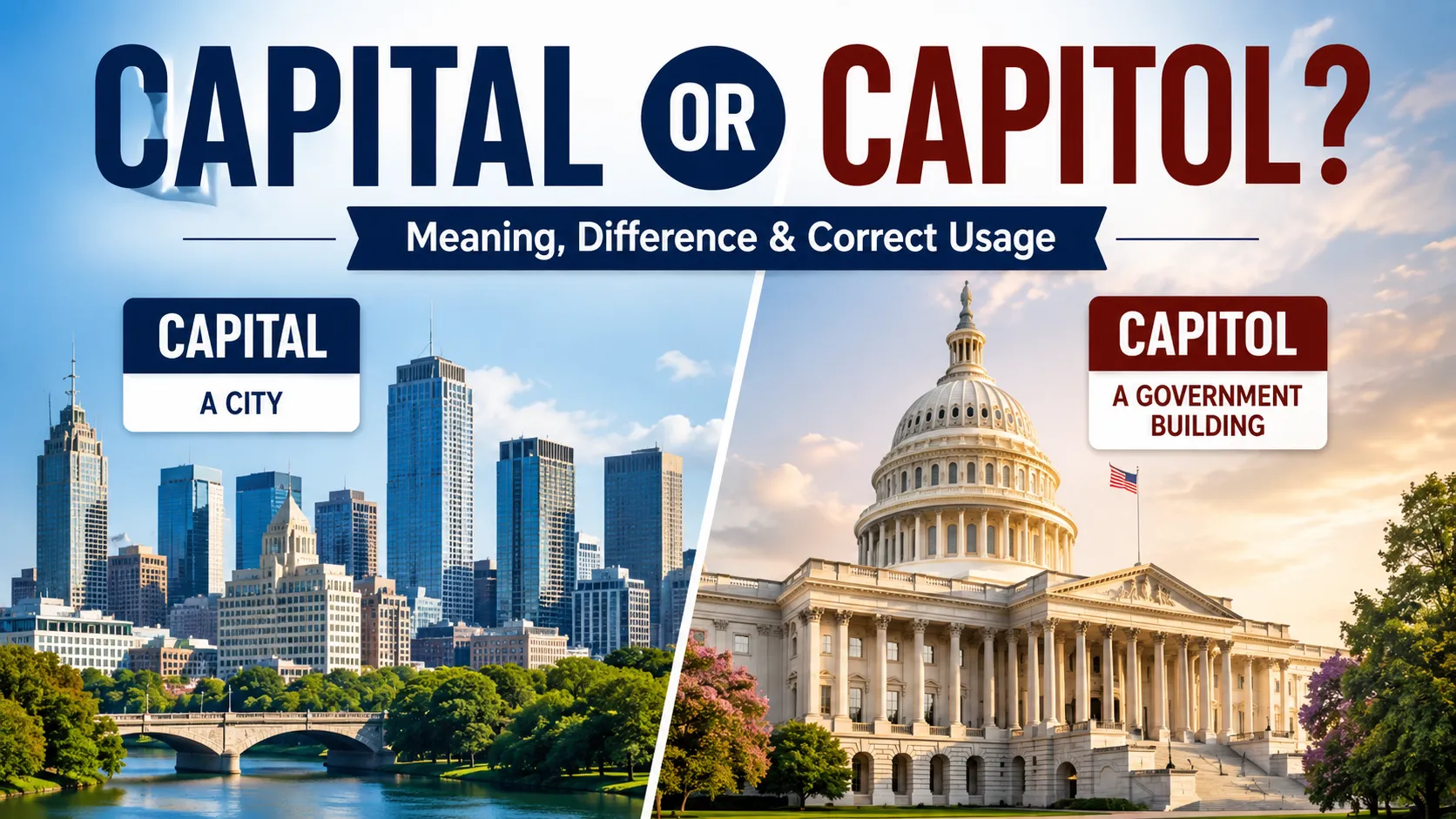
Capital or capitol depends on what you mean. Capital can mean a city, money, or something very important. Capitol means a building where lawmakers meet.
Have you ever typed a sentence, stopped, and wondered, “Is it capital or capitol?”
I have seen this mistake many times when helping students improve their English. The two words look almost the same and can sound the same in many accents, yet they have different meanings.
A student may write, “The state capital building is beautiful.” In some cases, that is correct. In others, capitol is the word they need.
The good news is that you do not need to memorise a long grammar rule. There is a simple way to tell these words apart.
Think about a place versus a building. A capital is often a city that serves as the centre of government. A capitol is usually the building where a legislature meets.
But there is more to the word capital. It can also mean money, an uppercase letter, or something very important.
This guide makes the difference simple. You will learn the meanings, common mistakes, examples, and a quick trick you can use whenever you are unsure.
Capital or Capitol
Capital has several meanings. It can refer to a government city, money used for business, an uppercase letter, or something of great importance.
Capitol is more specific. It usually refers to a building where a legislature meets.
Simple examples
- Washington, D.C. is the capital of the United States.
- The U.S. Capitol is the building where Congress meets.
Notice the difference. The capital is the city. The Capitol is the building.
The capital is the city.
The Capitol is the building.
That small difference can save you from a common spelling mistake.
The Origin and Background of Capital or Capitol
The confusion between capital and capitol is not new.
Both words have roots connected to Latin. The word capital comes from Latin capitalis, linked to caput, meaning “head.”
That idea of a head helps explain one meaning of capital. A capital city is the “head” or main centre of a country, state, or region.
The word capitol also has an ancient Roman connection. In Rome, the Capitolium was a famous temple area on Capitoline Hill.
Over time, English developed separate uses for the two spellings.
Today, the easiest rule is this:
Capital = many meanings. Capitol = a government building.
There is one detail worth remembering. In the United States, Capitol is often written with a capital C when denoting a specific government building, such as the U.S. Capitol.
The lowercase form can also appear when referring to a capitol building in a general sense.
Capital or Capitol Explained: Key Differences
The best way to understand the difference between capital and capitol is to compare their meanings.
| capital | Main city of a government | When talking about a country or state’s government city | Global |
| capital | Money or wealth used for business | When discussing finance or business | Global |
| capital | Uppercase letter | When discussing writing or grammar | Global |
| capital | Very important or serious | In phrases such as “capital offense” | Global |
| capitol | Legislative government building | When talking about a building where lawmakers meet | Mainly U.S. context |
1. Capital as a city
This is one of the most common meanings.
Example:
“Paris is the capital of France.”
Here, capital means the main city where the national government is based.
You can also use it for states:
Example:
“Sacramento is the capital of California.”
2. Capitol as a building
Capitol refers to a legislative building.
Example:
“Lawmakers returned to the state capitol.”
The word points to the building, not the city.
3. Capital as money
Capital can also mean money or other resources used to start or grow a business.
Example:
“The company needs more capital to expand.”
Here, capital would be wrong.
4. Capital as an uppercase letter
In writing, a capital letter is an uppercase letter.
Example:
“Begin the sentence with a capital letter.”
Again, capitol would be incorrect.
5. Capital as something important
The word can also describe something serious or very important.
For example:
“The death penalty is sometimes called capital punishment.”
This meaning has nothing to do with a government building.
Which Version Should You Use?
The choice becomes easy when you first identify the meaning.
For students
Use capital when you mean a city, money, an uppercase letter, or something important.
Use capitol only when you mean a legislative building.
For business writers
Use capital when discussing money, investment, or financial resources.
Correct: “The startup raised enough capital.”
Incorrect: “The startup raised enough capitol.”
For news and government writing
Be careful when describing government locations.
If you mean the city, use capital.
If you mean the legislative building, use capitol.
For example:
- “The state capital is growing quickly.”
- “The protesters gathered outside the state capitol.”
For global or neutral writing
When you are unsure, ask yourself:
Am I talking about a city or a building?
If it is a city, choose capital.
If it is a legislative building, choose capitol.
Common Mistakes With Capital or Capitol
Here are five common errors.
| “The capitol of France is Paris.” | “The capital of France is Paris.” | Paris is a city. |
| “The state capital building opened today.” | “The state capitol building opened today.” | You mean the government building. |
| “The company needs more capitol.” | “The company needs more capital.” | Capital can mean business money. |
| “Use a capitol letter here.” | “Use a capital letter here.” | Capital means uppercase. |
| “We visited the state capital during the tour.” | “We visited the state capitol during the tour.” | The sentence refers to the building. |
Why do these mistakes happen?
The words are homophones in many forms of English. That means they sound alike but have different meanings and spellings.
That makes them easy to confuse.
A quick memory trick
Think:
Capitol = a building.
Both words contain the idea of a place where people gather to govern.
For capital, remember that it has many jobs. It can describe a city, money, letters, and more.
Capital or Capitol in Real World Examples
Knowing the definition is useful. Seeing the words in real situations is even better.
Professional email
“The meeting will take place near the state capitol at 10 a.m.”
Here, the writer means the government building.
Another example:
“Our company needs additional capital before we begin the next phase.”
Here, capital means money.
News headline or article
Lawmakers Return to the State Capitol
The headline refers to the legislative building.
Compare it with:
New Businesses Open in the State Capitol
Here, capital means the city.
Social media post
“Finally visited the U.S. Capitol today. What an amazing building!”
The person is speaking about the building.
Another post might say:
“I finally moved to the state capital for my new job.”
That person moved to the city.
Formal document or paper
“The project will create new jobs in the national capital.”
The word refers to the city.
But:
“The committee will present its findings at the state capitol.”
The word refers to the building.
Capital or Capitol: Data, Trends & Usage
The capital or capitol question is mainly an informational search. People usually search the phrase when they are writing, studying, proofreading, or checking a spelling choice.
The confusion is especially common among:
- Students learning English
- Writers and bloggers
- Teachers and editors
- People writing about government.
- Job seekers preparing formal documents
- Anyone studying U.S. government and politics
The topic also matters because digital writing has made spelling more visible. A small spelling mistake can change the meaning of a sentence.
Searchers are often not looking for a long grammar lesson. They want a quick answer they can trust.
That is why the city-versus-building rule is so useful:
Capital = city. Capitol = legislative building.
Still, remember that capital has other meanings. Context always matters.
Capital or Capitol: Standalone Comparison Table
| capital | Main city of a country or state | Global | Talking about a government city |
| capitol | Legislative government building | Mainly U.S. | Talking about the building itself |
| capital | Money used for business | Global | Discussing investment or finance |
| capital | Uppercase letter | Global | Discussing writing or grammar |
| capital | Very important or serious | Global | Discussing phrases such as capital punishment |
A Simple Rule You Can Remember
If you only remember one thing, remember this:
Capital is the more general word. Capitol is the government building word.
Try this test before you write.
Ask:
“What am I talking about?”
If the answer is a city, write capital.
If the answer is a legislative building, write capitol.
If the answer is money, write capital.
If the answer is an uppercase letter, write capital.
This works in most everyday situations.
Frequently Asked Questions
Q: What does capital mean?
A: Capital has several meanings. It can mean the main city of a country or state, money used in business, an uppercase letter, or something very important.
Q: What does capitol mean?
A: Capitol usually means a building where lawmakers meet. In U.S. usage, it often refers to a specific state capitol or the U.S. Capitol.
Q: What is the difference between capital and capitol?
A: Capital has many meanings, including a government city and business money. Capitol refers to a legislative government building.
Q: Is “capital” or “capitol” correct for a city?
A: Use capital. For example, “Rome is the capital of Italy.” A city is never a “capitol.”
Q: Is “capital” or “capitol” correct for a government building?
A: Use capitol when you mean a legislative building. For example, “The lawmakers met inside the state capitol.”
Q: Where does the word capitol come from?
A: Capitol comes from the Latin name Capitolium, associated with Rome’s Capitoline Hill. The English word later became linked to legislative buildings.
Q: Can capital be used in formal writing?
A: Yes. Capital is a standard word in formal English. Its meaning depends on the context, such as a capital city, capital investment, or capital letter.
Q: Can capitol be used outside the United States?
A: It can be understood, but capitol is strongly associated with U.S. government buildings. In many other contexts, writers employ terms such as “parliament building” or “legislative building”.
Q: Is the U.S. Capitol a capital?
A: The U.S. Capitol is a building. Washington, D.C. is the capital of the United States. Keeping those two ideas separate makes the difference easy to remember.
Conclusion
The difference between capital and capitol looks small, but the meaning can change completely.
Use capital when you mean a government city. You can also use it for money, uppercase letters, and several other meanings.
Use capitol when you mean a legislative government building.
The easiest memory trick is simple:
Capital = city.
Capitol = building.
Use that quick rule when you choose between the two words.
When you see one of these words in a sentence, stop for a second and identify what you mean. Are you talking about a city, a building, money, or a letter?
That quick check will usually give you the answer, and the ending will stay easy to remember.
You do not need to second-guess these words every time you write. Once you understand the basic difference, the choice becomes natural.
Bookmark this guide so you never have to guess between “capital” and “capitol” again.
Read more: Envelop or Envelope: The Easy Way to Know the Difference

I have been working with English language content for over six years. I specialize in word comparisons and spelling differences that most people overlook. At WordsCombo, I help readers choose the right word every time.