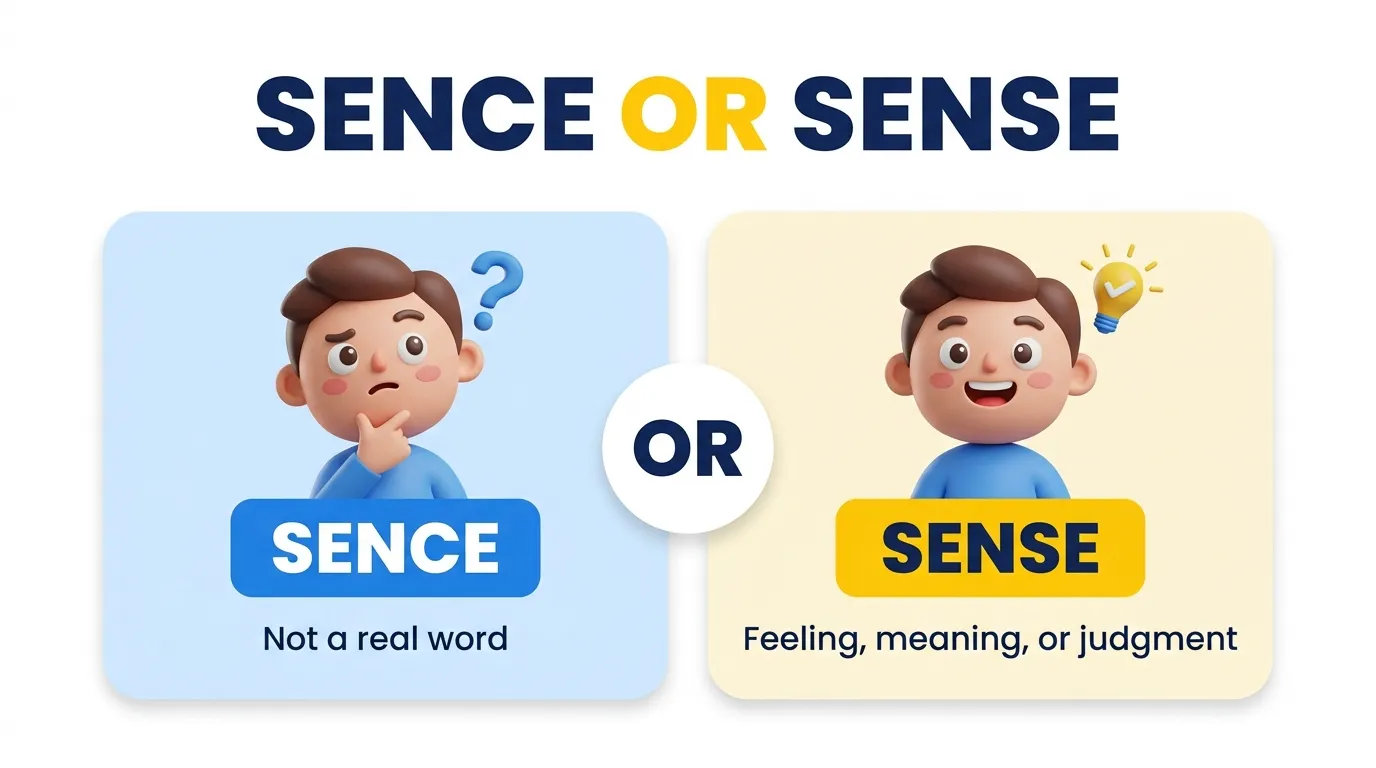
“Sence” is not a real word. The correct spelling is always “sense,” whether you mean a feeling, a meaning, or good judgment.
You are typing a text to your boss, trying to explain why the new plan makes “sence.” Then you pause. Something looks off about that word. In fact, your gut is right: “sence” is a common misspelling, and “sense” is the only correct form. This mix-up trips up even careful writers, so let’s clear it up for good.
“Sence” or “Sense” : Quick Answer
“Sense” is the correct English word. It covers feelings (a sense of relief), meaning (that sentence makes no sense), and judgment (common sense). “Sence,” on the other hand, has no real definition in any dictionary. It is simply a spelling slip, often caused by how the word sounds when spoken quickly.
For example:
- Correct: “I have a strange sense that something is wrong.”
- Incorrect: “I have a strange sence that something is wrong.”
The Origin of “Sense”
“Sense” comes from the Latin word sensus, which means feeling or perception. It traveled through Old French before landing in English around the 1300s. Since Latin roots often get simplified as words pass through languages, the spelling settled into the form we use now.
The word “sence” never had its own history at all. It exists only because people spell words the way they sound, and “sense” happens to end in a soft “s” sound that some writers turn into “ce” out of habit.
“Sence” vs “Sense” : Key Differences
- Spelling: “Sense” is correct in every dictionary. “Sence” is not a word anywhere.
- Usage: “Sense” works as a noun (a sense of humor) and a verb (I sense danger). “Sence” has no use because it does not exist.
- Origin: “Sense” traces back to Latin. “Sence” has no origin since it was never a real word.
- Common cause: People often write “sence” because it matches the sound of the word, not the correct spelling pattern.
- Confusion with other words: “Sense” is also mixed up with “since” (a time or reason word) and “cents” (money), though “sence” is simply a spelling error, not a separate word.
| Term | Meaning | When to Use | Region/Context |
| Sense | Feeling, meaning, or judgment | Anytime you need the real word | Used everywhere, US and UK alike |
| Sence | Not a word; a misspelling | Never | Should not appear in any writing |
| Since | Time or reason (because) | When showing a reason or a time frame | Used everywhere, often confused by sound |
Which One Should You Use?
For students writing essays, always use “sense.” Since teachers grade spelling closely, this small fix protects your grade.
For professionals sending emails, “sense” is the only safe choice. A misspelled word in a client message can hurt your credibility, so double check before you hit send.
For casual texting, autocorrect usually catches “sence” and fixes it. Still, it helps to know the correct spelling yourself rather than relying on your phone.
Common Mistakes with “Sence” and “Sense”
| Mistake | Correction | Why It Happens |
| “That makes no sence” | “That makes no sense” | Writers spell the word by ear instead of by rule |
| “I sence trouble ahead” | “I sense trouble ahead” | The verb form gets rushed while typing quickly |
| “Common sence tells you” | “Common sense tells you” | The phrase is so familiar that spelling gets ignored |
| “She has good sence of style” | “She has good sense of style” | People confuse “sense” with words ending in “-ce” |
Each of these errors comes from the same root cause. Because “sense” sounds like it could end in “ce,” writers guess wrong without checking.
“Sense” in Real-World Examples
Professional email: “Your feedback makes a lot of sense, and I will update the report today.”
News headline: “Voters Say New Policy Makes Economic Sense”
Social media post: “This song just hits different, you know what I mean, it makes sense in a way I can’t explain.”
Formal document: “The board found that the proposal did not make financial sense given current market conditions.”
“Sense” : Data, Trends & Usage
People search for “sence or sense” mostly because autocorrect flags the word or a grammar checker underlines it in red. This search often comes from students, non-native English speakers, and anyone unsure after typing quickly.
The intent behind this search is almost always to confirm spelling, not to learn grammar rules. As a result, most searchers want a fast, clear answer rather than a long explanation. This matters for anyone writing content or teaching English, since quick clarity serves readers better than dense detail.
“Sence” vs “Sense”: Comparison at a Glance
| Term/Variant | Meaning | Region/Context | Best Used When |
| Sense | Feeling, meaning, judgment | Global, standard English | Any time you need the real word |
| Sence | No meaning; misspelling | Not used in any region | Never; always correct to “sense” |
FAQs
Is “sence” ever a correct spelling?
No, “sence” is not found in any English dictionary. It is always a misspelling of “sense,” so you should replace it every time.
Why do people spell “sense” as “sence”?
This happens because the word’s ending sound can be confused with words like “since” or “fence.” Since spelling by ear often leads to mistakes, this mix-up is common.
Is “sense” a noun or a verb?
“Sense” works as both. As a noun, it means a feeling or meaning (a sense of pride). As a verb, it means to notice something (I sense a problem).
What is the difference between “sense” and “since”?
“Sense” relates to feeling, meaning, or judgment. “Since,” on the other hand, shows time or gives a reason, as in “since Monday” or “since you asked.”
Is “sense” acceptable in formal writing?
Yes, “sense” is fully acceptable in formal writing, resumes, and academic papers. It is a standard English word used in every type of writing.
How can I remember the correct spelling?
Think of the phrase “make sense,” which almost everyone has seen written correctly. That familiar phrase can anchor the spelling in your memory.
Does “sence” appear in any dialect or old English form?
No, even older forms of English used “sens” or “sense,” never “sence.” This confirms that the “sence” spelling has no historical basis at all.
Final Thoughts on Sence or Sense
The answer here is simple: “sense” is always correct, and “sence” is always wrong. Once you remember that, this mix-up disappears from your writing for good.
Since the confusion usually comes from sound rather than meaning, the fix is easy. Read your sentence back, and if you hear “sense,” write it exactly that way, with an “s” at the end.
One last tip: keep the phrase “makes sense” in mind as your anchor. Whenever you’re unsure, that short phrase will guide you to the right spelling every time.
Curious about other tricky word pairs? Explore Lives or Lifes.

I started writing about English word differences after years of teaching students who kept making the same mistakes. My focus is on making spelling rules feel simple and easy to remember. At WordsCombo, I turn confusing word pairs into clear comparisons.