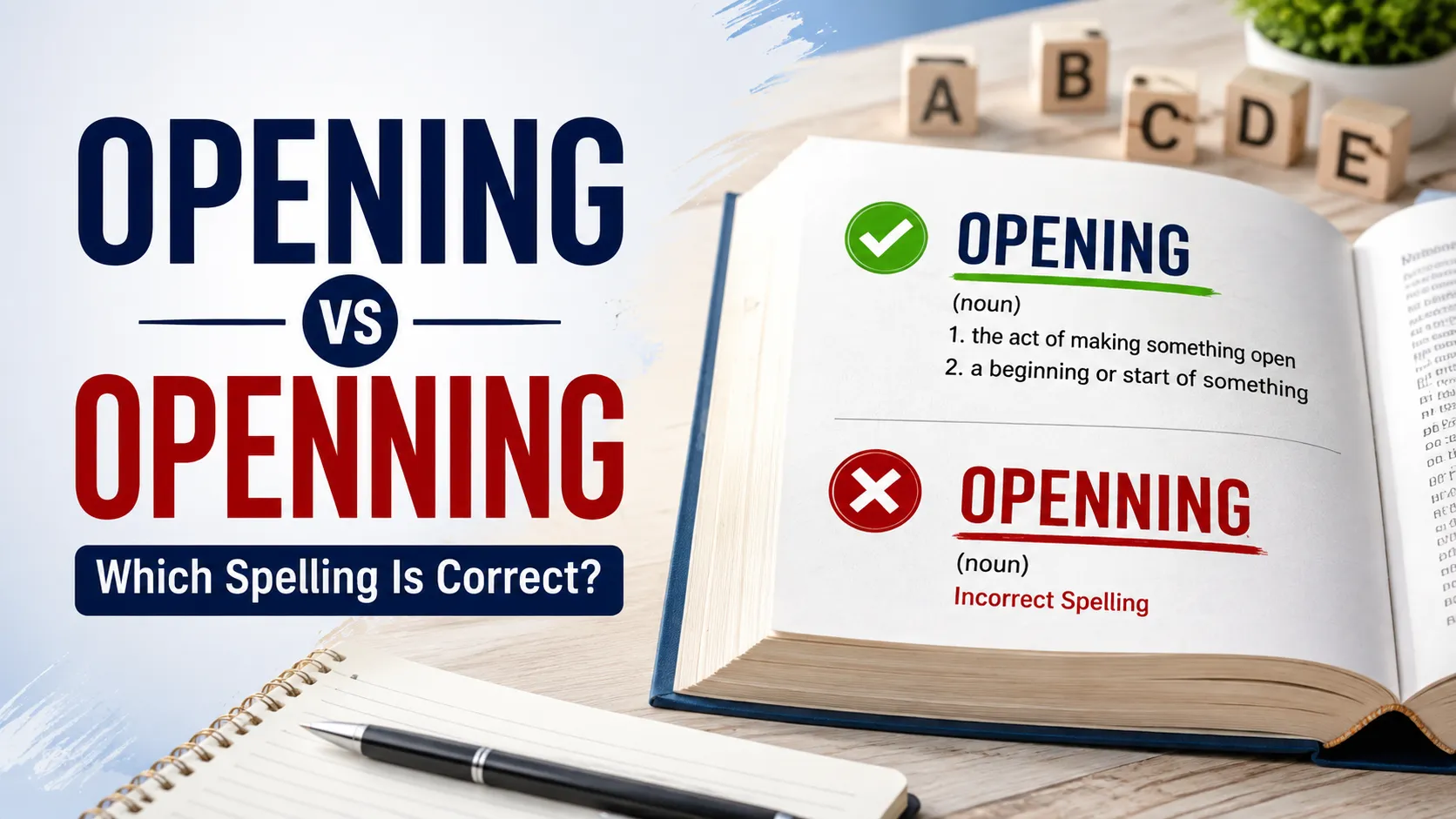
Opening is the correct spelling. Openning is a common spelling mistake and is not the standard English form.
Have you ever typed a word, looked at it twice, and thought, “Wait, does that look right?” Opening is one of those words.
I have seen this mistake many times when helping students improve their English writing. The word seems tricky because we often double the final consonant before adding ing. For example, run becomes running and sit becomes sitting. So it is easy to think that open should become openning.
But English does not work that way here.
The correct word is opening. You do not add a second n.
This small spelling difference matters. You may need the word in an email, school assignment, business report, news story, or social media post. Using the wrong spelling can make your writing look less polished.
In this guide, you will learn why opening is correct, why openning is wrong, how to use the word, and how to avoid this mistake in the future.
Opening
Opening is the correct spelling.
Openning is incorrect in standard English.
The word opening can mean the act of making something open, a space or gap, the start of an event, or the beginning of something.
Simple examples
- The store is opening at 9 a.m.
- She gave the opening speech.
- There is a small opening in the wall.
- We are waiting for an opening in the schedule.
Notice that the word always has one n after the letter e:
open + ing = opening
Not:
open + ning = openning
The Origin and Background of Opening
The word opening comes from the verb open.
The word open has a long history in English. It is related to older Germanic words that carried the idea of making something accessible, uncovered, or not closed.
Over time, open became a common English verb, adjective, and noun.
When we add ing to open, we get:
open + ing = opening
This can describe an action:
He is opening the door.
It can also describe the beginning of something:
The opening of the new school was a big event.
The confusion usually comes from a spelling rule many learners know.
Words such as:
- run → running
- sit → sitting
- stop → stopping
double the final consonant before ing.
But open does not follow that pattern.
The final n is not doubled.
So the correct spelling is always opening.
Opening Explained: Key Differences and Variations
Opening can have several meanings depending on the sentence.
| Term | Meaning | When to Use | Region/Context |
|---|---|---|---|
| Opening | Beginning of something | Events, speeches, books, films | Global English |
| Opening | Making something open | Doors, boxes, accounts | Global English |
| Opening | A gap or space | Walls, windows, objects | Global English |
| Opening | A job or available position | Employment | Business/Work |
| Open | Not closed or available | General descriptions | Global English |
| Openning | Incorrect spelling | Do not use | Nonstandard |
1. Opening as a beginning
You can use opening when something starts.
The opening ceremony begins at 10 a.m.
Her opening remarks were short and clear.
2. Opening as an action
It can describe the act of making something open.
He is opening the package.
She is opening the window.
3. Opening as a space
It can also mean a hole, gap, or entrance.
We found an opening in the fence.
The bird flew through the opening.
4. Opening as an opportunity
In work and business, opening can mean an available position or opportunity.
The company has a job opening for a teacher.
I heard about an opening in the marketing team.
Which Version Should You Use?
If you are wondering whether to write opening or openning, the answer is simple:
Use “opening.”
For students
Use opening in essays, homework, exams, and assignments.
It is the standard spelling and will be understood everywhere.
For professionals
Use opening in emails, reports, job advertisements, presentations, and business documents.
For example:
We currently have an opening for a sales manager.
For global English
Use opening.
It is the standard spelling in both American and British English. There is no need to change it based on region.
Best rule: When you mean the beginning, an available position, a gap, or the act of making something open, spell it opening.
Common Mistakes with Opening
Here are some mistakes English learners often make.
| Mistake | Correction | Why? |
|---|---|---|
| Openning | Opening | The final n is not doubled. |
| Openinng | Opening | Extra letters are unnecessary. |
| Opning | Opening | The vowel sequence must remain. |
| Openingg | Opening | Do not add an extra g. |
| The openning event | The opening event | “Opening” is the standard spelling. |
Mistake 1: Writing “openning”
❌ The store is openning tomorrow.
✅ The store is opening tomorrow.
This happens because learners may apply the doubling rule incorrectly.
Mistake 2: Removing a vowel
❌ The opning ceremony starts soon.
✅ The opening ceremony starts soon.
Do not remove the e.
Mistake 3: Adding an extra letter
❌ The openingg was successful.
✅ The opening was successful.
The correct spelling ends with ing.
Opening in Real World Examples
Knowing the spelling is useful. Knowing how people actually use the word is even better.
1. Professional email
Thank you for informing me about the job opening. I would like to apply for the position.
Here, opening means an available job.
2. News headline
New Restaurant Celebrates Its Grand Opening
Here, opening refers to the start of business operations.
3. Social media post
We are excited to announce the opening of our new store this Friday!
Here, opening means the event when the store begins operating.
4. Formal report
The opening ceremony was attended by local officials and community leaders.
Here, opening describes the beginning ceremony.
5. Everyday conversation
Can you help me with the opening of this jar?
Here, opening refers to the act of making something open.
Opening: Data, Trends & Usage
The question “opening or openning?” is mainly an informational search.
People usually search for it when they are unsure about spelling. Students, English learners, job seekers, and professionals may all encounter the problem.
The confusion is easy to understand. English has many words where the final consonant is doubled before ing.
For example:
- run → running
- swim → swimming
- stop → stopping
- plan → planning
That pattern can make openning look reasonable.
However, open follows a different spelling pattern.
The word becomes:
open → opening
This is why learning the word as a complete spelling pattern is more useful than trying to guess it each time.
Opening vs. Openning: Side by Side Comparison
| Term/Variant | Meaning | Region/Context | Best Used When |
|---|---|---|---|
| Opening | Beginning or start | All standard English | Talking about starts or beginnings |
| Opening | Act of making something open | All standard English | Describing an action |
| Opening | Gap or entrance | All standard English | Describing a space |
| Opening | Available job or opportunity | Work/business | Talking about vacancies |
| Openning | Incorrect spelling | Nonstandard | Do not use |
The most important point is simple:
Opening is correct. Openning is not.
Why Is “Openning” So Common?
The mistake comes from a useful English spelling rule.
When a short word ends in one consonant after one vowel, the consonant may be doubled before certain endings.
For example:
- run → running
- sit → sitting
- plan → planning
But this rule does not apply to every word.
Open does not become openning.
Think of it this way:
open + ing = opening
The base word already gives you the correct spelling.
A good habit is to learn common words as complete forms rather than relying on spelling rules every time.
FAQ About Opening
Q: What does opening mean?
A: Opening can mean the beginning of something, the act of making something open, a gap or entrance, or an available opportunity. Its meaning depends on the sentence.
Q: How do you spell opening correctly?
A: The correct spelling is opening. It has only one n between the “e” and “i”: opening.
Q: Is openning correct?
A: No. Openning is a spelling mistake in standard English. The correct form is opening.
Q: Why don’t we double the n in opening?
A: The spelling rule that doubles a final consonant does not apply here. The verb open becomes opening, not openning.
Q: Is opening acceptable in formal writing?
A: Yes. Opening is completely standard and appropriate in formal writing. You can use it in reports, emails, essays, applications, and professional documents.
Q: Which is correct: opening or openning?
A: Opening is correct. Openning is incorrect.
Q: Can opening be used for a job?
A: Yes. Opening can mean an available job position. For example, “The company has an opening for a graphic designer.”
Q: Can opening mean the beginning of an event?
A: Yes. You can say opening ceremony, opening speech, or opening event. In each case, the word refers to the beginning of something.
A Simple Trick to Remember Opening
If you often forget the spelling, use this quick trick:
OPEN + ING = OPENING
Do not add another n.
You can also remember this sentence:
The store is opening today.
The word opening contains the complete word open.
That makes the spelling easier to remember.
Conclusion
The difference between opening and openning looks small, but correct spelling can make a big difference in your writing.
Remember these four points:
- Opening is the correct spelling.
- Openning is incorrect.
- Opening can describe a beginning, action, gap, or opportunity.
- The correct form is open + ing = opening.
You do not need a complicated rule to remember it. Just keep the original spelling of open and add ing.
So, the next time you write about an opening ceremony, a job opening, or something that is opening, you can write it with confidence.
Bookmark this guide so you never second guess “opening” again.
Read more: Noisey or Noisy: Which Spelling Is Correct? Easy Guide

I started writing about English word differences after years of teaching students who kept making the same mistakes. My focus is on making spelling rules feel simple and easy to remember. At WordsCombo, I turn confusing word pairs into clear comparisons.