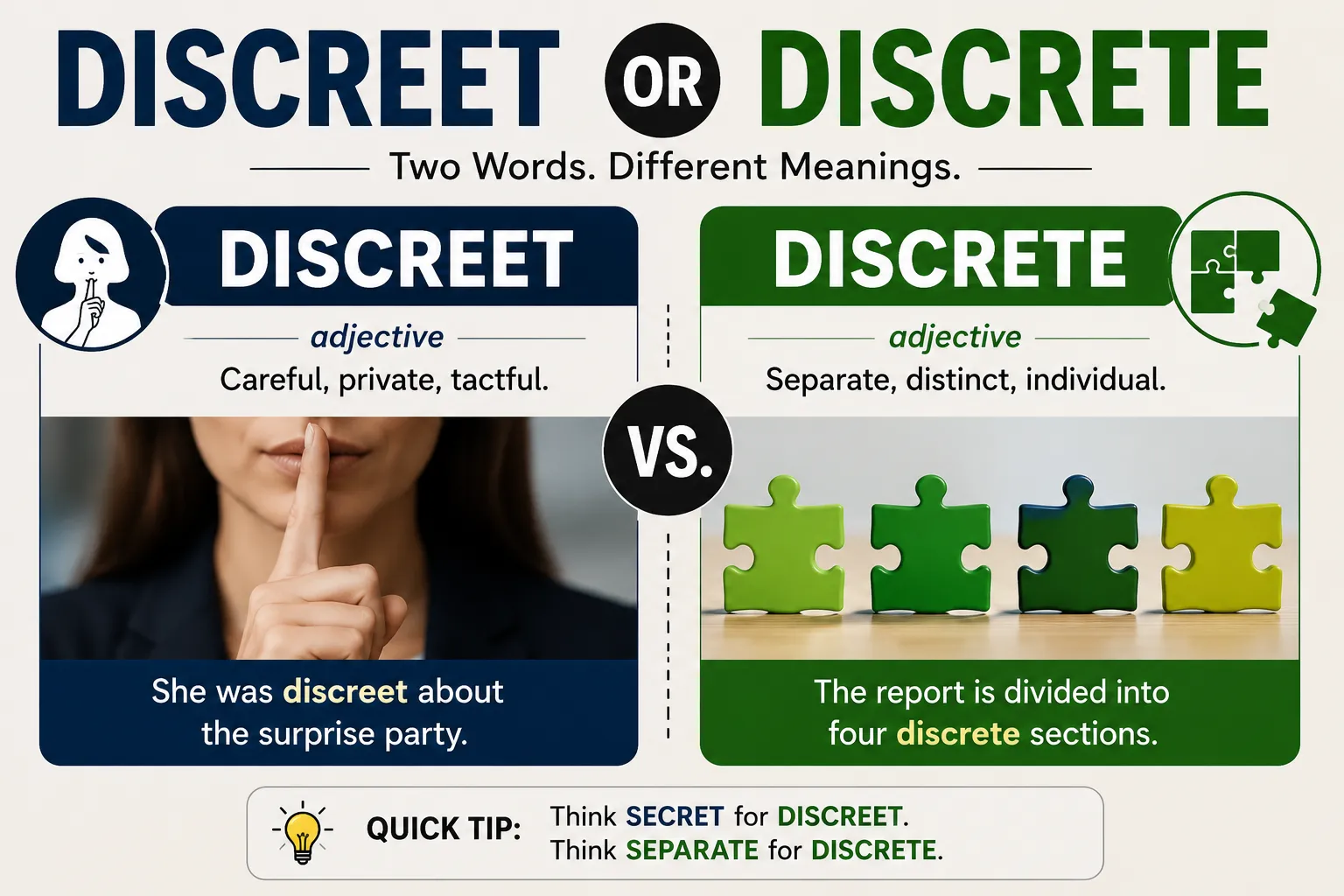
Discreet means careful, private, or tactful, while discrete means separate, distinct, or individual. Remember: discreet = secretive, discrete = separate.
A few years ago, I was editing a business email for a client. Everything looked perfect until I noticed one small mistake. The email asked for “discrete handling” of sensitive information. The writer actually meant “discreet handling.”
It was just one letter different, but the meaning completely changed.
If you’ve ever paused while writing because you weren’t sure whether to use discreet or discrete, you’re not alone. These two words confuse students, writers, professionals, and even native English speakers. They sound almost the same and look nearly identical, which makes them easy to mix up.
The good news is that the difference is simple once you know the trick.
In this guide, you’ll learn the meaning of discreet and discrete, where these words came from, when to use each one, and easy ways to remember the correct spelling. You’ll also see clear examples that make the difference stick.
Let’s clear up the confusion once and for all.
Discreet or Discrete
Both words are correct English words, but they mean different things.
- Discreet = careful, private, and tactful.
- Discrete = separate, distinct, or individual.
Examples
✅ Discreet
She was discreet about the company’s private plans.
Here, discreet means she kept the information confidential.
✅ Discrete
The report divides the data into discrete sections.
Here, discrete means separate or independent sections.
Easy Memory Trick
Think of the extra “e” in discreet as standing for “etiquette.” Someone who is discreet has good manners and knows when to stay quiet.
Think of the middle “t” in discrete as a divider that separates things into different parts.
The Origin and Background of Discreet or Discrete
These words have an interesting history.
Both discreet and discrete come from the Latin word discretus, which means separated or distinguished.
Over time, English gave each word its own meaning.
- Discreet developed the idea of showing good judgment and being careful with information.
- Discrete kept the original meaning of something being separate or distinct.
That shared history explains why the words still look so similar today.
Why Do People Confuse Them?
There are several reasons.
- They have almost identical spelling.
- They sound nearly the same.
- Spell check often misses the mistake because both are real words.
- Many people learn one word but rarely use the other.
For example:
❌ The lawyer gave discrete advice.
✅ The lawyer gave discreet advice.
The lawyer is being careful and tactful, not separate.
Another example:
❌ The project has discreet phases.
✅ The project has discrete phases.
The phases are separate from one another.
Discreet vs. Discrete Explained: Key Differences
The easiest way to choose the right word is to ask one question:
Are you talking about privacy or separation?
If it’s about privacy, use discreet.
If it’s about separate parts, use discrete.
| Term | Meaning | When to Use | Region/Context |
|---|---|---|---|
| Discreet | Careful, private, tactful | Confidential information, polite behavior, sensitive situations | Used worldwide in everyday and professional English |
| Discrete | Separate, distinct, individual | Mathematics, science, technology, business, data analysis | Common in academic, technical, and professional writing |
When to Use Discreet
Use discreet when talking about:
- Keeping a secret
- Respecting privacy
- Acting with good judgment
- Avoiding unwanted attention
- Handling sensitive information
Examples
- The doctor was discreet with the patient’s records.
- Please be discreet during the meeting.
- They wanted a discreet security team.
In each example, the focus is on being careful and private.
When to Use Discrete
Use discrete when talking about:
- Separate groups
- Individual parts
- Independent categories
- Technical systems
- Mathematics and computer science
Examples
- The survey has five discrete sections.
- Scientists studied three discrete populations.
- A computer processes discrete signals differently from continuous signals.
Here, the focus is on things being separate rather than connected.
A Simple Comparison
Imagine a hotel.
A discreet guest speaks quietly and respects everyone’s privacy.
A discrete room is one separate room among many others.
One word describes behavior.
The other describes structure.
That small difference changes the entire meaning of your sentence.
Which Version Should You Use?
Choosing between discreet and discrete becomes easy once you know what you want to say.
Ask yourself this simple question:
Am I talking about privacy or separate things?
- If the answer is privacy, choose discreet.
- If the answer is separate things, choose discrete.
For Students
Use discreet when writing about people, behavior, or private matters.
Example:
The teacher was discreet when discussing the student’s grades.
Use discrete when writing about subjects like math, science, or technology.
Example:
The graph shows discrete values.
For Professionals
Business emails often require the word discreet.
Example:
Please handle this matter in a discreet manner.
Reports, data analysis, and technical documents often require discrete.
Example:
The report divides customers into four discrete groups.
For Writers and Bloggers
Think about your audience.
If you’re describing someone’s actions, use discreet.
If you’re describing categories, sections, or parts, use discrete.
For Global English
The meanings are the same in:
- American English 🇺🇸
- British English 🇬🇧
- Canadian English 🇨🇦
- Australian English 🇦🇺
There is no regional difference. Only the meaning changes.
Quick Decision Guide
| If you mean… | Use… |
|---|---|
| Private | Discreet |
| Careful | Discreet |
| Tactful | Discreet |
| Secret | Discreet |
| Separate | Discrete |
| Independent | Discrete |
| Individual | Discrete |
| Distinct | Discrete |
Common Mistakes with Discreet or Discrete
Even experienced writers confuse these words. Here are the mistakes you should avoid.
| ❌ Mistake | ✅ Correct | Why? |
|---|---|---|
| Please be discrete about this issue. | Please be discreet about this issue. | The sentence is about privacy. |
| The report has three discreet sections. | The report has three discrete sections. | Sections are separate parts. |
| She received discrete customer service. | She received discreet customer service. | Customer service can be tactful, not separate. |
| The machine has discreet components. | The machine has discrete components. | Components are individual parts. |
| Our lawyer remained discrete. | Our lawyer remained discreet. | Lawyers are careful with confidential information. |
Why These Mistakes Happen
People often make these errors because:
- Both words sound almost the same.
- Both words are correctly spelled English words.
- Spell-check does not always catch the mistake.
- Many people remember the spelling but forget the meaning.
Easy Trick to Remember Forever
Discreet = Secret
Notice that both words contain “ee.”
- discreet
- seecret
Both relate to privacy.
Discrete = Separate Pieces
Think of discrete as describing separate blocks or units.
Examples:
- Discrete numbers
- Discrete categories
- Discrete signals
- Discrete departments
Discreet or Discrete in Real World Examples
Let’s see how these words appear in everyday writing.
1. Professional Email
Thank you for your message. Our team will handle your request in a discreet and professional manner.
Here, discreet means confidential.
2. News Headline
Scientists discover discrete climate zones across the mountain range.
The mountain has separate climate regions.
3. Social Media Post
Looking for a discreet gift delivery? We’ve got you covered.
The company promises privacy.
4. Business Report
Sales data was divided into five discrete customer groups.
The groups are separate.
5. Healthcare Example
Nurses remained discreet while discussing patient information.
Patient privacy matters.
6. Technology Example
The software stores information in discrete data blocks.
Each block is separate.
7. Everyday Conversation
Correct
Sarah was very discreet about the surprise party.
Correct
The museum has several discrete exhibition halls.
Discreet or Discrete: Data, Trends & Usage
People search for discreet or discrete because it is one of the most commonly confused word pairs in English.
Search Intent
Primary Intent: Informational
People want to know:
- Which spelling is correct?
- What is the difference?
- Which word should they use?
- How can they remember it?
Who Searches This Topic Most?
This topic is especially popular among:
- Students
- English learners
- Bloggers
- Business professionals
- Editors
- Copywriters
- Teachers
- Job seekers
Where Is It Commonly Used?
Discreet
You’ll often see this word in:
- Business emails
- Customer support
- Healthcare
- Legal writing
- Hotel services
- Marketing
Discrete
You’ll often see this word in:
- Mathematics
- Statistics
- Computer science
- Engineering
- Scientific research
- Data analysis
Why It Matters Today
Clear writing builds trust.
Using the wrong word can confuse your readers and make your writing look less professional. Whether you’re sending an email, writing a report, publishing a blog post, or completing an assignment, choosing discreet or discrete correctly helps your message stay clear and accurate.
Standalone Comparison Table
| Term/Variant | Meaning | Region/Context | Best Used When |
|---|---|---|---|
| Discreet | Careful, private, tactful | Everyday English, business, healthcare, legal writing | Talking about confidentiality, privacy, or good judgment |
| Discrete | Separate, distinct, individual | Mathematics, science, technology, research | Talking about separate parts, categories, or units |
Frequently Asked Questions (FAQs)
Q1: What does “discreet” mean?
Discreet means careful, private, and tactful. A discreet person knows how to handle sensitive information without drawing attention. You will often see this word in business, healthcare, and everyday conversations.
Example:
The manager was discreet when discussing employee salaries.
Q2: What does “discrete” mean?
Discrete means separate, distinct, or individual. It describes things that are not connected but exist as separate parts or units.
Example:
The experiment was divided into four discrete stages.
Q3: How do you use “discreet” and “discrete” correctly?
Think about the meaning before choosing the word.
- Use discreet when talking about privacy, secrecy, or good judgment.
- Use discrete when talking about separate parts, categories, or groups.
A simple memory trick is:
- Discreet = Secret
- Discrete = Separate
Q4: Discreet vs. Discrete: What’s the difference?
The difference is simple.
| Discreet | Discrete |
|---|---|
| Private | Separate |
| Tactful | Distinct |
| Careful | Individual |
| Confidential | Independent |
Although they sound alike, they are not interchangeable. Using the wrong one can change the meaning of your sentence.
Q5: Is “discreet” acceptable in formal writing?
Yes. Discreet is widely accepted in formal writing. It is common in business emails, legal documents, medical communication, and professional reports whenever privacy or confidentiality is important.
Q6: Which version is correct: “discreet” or “discrete”?
Both spellings are correct. The right choice depends on the context.
Choose discreet if you mean private or careful.
Choose discrete if you mean separate or distinct.
Q7: Can “discrete” be used in mathematics and technology?
Yes. In fact, discrete is one of the most common words in mathematics and computer science.
Examples include:
- Discrete mathematics
- Discrete data
- Discrete variables
- Discrete signals
In these fields, the word describes values or objects that are separate rather than continuous.
Conclusion
The words discreet and discrete may look almost identical, but their meanings are very different. Remember this simple rule: discreet is about privacy, careful behavior, and good judgment, while discrete is about separate, distinct, or individual parts.
A quick way to remember the difference is to connect discreet with secret because both relate to confidentiality. Think of discrete as describing separate pieces or categories. This small trick can help you avoid one of the most common spelling mistakes in English.
Whether you’re writing an email, preparing a report, completing a school assignment, or publishing a blog post, choosing the correct word makes your writing clearer and more professional. Readers notice accurate language, and it builds trust in your communication.
Now that you know exactly when to use discreet and discrete, you can write with confidence. Bookmark this guide for future reference, and share it with anyone who has ever been confused by these two commonly mixed-up words.
Read more: Precede or Proceed: The Complete Guide to Using Both Correctly

I have been working with English language content for over six years. I specialize in word comparisons and spelling differences that most people overlook. At WordsCombo, I help readers choose the right word every time.