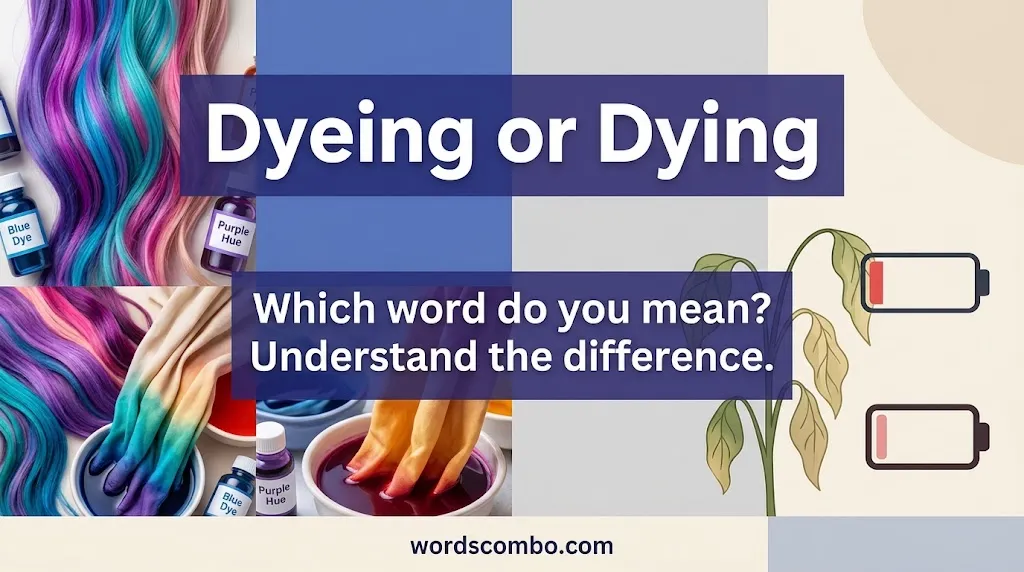
Dyeing means changing the color of something, while dying means approaching death or gradually coming to an end.
I once caught this mistake while checking a short piece of writing about hair color. The sentence said someone was “dying her hair,” and for a second it looked completely normal. Then the meaning jumped out. She was not dying her hair. She was dyeing it.
That tiny extra e can change the whole meaning of a sentence. It is especially easy to miss because dyeing and dying sound almost the same when spoken.
The confusion becomes even stronger when you type quickly. Your mind knows what you mean, but your fingers may choose the shorter spelling. That can create an awkward sentence in an email, school assignment, social media post, or article.
The good news is that the difference is easy to remember once you connect each word to its base verb. Dyeing comes from dye, which means to add or change color. Dying comes from die, which means to stop living or, in some contexts, gradually disappear.
Dyeing or Dying: Quick Answer
Use dyeing when you mean changing the color of something.
- She is dyeing her hair brown.
- We are dyeing the fabric blue.
Use dying when you mean approaching death, losing life, or gradually coming to an end.
- The old tree is dying.
- My phone battery is dying.
The simplest rule is:
Dye = color → dyeing
Die = death or decline → dying
The Background of Dyeing and Dying
These two words are easy to confuse because their spelling and pronunciation are very close, but they come from different verbs.
Dyeing comes from dye. The verb dye means to change the color of something by using a coloring substance.
You can dye many things, including:
- Hair
- Clothes
- Fabric
- Yarn
- Eggs
- Paper
- Other materials
The spelling keeps the e from the word dye:
dye → dyeing
Dying, on the other hand, comes from die. It describes the process of losing life or something gradually coming to an end.
Its spelling follows a different pattern:
die → dying
That change can feel strange at first. The final e does not stay in the usual form of the word. Instead, the ie changes to y before -ing.
You see a similar pattern in:
- lie → lying
- tie → tying
- die → dying
This is why dieing is not the normal spelling when you mean the process of dying.
Dyeing or Dying Explained: The Key Difference
The easiest way to choose between the two words is to identify the base verb.
If the base verb is dye, use dyeing.
If the base verb is die, use dying.
| Term | Meaning | When to Use | Region/Context |
| Dyeing | Changing the color of something | Hair, clothes, fabric, eggs, and other materials | Standard English |
| Dying | Approaching death or coming to an end | People, animals, plants, batteries, traditions, businesses | Standard English |
| Dieing | Not the normal form of die + ing | Avoid it in ordinary writing | Rare specialized uses may exist |
Consider these two sentences:
She is dyeing her hair.
Here, she is changing her hair color.
Her hair is dying.
This would suggest something very different and would not normally make sense if you simply mean hair coloring.
Another useful pair is:
They are dyeing the shirts red.
They are adding color to the shirts.
The flowers are dying.
The flowers are losing life.
The spelling changes because the meaning changes.
Which Version Should You Use?
Your choice depends entirely on what you mean.
If you are talking about color
Use dyeing.
This is the word you need for hair, fabric, clothing, eggs, yarn, or another object that is being given a new color.
For example:
She is dyeing her hair blonde.
We spent Saturday dyeing old T-shirts.
If you are talking about death
Use dying.
This applies to people, animals, plants, and other living things.
For example:
The injured bird is dying.
The plant is dying without enough water.
If you are talking about something gradually ending
Use dying as well.
The word can describe more than physical death. A business, tradition, custom, language, or trend can also be described as dying when it is slowly disappearing.
For example:
The old tradition is dying out.
The small business is dying because fewer people visit the area.
For American English
Use the same distinction.
American English uses dyeing for changing color and dying for death or decline.
For British English
The same distinction applies.
British English also uses dyeing for coloring and dying for death or decline.
So this is not a major American-versus-British spelling issue. Meaning is what determines the correct word.
Common Mistakes with Dyeing or Dying
1. Writing “dying my hair”
This is one of the most common mistakes.
❌ I am dying my hair black.
✅ I am dyeing my hair black.
The correct word is dyeing because the action is changing hair color.
2. Writing “dyeing” for something losing life
❌ The flowers are dyeing.
✅ The flowers are dying.
The flowers are not being given a new color. They are losing life, so dying is correct.
3. Writing “dieing”
❌ The plant is dieing.
✅ The plant is dying.
When die takes the -ing form, it becomes dying, not dieing.
4. Confusing “dyed” and “died”
The past forms can also cause trouble.
Dyed means changed color.
She dyed her hair red.
Died means stopped living.
Her old plant died last winter.
The difference is just one letter, but the meanings are completely different.
5. Choosing the word by sound alone
Both dyeing and dying sound very similar. That makes pronunciation a poor way to choose the spelling.
Instead, ask yourself:
Am I talking about color or life?
Color means dyeing.
Death or decline means dying.
Dyeing or Dying in Real-World Examples
The easiest way to understand the difference is to see how each word works in everyday writing.
Professional email
I will be dyeing the sample fabric before Friday so we can review the final color.
Here, dyeing refers to changing the fabric’s color.
News-style writing
Several older trees are dying after years of drought.
Here, dying describes trees that are losing life.
Social media post
Finally dyeing my hair the color I’ve wanted for months!
The writer is changing their hair color, so dyeing is correct.
Formal report
The traditional craft is slowly dying out as fewer young people learn the skill.
Here, dying has a figurative meaning. The craft is gradually disappearing.
Everyday conversation
My phone is dying, so I need a charger.
This does not mean the phone is literally alive. Dying can describe something that is losing power or gradually stopping.
Dyeing or Dying: Comparison at a Glance
| Term/Variant | Meaning | Region/Context | Best Used When |
| Dyeing | Adding or changing color | American and British English | Coloring hair, fabric, clothes, eggs, or other materials |
| Dying | Approaching death or gradually ending | American and British English | Talking about life, decline, power, traditions, or similar ideas |
| Dieing | Not the normal spelling of the verb die | Ordinary English | Avoid when you mean “dying” |
| Dye | To change color | Standard English | Talking about the base action |
| Die | To stop living or cease to exist | Standard English | Talking about the base action |
There is one shortcut worth remembering:
If you can replace the word with “coloring,” choose dyeing.
If you can replace it with “dying” or “coming to an end,” choose dying.
A Simple Memory Trick for Dyeing vs Dying
Think about the extra E in dyeing.
The word dye is connected to color.
So:
DYE + ING = DYEING = COLOR
Now look at the other word:
DIE + ING = DYING = DEATH OR DECLINE
A second trick is to use the base verb.
Ask:
What is the original verb?
If the answer is dye, write dyeing.
If the answer is die, write dying.
You can also remember this quick contrast:
Dyeing changes color.
Dying changes life into death, or describes something fading away.
That one distinction will solve most spelling questions.
Dyeing or Dying: Data, Trends & Usage
The main search intent behind dyeing or dying is informational. People usually want to know which spelling fits a sentence and why the two forms are different.
The confusion often appears in phrases where the surrounding words do not immediately reveal the meaning. Dyeing hair, dying hair, dyeing clothes, and dying plants can look almost identical at a glance.
Hair-related searches are especially likely to cause confusion because dyeing and dying sound the same in normal speech. Someone may know exactly what they mean but still choose the wrong spelling when typing.
The topic also matters in professional writing. A small spelling mistake can completely change the meaning of a sentence. That is why checking the base verb is more useful than relying on pronunciation.
For a USA audience, the good news is simple: there is no major regional spelling choice to memorize here. The same meaning-based rule works in both American and British English.
The practical insight is this: do not memorize the two words as isolated spellings. Connect each one to its verb. Once you remember dye → dyeing and die → dying, the choice becomes much easier.
FAQs About Dyeing or Dying
Is it dyeing or dying my hair?
Dyeing my hair is correct when you mean changing your hair color. The word comes from dye, which means to color something.
What is the difference between dyeing and dying?
Dyeing means changing the color of something. Dying means approaching death, losing life, or gradually coming to an end.
Is “dying my hair” ever correct?
Not when you mean coloring your hair. In that context, dyeing my hair is the correct phrase.
Why is dyeing spelled with an e?
Dyeing comes from the verb dye, so the spelling keeps the word’s connection to its base form. This helps separate it from dying, which comes from die.
Is “dieing” the correct spelling?
No, not when you mean the ordinary process of dying. The standard spelling is dying, as in “The plant is dying.”
Is dyeing or dying used for Easter eggs?
Use dyeing Easter eggs when you mean coloring them. The action comes from the verb dye.
Is “dying” correct in American English?
Yes. Dying is the standard American English form when you mean approaching death or gradually coming to an end. The spelling is the same in British English.
Is “dyeing” correct in formal writing?
Yes. Dyeing is perfectly appropriate in formal writing when you are describing the process of changing a color. For example, a report can discuss dyeing fabric or dyeing materials.
How can I remember dyeing and dying?
Remember the base verbs: dye → dyeing and die → dying. If color is involved, choose dyeing. If death or gradual decline is involved, choose dying.
Final Thoughts on Dyeing or Dying
The difference between dyeing and dying becomes simple once you stop looking at the spelling alone.
Use dyeing when something is being colored. You might be dyeing your hair, dyeing fabric, or dyeing Easter eggs. The word comes from dye.
Use dying when someone or something is approaching death or gradually coming to an end. A person can be dying, a plant can be dying, a battery can be dying, and even an old tradition can be dying out. The word comes from die.
There is no major US-versus-UK spelling issue here. Both forms work the same way in standard American and British English.
The most useful rule is also the easiest: dye means color, while die means death or decline. Once you connect each word to its base verb, you will rarely need to second-guess the spelling again.
Bookmark this guide so you can quickly check dyeing or dying whenever the two words look confusing.
Curious about another easily confused word pair? Explore Couch or Coach: What’s the Difference?

I have been working with English language content for over six years. I specialize in word comparisons and spelling differences that most people overlook. At WordsCombo, I help readers choose the right word every time.


1 thought on “Dyeing or Dying: Easy Guide to the Difference”