💬 Imply means to suggest an idea without saying it directly, while 🧠 infer means to understand or guess that idea from what someone says.
Have you ever said, “What are you trying to infer?” and then wondered if it sounded right?
You are not alone.
When I help people with confusing English words, imply and infer are a pair that often causes trouble. The reason is simple. Both words deal with ideas that are not said in a direct way.
But they do different jobs.
Imagine your friend looks outside and says, “Those clouds are getting very dark.”
Your friend may imply that rain is coming.
You may infer that you should take an umbrella.
That small change in point of view makes all the difference.
English learners, students, writers, and even native speakers can mix these words up. In fact, the meanings have had some overlap in English history, which helps explain the confusion. Still, modern dictionaries and style guides usually teach a clear difference.
By the end of this guide, you will know exactly when to use imply and when to use infer.
And there is an easy memory trick that makes the choice much simpler.
Imply or Infer : Quick Answer
The simplest rule is:
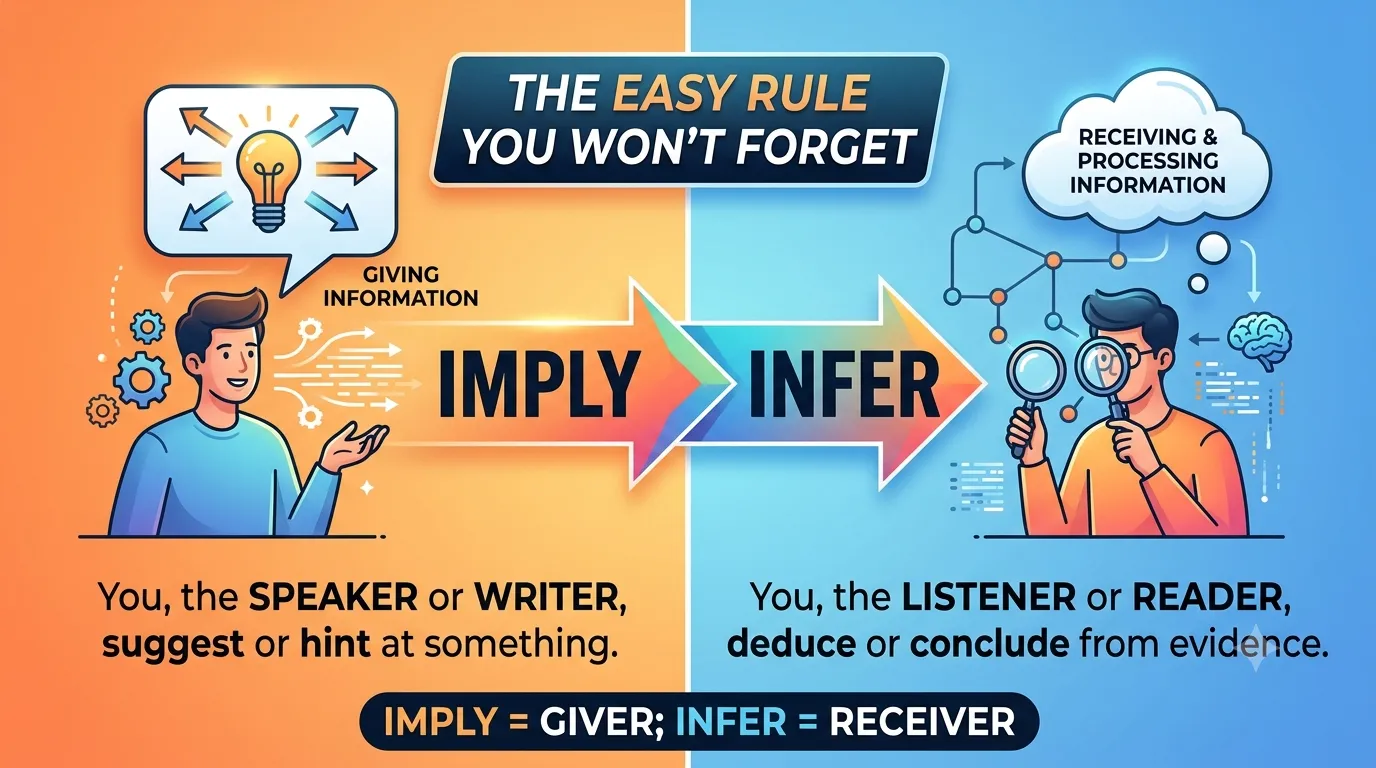
The speaker implies. The listener infers.
To imply means to suggest an idea without saying it directly. Cambridge defines the basic difference in the same way: people imply through what they say, while other people infer from that information.
To infer means to reach a conclusion from clues, facts, or evidence.
Simple example
Sarah says:
“I have an early meeting tomorrow.”
She does not say, “I want to leave the party.”
But she may imply it.
You hear her words and decide she wants to go home.
You infer it.
Think of the process like this:
Person A → implies an idea → Person B infers the idea
One person sends the hidden message.
The other person works it out.
The Origin and Background of Imply or Infer
The difference becomes easier to remember when you look at where the words came from.
Imply comes from a Latin root linked to the idea of folding, involving, or wrapping something inside something else. The English word developed from forms connected with Latin implicare.
That image is useful.
When you imply something, the idea is almost “folded inside” your words. You do not state it openly.
Infer has a different history. It comes through Latin inferre, with senses linked to bringing in or reaching a conclusion. The meaning “draw a conclusion” was established in English centuries ago.
So you can picture the difference like this:
- Imply: put an idea into a message.
- Infer: take an idea out of the evidence.
There is one historical twist.
Infer has sometimes been used with a meaning close to imply. Merriam-Webster notes that this overlap goes back centuries. However, using infer to mean suggest is still often treated as an error in modern edited English.
For school, business, academic, and professional writing, keeping the two words separate is the safest choice.
Imply or Infer Explained : Key Differences
Both words deal with messages and meaning.
The difference is direction.
| Term | Meaning | When to Use | Region/Context |
|---|---|---|---|
| Imply | Suggest without saying directly | When someone sends a hidden or indirect message | Standard English |
| Infer | Reach a conclusion from clues | When someone understands or decides something from evidence | Standard English |
| Implication | An indirect meaning or possible result | When talking about what something suggests | General and formal writing |
| Inference | A conclusion based on evidence | When describing the conclusion someone reaches | Academic, scientific, and general writing |
Example with “imply”
“The manager implied that some jobs could be cut.”
The manager did not clearly say, “We will cut jobs.”
The suggestion came from the manager.
So implied is correct.
Example with “infer”
“From the manager’s comments, workers inferred that jobs could be cut.”
The workers reached a conclusion.
So inferred is correct.
One sentence can use both
Here is the clearest example:
“The teacher implied that the test would be difficult, and the students inferred that they should study more.”
The teacher sends the hint.
The students understand the hint.
That is the whole difference.
Which Version Should You Use?
The right choice depends on who is doing the action.
For speakers and writers → use “imply”
Use imply when someone communicates an idea without stating it directly.
For example:
“She implied that she was unhappy with the result.”
Her words or actions created the suggestion.
For readers and listeners → use “infer”
Use infer when someone receives information and reaches a conclusion.
For example:
“I inferred from his tone that he was angry.”
You noticed his tone.
Then you formed a conclusion.
For students → remember “I infer”
A handy memory trick is:
I Infer.
Both words begin with I.
You can think:
I infer information from clues.
For professional or academic writing
Keep the distinction clear.
Scientific and academic writing often uses infer when a conclusion comes from results or evidence. Scribbr, for example, describes infer as drawing a conclusion from evidence and imply as suggesting something indirectly.
For global English
The same basic distinction works well in both British and American English.
Cambridge presents the speaker/listener distinction, while Merriam-Webster gives the same modern usage pattern.
So you do not need separate US and UK rules.
Common Mistakes with Imply or Infer
Most errors happen because the writer focuses on the hidden meaning but forgets who created it.
Here are five common mistakes.
1. Using “infer” when you mean “imply”
Mistake:
“Are you inferring that I cheated?”
Better:
“Are you implying that I cheated?”
The other person is making the suggestion.
You are receiving it.
2. Using “imply” for your own conclusion
Mistake:
“From the evidence, I implied that he had left.”
Correct:
“From the evidence, I inferred that he had left.”
You reached the conclusion from evidence.
3. Thinking “infer” means “guess”
An inference is usually based on some clue or evidence.
For example:
“The lights are off, so I infer that nobody is home.”
You have evidence.
You may still be wrong, but your conclusion has a reason behind it.
4. Treating “imply” as the same as “say”
If someone says something directly, they are not merely implying it.
Direct:
“Your work is late.”
Implied:
“I expected to receive your work yesterday.”
The second sentence suggests that the work is late without stating it in the same direct way.
5. Forgetting the source of the message
Ask one question:
Who has the clue, and who reaches the conclusion?
The person creating the clue can imply.
The person reading the clue can infer.
Imply or Infer in Real-World Examples
Understanding the rule is easier when you see both words in natural settings.
Professional email
“Your email implies that the project may need more time.”
The email contains the suggestion.
News article
“Analysts inferred from the latest figures that demand was slowing.”
The analysts studied evidence and reached a conclusion.
Social media post
“Not trying to imply anything, but that announcement sounds interesting.”
The writer is talking about sending a possible hidden message.
Formal report
“The data allow us to infer that customer demand increased during the period.”
The conclusion comes from data.
Everyday conversation
“You keep looking at the door. Are you implying that you want me to leave?”
The speaker notices a possible hint.
Another version could be:
“You kept looking at the door, so I inferred that you wanted me to leave.”
Notice how the same event can involve both words.
One describes the signal.
The other describes the conclusion.
Imply or Infer : Data, Trends and Usage
The search intent behind “imply or infer” is mainly informational.
People searching the phrase usually want a fast answer to questions such as:
- What is the difference between imply and infer?
- Should I say “implying” or “inferring”?
- Can infer mean imply?
- How do I remember the difference?
- Which word should I use in a sentence?
The confusion is not limited to beginner English learners. Major dictionaries, grammar resources, writing guides, and newspaper style guides still explain the distinction, which shows that it remains a common usage issue.
The topic matters in several settings.
Students need the difference for essays and exams.
Writers need it for clear communication.
Researchers often use infer when talking about conclusions drawn from evidence.
Journalists and editors also care about the distinction because changing one word can change who is responsible for an idea.
That last point matters.
Compare:
“The report implies fraud.”
The report contains signs that suggest fraud.
“We infer fraud from the report.”
We reach that conclusion after reading it.
The idea may be similar, but the responsibility for the conclusion changes.
Imply or Infer: Standalone Comparison Table
| Term/Variant | Meaning | Region/Context | Best Used When |
|---|---|---|---|
| Imply | Suggest indirectly | General English | A person, action, or statement sends a hint |
| Implied | Suggested indirectly in the past | General English | Describing an earlier hint |
| Implying | Suggesting indirectly now | Speech and writing | Talking about an active suggestion |
| Infer | Draw a conclusion | General, academic, scientific | Someone understands something from clues |
| Inferred | Reached a conclusion in the past | General and formal English | Describing a past conclusion |
| Inference | A conclusion based on evidence | Academic and general English | Naming the conclusion itself |
| Implication | An indirect meaning or possible effect | General and formal English | Naming what something suggests |
Frequently Asked Questions About Imply or Infer
Q: What does imply or infer mean?
A: Imply means to suggest something without saying it directly. Infer means to reach a conclusion from information or evidence.
Q: How do you use imply correctly?
A: Use imply when a person, statement, action, or piece of evidence suggests something. For example, “Her smile implied that she already knew the answer.”
Q: How do you use infer correctly?
A: Use infer when someone reaches a conclusion from clues. For example, “I inferred from her smile that she already knew the answer.”
Q: Imply vs infer : what is the main difference?
A: The difference is direction. A speaker implies a message, while a listener infers meaning from that message. Cambridge gives essentially this speaker-versus-listener rule.
Q: Is infer acceptable in formal writing?
A: Yes. Infer is common in formal and academic writing when conclusions are based on evidence, facts, results, or observations.
Q: Which is correct: “Are you implying?” or “Are you inferring?”
A: Usually, “Are you implying?” is correct when you mean “Are you suggesting something?” You would use inferring when asking whether someone is drawing a conclusion from evidence.
Q: Where do imply and infer come from?
A: Imply developed from roots connected with folding or involving something, while infer comes from Latin inferre and developed the sense of reaching a conclusion.
Imply or Infer: The Rule to Remember
The difference between imply and infer becomes easy once you stop treating them as two words for the same action.
Remember these three points.
First, imply means to suggest something without saying it directly.
Second, infer means to reach a conclusion from clues, facts, words, or evidence.
Third, think about the direction of the message.
The speaker implies. The listener infers.
You can also use the simple memory trick “I infer.” If you are the person working out what the clues mean, infer is probably the word you need.
In careful school, business, academic, and professional writing, it is best to keep the two meanings separate. That makes your sentence clearer and shows exactly who is suggesting an idea and who is drawing the conclusion.
Now you know exactly how to choose imply or infer. Try the rule in your next email, essay, or conversation.
And bookmark this guide so you never have to second-guess the difference again.
Read more: Capital or Capitol: The Easy Way to Know

I have been working with English language content for over six years. I specialize in word comparisons and spelling differences that most people overlook. At WordsCombo, I help readers choose the right word every time.