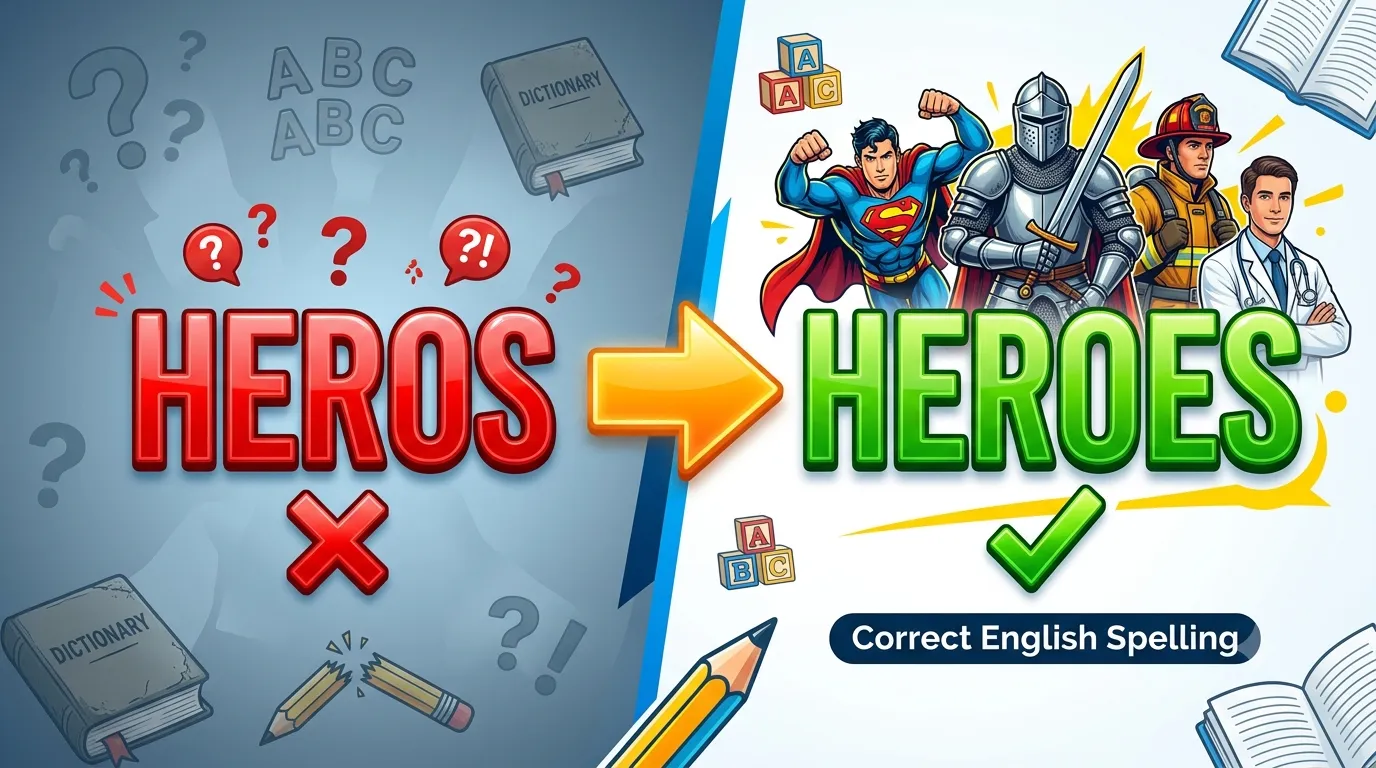
Heroes is the correct plural of hero. Heros is a spelling mistake and should not be used in standard English writing.
I still remember reading a student’s essay that proudly said, “Our country’s greatest heros deserve respect.” The idea was wonderful, but one small spelling mistake stood out immediately. It reminded me that even confident writers can mix up heros and heroes because English plurals do not always follow the same pattern.
If you’ve ever paused while typing because you weren’t sure which spelling is right, you’re not alone. This is one of the most common spelling questions among students, bloggers, business professionals, and English learners. Since both words look believable, many people assume either spelling works.
The good news is that the answer is simple. Once you understand the rule, you’ll never second-guess yourself again.
In this guide, you’ll learn the correct spelling, why the confusion happens, where the word comes from, and how to use it correctly in everyday writing. You’ll also see clear examples and practical tips that make the rule easy to remember.
Heros or Heroes: Quick Answer
The correct plural form of hero is heroes.
The spelling heros is incorrect in modern English.
Examples
✅ The firefighters became local heroes.
✅ Many children look up to their sports heroes.
❌ The firefighters became local heros.
❌ We celebrate our national heros every year.
Simple rule: When a noun ends in -o, many English words form the plural by adding -es. Since hero follows this rule, its plural is heroes.
The Origin and Background of Heros or Heroes
The word hero has a long history. It comes from the ancient Greek word hērōs, which referred to a brave warrior, protector, or someone admired for outstanding courage.
Later, the word entered Latin before becoming part of the English language. Over time, its meaning expanded beyond mythical warriors. Today, a hero can be anyone who shows courage, kindness, leadership, or selfless action.
Examples include:
- A firefighter saving lives.
- A doctor treating patients during a crisis.
- A parent making sacrifices for family.
- A teacher inspiring students.
So where does heros come from?
It isn’t an alternative spelling. Instead, it usually appears because writers naturally add -s, forgetting that hero belongs to a group of nouns that take -es in the plural.
English has several similar words:
- potato → potatoes
- tomato → tomatoes
- echo → echoes
- veto → vetoes
- hero → heroes
Learning this pattern makes the correct spelling much easier to remember.
Heros or Heroes Explained: Key Differences
Although these spellings look almost identical, only one is accepted in English dictionaries.
| Term | Meaning | When to Use | Region/Context |
|---|---|---|---|
| Heroes | Correct plural of hero | Always when referring to more than one hero | British English, American English, Australian English, Canadian English and all standard English |
| Heros | Misspelling | Never in formal writing | Typing or spelling error |
Why do people write “heros”?
Several reasons explain the mistake.
1. Simple plural habit
Many English nouns become plural by adding -s.
For example:
- book → books
- chair → chairs
- apple → apples
Writers often apply this pattern to hero, producing heros.
2. English exceptions
English contains many spelling rules with exceptions. Words ending in -o can be confusing because some add -s, while others add -es.
Examples:
- piano → pianos
- photo → photos
- radio → radios
But:
- hero → heroes
- potato → potatoes
- tomato → tomatoes
This mix causes uncertainty.
3. Typing quickly
Many spelling errors happen because people type fast and skip the extra e before -s.
Fortunately, spell-check software usually catches this mistake.
Examples in Sentences
Correct:
- The rescue team became heroes overnight.
- Children often see their parents as heroes.
- Comic book heroes inspire millions of readers.
Incorrect:
- The rescue team became heros overnight.
- My favorite movie heros wear capes.
Standalone Comparison Table
| Term/Variant | Meaning | Region/Context | Best Used When |
|---|---|---|---|
| Hero | One brave or admired person | Universal English | Singular noun |
| Heroes | More than one hero | Universal English | Correct plural |
| Heros | Misspelling | Not accepted in standard English | Never use |
Which Version Should You Use?
The answer is straightforward.
Always choose heroes.
There are no situations in standard English where heros is preferred.
For Students
Use heroes in homework, essays, exams, and assignments. Teachers expect the correct spelling.
For Bloggers and Content Writers
Always write heroes. Search engines and readers both expect proper spelling. Using heros can reduce your credibility and make your content appear less professional.
For Business Professionals
Reports, presentations, emails, and marketing materials should always use heroes. Correct spelling reflects attention to detail.
For Authors and Journalists
Editors follow standard English dictionaries. Heroes is the accepted plural in books, newspapers, magazines, and online publications.
For English Learners
Memorise this simple rule:
Hero ends in -o, so its plural becomes heroes by adding -es.
A helpful memory trick is:
- One hero
- Two heroes
Never write heros.
Quick Memory Tip
Think of these words together:
- Hero → Heroes ✅
- Potato → Potatoes ✅
- Tomato → Tomatoes ✅
If you remember one, you’ll likely remember the others.
Common Mistakes with Heros or Heroes
Even experienced writers occasionally make this mistake. Here are the most common errors and how to fix them.
| Mistake | Correct | Why? |
|---|---|---|
| The heros saved the town. | The heroes saved the town. | Heroes is the correct plural. |
| Our national heros are remembered. | Our national heroes are remembered. | Add -es, not just -s. |
| She is one of my favourite heros. | She is one of my favourite heroes. | Standard English uses heroes. |
| Comic book heros are popular. | Comic book heroes are popular. | Heros is a spelling error. |
| Many everyday heros go unnoticed. | Many everyday heroes go unnoticed. | Always use heroes for the plural. |
Why do these mistakes happen?
- People assume every noun simply adds -s.
- Some words ending in -o take -s, while others take -es.
- Fast typing often leads to missing the extra e.
- Writers rely on how the word sounds instead of how it is spelled.
Tip: If you’re talking about more than one hero, write heroes every time.
Heroes in Real-World Examples
Seeing the word in context makes it easier to remember.
Professional Email
We would like to thank our healthcare heroes for their dedication and hard work throughout the year.
News Headline
Local Heroes Rescue Family from Flooded Home
Social Media Post
Every community has everyday heroes. Thank you to everyone who helps others without expecting anything in return. ❤️
Formal Report
The organisation recognised several community heroes for their outstanding volunteer service.
School Essay
Many young people consider their parents to be their first heroes because they provide love, guidance, and support.
Heros or Heroes: Data, Trends & Usage
The question “heros or heroes” is searched by thousands of English learners every year. Most people simply want to know which spelling is correct before submitting schoolwork, publishing a blog post, or sending an important email.
Search Intent
Primary intent: Informational
Users want a quick, trustworthy answer rather than a long grammar lesson.
Who Searches This Most?
- Students
- Teachers
- Bloggers
- Copywriters
- Content marketers
- English language learners
- Business professionals
Regions with High Interest
The spelling question appears across English-speaking countries, including:
- United States
- United Kingdom
- Canada
- Australia
- India
- Pakistan
- Philippines
Because English is used worldwide, correct spelling matters more than ever. A small mistake like heros can make an otherwise excellent piece of writing look less polished.
Why This Matters Today
People publish online every day. Whether you’re writing a blog, posting on social media, sending an email, or creating school assignments, correct spelling builds trust and professionalism. Using heroes instead of heros helps your writing appear accurate and credible.
Frequently Asked Questions
Q: What does “heroes” mean?
A: Heroes is the plural form of hero. It refers to two or more people who are admired for courage, bravery, kindness, or outstanding achievements.
Q: Is “heros” ever correct?
A: No. Heros is a spelling mistake in standard English. The correct plural spelling is always heroes.
Q: Why does “hero” become “heroes”?
A: Many English nouns ending in -o form their plural by adding -es instead of just -s. Hero follows this pattern.
Q: Is “heroes” correct in British and American English?
A: Yes. Both British English and American English use heroes. There is no regional spelling difference.
Q: Can I use “heroes” in formal writing?
A: Absolutely. Heroes is the standard spelling for academic papers, business documents, books, newspapers, and professional communication.
Q: What is the difference between “hero” and “heroes”?
A: Hero refers to one person, while heroes refers to more than one person.
Example:
- One hero
- Two heroes
Q: How can I remember the correct spelling?
A: Think of similar words that add -es:
- hero → heroes
- potato → potatoes
- tomato → tomatoes
Remembering this pattern will help you avoid writing heros.
Conclusion
The answer to heros or heroes is simple once you know the rule. Heroes is the only correct plural form of hero, while heros is a common spelling mistake that should be avoided.
Here are the key points to remember:
- Hero is singular.
- Heroes is the correct plural.
- Heros is incorrect in standard English.
- The correct spelling is accepted in British, American, Canadian, and Australian English.
- Using the right spelling makes your writing look more professional and trustworthy.
English has many tricky spelling rules, but this one is easy to master with a little practice. The next time you write about brave people, comic book characters, or everyday role models, you’ll know exactly which spelling to choose.
Bookmark this guide so you never second-guess “heroes” again. If you found it helpful, share it with a friend or classmate who might still be writing “heros.”
Read more: Themself or Theirself: Understanding Pronoun Use

I started writing about English word differences after years of teaching students who kept making the same mistakes. My focus is on making spelling rules feel simple and easy to remember. At WordsCombo, I turn confusing word pairs into clear comparisons.



1 thought on “Heros or Heroes: The Complete Guide to Correct Spelling”