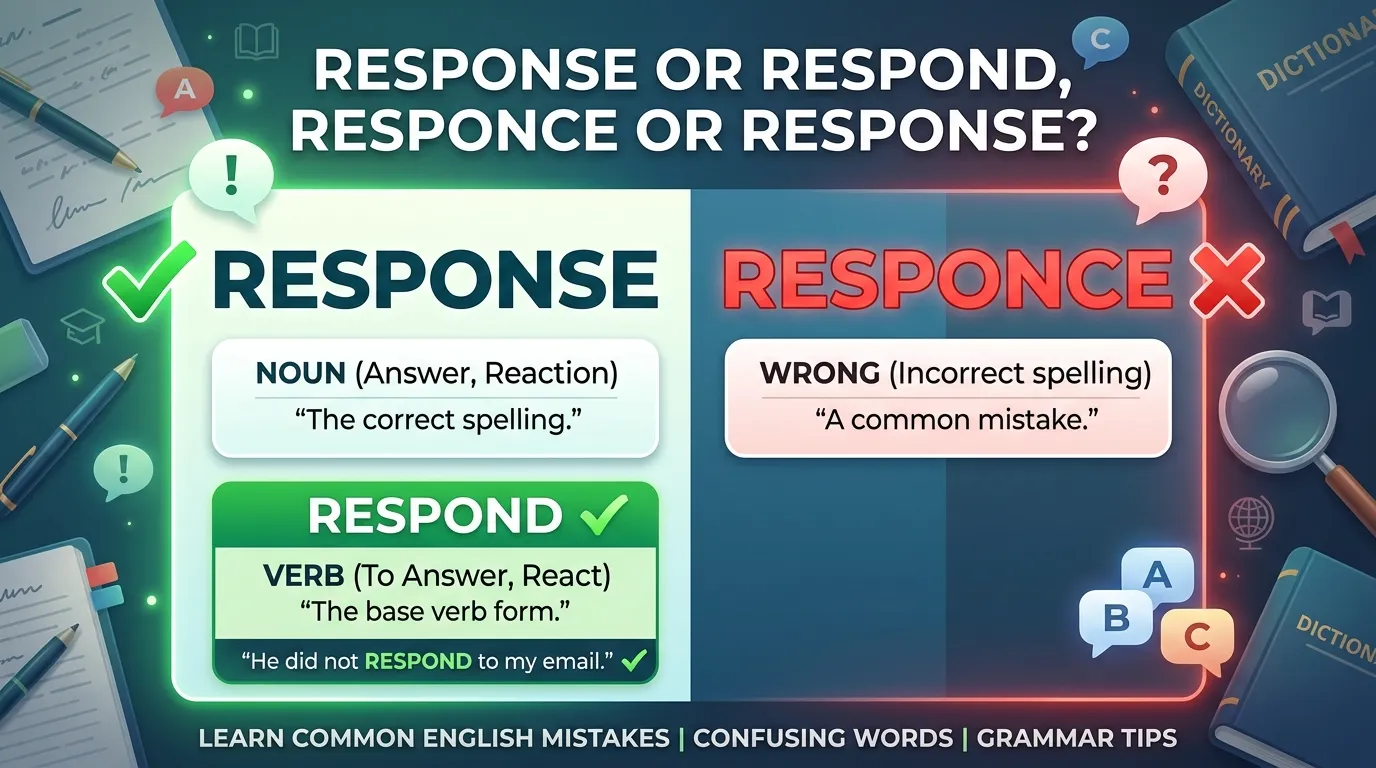
Response is a noun meaning an answer or reaction, while respond is a verb meaning to answer or react. Responce is an incorrect spelling; the correct word is response.
Have you ever typed “responce” and stopped for a second because it looked right? Or wondered whether you should write “response” or “respond” in a sentence?
I have seen this mistake many times while checking student essays, emails, and everyday writing. The tricky part is that response and respond are both correct words. They are also closely related. That makes them easy to mix up.
Then there is responce, which looks almost correct but is not standard English.
The good news is that you do not need to memorize a long grammar rule. Once you understand the job each word does, the difference becomes simple.
Response is usually a thing. It is the answer, reaction, or reply you give.
Respond is an action. It means to answer, react, or reply.
In this guide, you will learn the meaning of each word, see easy examples, discover common mistakes, and learn a quick trick that can help you choose the right form every time.
Response or Respond: Quick Answer
The easiest way to remember the difference is this:
- Response = a noun
- Respond = a verb
- Responce = incorrect spelling
A response is something you give.
I received a quick response to my email.
To respond means to take the action of answering.
Please respond to my email today.
Notice the difference:
She gave me a response.
She did not respond to my message.
Both words are correct. They simply play different roles in a sentence.
What Does “Response” Mean?
Response means an answer, reply, reaction, or result caused by something.
For example:
His response was polite.
Here, response is the answer he gave.
You can also use it for a reaction:
The audience had a positive response to the speech.
What Does “Respond” Mean?
Respond is a verb. It means to answer or react to something.
For example:
She did not respond to my question.
Here, respond describes the action of answering.
A simple rule works well:
If you can put “a” or “the” before the word, you probably need “response.”
a response
the response
You cannot normally say:
a respond ❌
That clue makes the choice much easier.
The Origin and Background of Response and Respond
The words response and respond come from the same word family.
Both are linked to the Latin word respondere, which means “to answer” or “to reply.”
Over time, English developed different forms of the word.
Respond became the verb used for the act of answering.
Response became the noun used for the answer or reaction itself.
That is why the words look so similar.
Think about other word pairs with the same pattern:
- decide → decision
- explain → explanation
- invite → invitation
- respond → response
The spelling changes slightly when the word changes form. This is one reason learners may write responce by mistake.
The ending -ce can look natural because English has many words ending in -ce. But response uses -se, not -ce.
So remember:
response ✅
responce ❌
Response vs Respond: Key Difference
The main difference is grammatical.
| Term | Meaning | When to Use | Region/Context |
|---|---|---|---|
| Response | An answer, reply, or reaction | When naming the answer or reaction | Standard English |
| Respond | To answer or react | When describing the action | Standard English |
| Responce | No standard English meaning | Do not use it | Incorrect spelling |
Examples With “Response”
I am waiting for your response.
Her response was honest.
We received a positive response from customers.
His response surprised everyone.
In each sentence, response names a thing: an answer, reply, or reaction.
Examples With “Respond”
Please respond as soon as possible.
He did not respond to my message.
She responded to the question clearly.
How should I respond to this email?
Here, the word describes an action.
A Simple Test
Ask yourself:
Am I talking about the answer, or the action of answering?
If you mean the answer, use response.
I liked her response.
If you mean the action, use respond.
I asked her to respond.
This tiny test can prevent many mistakes.
Response or Respond: Which One Should You Use?
Your choice depends on the sentence, not your country.
Unlike some spelling differences such as color/colour or organize/organise, response and respond are not regional alternatives.
Both are standard in American English and British English.
Use response when you need a noun.
We are waiting for your response.
Use respond when you need a verb.
We hope you will respond soon.
For Students
Students should learn both words.
Use response when discussing an answer or reaction.
The character’s response shows that he is afraid.
Use respond when describing what someone does.
The character responds to the threat.
For Professional Writing
Both words are common in emails, reports, business documents, and customer service.
For example:
Thank you for your response.
Or:
Thank you for responding so quickly.
The first sentence focuses on the reply. The second focuses on the action.
For Global English
The safest choice is simple:
Use the word that fits the grammar of your sentence.
There is no need to choose between British and American spelling here.
Common Mistakes With Response and Respond
These words cause a few predictable errors.
1. Writing “Responce”
Mistake:
Thank you for your responce.
Correct:
Thank you for your response.
The word is spelled with -se at the end.
Response has no c.
2. Using “Respond” After “Your”
Mistake:
Thank you for your respond.
Correct:
Thank you for your response.
Why?
Because your needs a noun here.
You have a response. You do not have a respond.
3. Using “Response” as a Verb
Mistake:
Please response to this email.
Correct:
Please respond to this email.
The sentence needs an action. Therefore, you need the verb respond.
4. Confusing “Respond” With “Response”
Mistake:
I am waiting for you to response.
Correct:
I am waiting for you to respond.
The phrase “to respond” uses the infinitive form of the verb.
5. Mixing Both Words in One Sentence
Sometimes writers use the wrong form because they focus on meaning instead of grammar.
Compare:
We need your response by Friday.
and:
Please respond by Friday.
Both sentences are correct.
The first asks for an answer.
The second asks someone to perform the action of answering.
Response and Respond in Real-World Examples
Seeing these words in everyday situations makes the difference easier to remember.
1. Professional Email
Subject: Request for a Response
Thank you for reviewing the document. I would appreciate your response by Friday.
Here, response is a noun.
You could also write:
Please respond by Friday.
Here, respond is a verb.
2. News Headline
A news story might say:
Government Responds to Public Concerns
Here, responds is a verb because the government is performing an action.
A different headline could say:
Public Response to New Policy Is Mixed
Here, response is a noun because the headline refers to the public reaction.
3. Social Media Post
I finally got a response to my question!
Or:
Please respond if you have experienced the same problem.
Both forms sound natural.
4. Formal Report
The company’s response to the complaint was quick and professional.
Or:
The company responded to the complaint within 24 hours.
The meaning is closely related, but the grammar is different.
5. Everyday Conversation
What was his response?
I don’t know. He didn’t respond.
This is a great example because both words can appear naturally in the same conversation.
Response or Respond: A Quick Memory Trick
Here is one of the easiest ways to remember the difference:
Response = thing
Respond = action
Think of it this way:
You respond.
You give a response.
For example:
I will respond to your message.
I will send my response tomorrow.
You can also remember the word family:
respond → response
The verb tells you what someone does.
The noun tells you what someone gives.
Standalone Comparison: Response, Respond, and Responce
| Term/Variant | Meaning | Region/Context | Best Used When |
|---|---|---|---|
| Response | An answer, reply, or reaction | All standard English | You need a noun |
| Respond | To answer or react | All standard English | You need a verb |
| Responce | Incorrect spelling | Nonstandard | Never use it in normal English |
One detail is worth remembering: response and respond are not competing spellings.
They are different parts of speech.
That means the question is not really “Which spelling is better?”
The better question is:
“Do I need a noun or a verb?”
Once you ask that, the answer is usually clear.
Response: Data, Trends & Usage
Searches for response or respond often come from learners who know the basic meaning but are unsure about grammar. Searches for responce or response usually come from people checking whether the spelling contains c or s.
That tells us something useful.
The confusion has two separate causes:
- Grammar confusion: response vs. respond.
- Spelling confusion: responce vs. response.
These problems often appear in emails, school assignments, online forms, workplace messages, and everyday writing.
The topic also matters because digital communication has made words such as respond, response, reply, and reaction part of daily life.
You might ask someone to respond to a message. You might wait for a response. You might receive an automatic response from a company.
Learning the difference helps you write more clearly in all these situations.
For search intent, this is mainly an informational spelling and grammar query. Most readers want a quick answer first, followed by examples that help them avoid the mistake next time.
Response vs. Reply: Are They the Same?
Response and reply are close in meaning, but they are not always used in exactly the same way.
A reply usually means an answer to something that was said or written.
I sent her a message and received a reply.
A response can mean an answer, but it can also describe a broader reaction.
The audience had a strong response to the speech.
You can usually use response when talking about reactions, feedback, or answers.
That makes it a little broader than reply.
Respond vs. Answer: Are They the Same?
Again, the meanings overlap.
Please answer my question.
Please respond to my question.
Both sentences work.
However, respond can have a wider meaning. It can describe reacting to a person, situation, event, or request.
The doctor responded quickly.
The company responded to customer complaints.
So respond is not limited to giving a direct answer.
How to Remember the Correct Spelling of Response
The most common spelling mistake is responce.
A useful trick is to remember that response is related to respond.
The shared letters can help:
respond → response
Both begin with respon-.
Then remember:
response ends in -se.
Not:
responce ❌
Try writing the correct word several times:
response
response
response
After a while, the correct spelling will feel natural.
FAQ: Response or Respond, Responce or Response
Q: What does “response” mean?
A: Response is a noun that means an answer, reply, or reaction. For example, “Her response was helpful.”
Q: What does “respond” mean?
A: Respond is a verb that means to answer or react. For example, “Please respond to my message.”
Q: Is “responce” correct English?
A: No. Responce is a misspelling. The correct spelling is response.
Q: What is the difference between response and respond?
A: Response is a noun, while respond is a verb. You give or receive a response, but you respond to something.
Q: Which is correct: “your response” or “your respond”?
A: Your response is correct. The word after “your” is a noun, so response is needed.
Q: Can I say “Please response to my email”?
A: No. Say “Please respond to my email.” The sentence needs a verb because it describes an action.
Q: Is response acceptable in formal writing?
A: Yes. Response is a standard word used in formal emails, reports, academic writing, business documents, and professional communication.
Q: Where do response and respond come from?
A: They come from the same Latin word family linked to respondere, meaning to answer or reply. Their shared origin explains why they look so similar.
Q: Is response the same as reply?
A: They can have similar meanings, especially when talking about an answer. However, response can also describe a wider reaction or result.
Final Takeaway
The difference between response, respond, and responce is much easier than it first appears.
Response is a noun. It means an answer, reply, or reaction.
Respond is a verb. It means to answer or react.
Responce is simply a spelling mistake. The correct spelling is response.
When you are unsure, ask yourself one quick question:
Am I talking about the answer, or the action of answering?
If you mean the answer, choose response.
I am waiting for your response.
If you mean the action, choose respond.
Please respond soon.
And if you are wondering whether responce is correct, remember the simple rule: response is spelled with -se, not -ce.
These small word choices can make your emails, essays, reports, and messages look much more polished.
Bookmark this guide so you never have to second-guess response or respond again.
Related words: Wintery or Wintry: The Complete Easy Guide

I started writing about English word differences after years of teaching students who kept making the same mistakes. My focus is on making spelling rules feel simple and easy to remember. At WordsCombo, I turn confusing word pairs into clear comparisons.





1 thought on “Response or Respond, Responce or Response: The Complete Easy Guide”