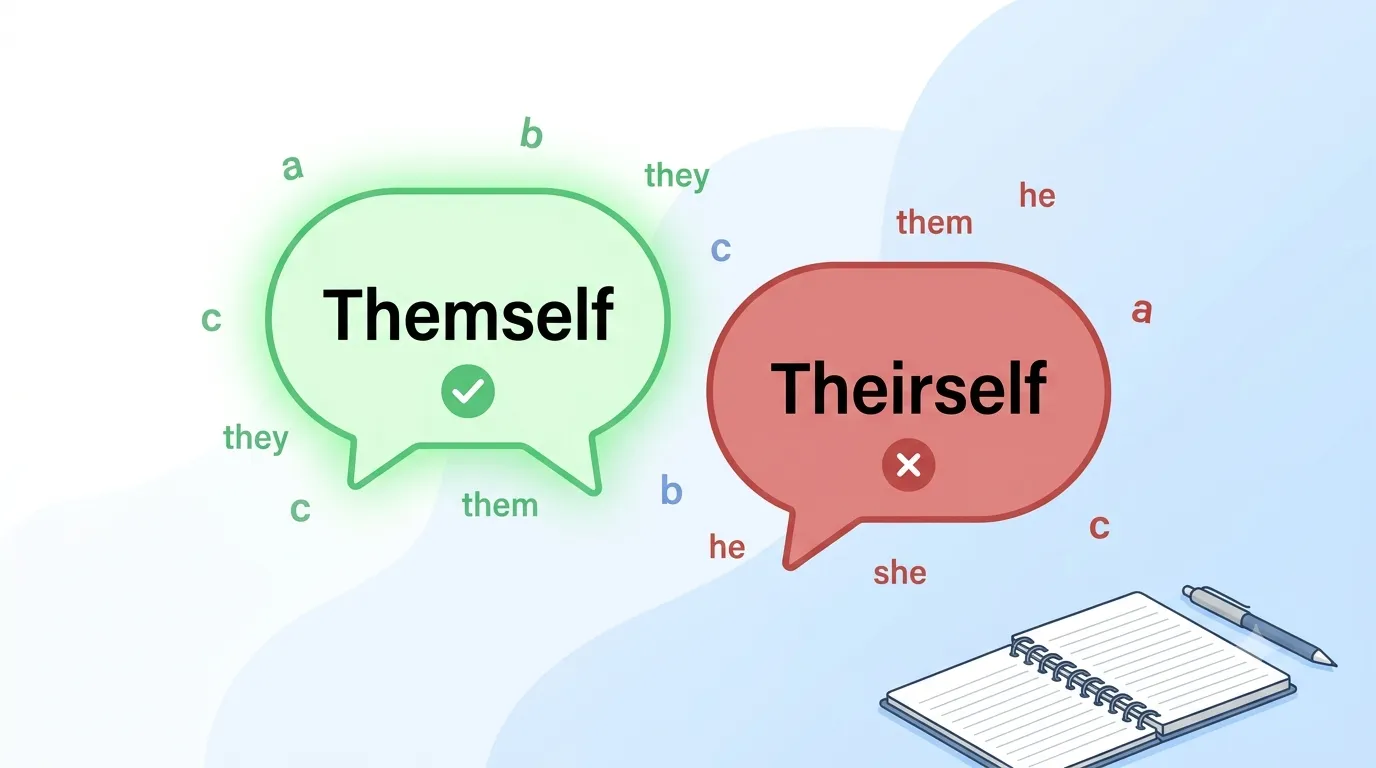
Themself is the correct modern word to use as a gender neutral singular reflexive pronoun. Theirself is considered nonstandard and should be avoided in formal writing.
I still remember the email that made me stop and stare at my screen. A colleague wrote, “The new hire should introduce theirself to the team.” Something felt off. But I couldn’t say why.
That small moment sent me down a rabbit hole. Turns out, this mix-up trips up a lot of smart people. Themself and theirself sound almost identical. Your brain wants to treat them the same way.
But they aren’t the same. One is accepted by major dictionaries. The other is a common error that slips past spell-check.
This confusion usually shows up when writers try to be inclusive. You want a pronoun that doesn’t assume gender. So you reach for something that sounds right. Often, the wrong version comes out first.
This guide clears up the mess. You’ll learn which word to use, why the confusion exists, and how to avoid the mistake for good. No grammar jargon. Just clear answers you can use today.
Themself or Theirself: Quick Answer
Themself is the standard, dictionary-recognized spelling. It works as a singular reflexive pronoun when the subject’s gender is unknown or nonbinary.
Theirself is not standard English. It shows up in casual speech, but style guides and dictionaries don’t recognize it.
Example:
- ✅ “Everyone should give themself credit for trying.”
- ❌ “Everyone should give theirself credit for trying.”
The Origin of Themself and Theirself
English has always struggled with singular they. Writers used it as far back as the 1300s, long before modern grammar rules existed.
The reflexive form followed a messy path. Old dialects sometimes used theirself or theirselves in spoken English. These forms never gained formal acceptance.
Themself followed a more logical pattern. It mirrors himself and herself, just swapping in the gender-neutral them. That structure made it easier for dictionaries and style guides to adopt.
By the 2010s, major style guides like APA and Merriam-Webster formally recognized singular they and themself. Theirself never received that same recognition, despite being used informally for centuries.
Themself vs Theirself: Key Differences
| Term | Meaning | When to Use | Region/Context |
|---|---|---|---|
| Themself | Standard reflexive form of singular “they” | Formal and informal writing, inclusive language | Widely accepted in US and UK English |
| Theirself | Nonstandard variant | Casual speech only, avoid in writing | Regional dialects, informal speech |
| Themselves | Plural reflexive pronoun | Multiple people or a group | Standard in all English varieties |
The pattern is simple. Themself matches formal grammar rules. Theirself does not. Themselves stays plural and unrelated to this specific mix-up.
Which Version Should You Use?
- For professional or academic writing → use themself, since it’s dictionary-approved and grammatically consistent.
- For casual conversation → themself still works best, though theirself may appear in some regional dialects.
- For inclusive or gender-neutral writing → themself is your safest, most widely recognized choice.
There’s no real case where theirself is the better pick. If you want to sound polished and correct, themself wins every time.
Common Mistakes with Themself and Theirself
Mistake 1: Using “theirself” in professional emails. ✅ Correction: “She reminded themself to double-check the report” (when gender is unspecified).
Mistake 2: Confusing “themself” with “themselves” for one person. ✅ Correction: Use themself for one person, themselves for a group.
Mistake 3: Avoiding singular “they” entirely out of uncertainty. ✅ Correction: Singular they and themself are grammatically valid and widely accepted.
Mistake 4: Mixing “hisself” and “theirself” as if they’re both standard. ✅ Correction: Neither is standard. Use himself or themself instead.
Mistake 5: Assuming spell-check will catch the error. ✅ Correction: Many spell-checkers don’t flag “theirself,” so proofread manually.
These errors happen because English pronoun rules shifted fast. Older habits and regional speech patterns still linger in everyday writing.
Themself in Real-World Examples
Professional email: “Please ask the candidate to introduce themself during the interview.”
News headline: “Local Hero Saves Family, Says Anyone Would Do It Themself.”
Social media post: “Proud of my friend for finally treating themself to that vacation. 🎉”
Formal document: “The applicant must certify that they completed the form themself.”
Each example shows themself replacing gendered pronouns naturally, without sounding forced or awkward.
Themself or theirself: Data, Trends & Usage
Searches for themself vs theirself spike whenever style guides update their pronoun rules. Writers, editors, and students search this term most often.
This is mostly an informational search. People want clarity, not a product or service.
English teachers and content writers in the US and UK show the highest interest. Many are updating older writing habits to match modern, inclusive language standards.
This matters now because inclusive language keeps evolving. Getting it right builds trust with readers and avoids awkward corrections later.
Themself vs Theirself: Standalone Comparison
| Term/Variant | Meaning | Region/Context | Best Used When |
|---|---|---|---|
| Themself | Singular reflexive, gender-neutral | Standard US/UK English | Formal writing, inclusive language |
| Theirself | Nonstandard reflexive variant | Casual regional speech | Avoid in writing entirely |
| Themselves | Plural reflexive pronoun | All English varieties | Referring to multiple people |
Frequently Asked Questions
Q: What does themself mean?
A: Themself is a singular reflexive pronoun. It’s used when someone’s gender is unknown, nonbinary, or irrelevant to the sentence.
Q: How do you use themself correctly?
A: Use it the same way you’d use himself or herself, but for a person whose gender isn’t specified. Example: “They finished the project themself.”
Q: Themself vs theirself: what’s the difference?
A: Themself is the standard, dictionary-recognized form. Theirself is nonstandard and appears mostly in casual or regional speech.
Q: Is themself acceptable in formal writing?
A: Yes. Major style guides, including APA, recognize themself as correct for gender-neutral singular reference.
Q: Which version is correct: themself or theirself?
A: Themself is correct. Theirself is not recognized by standard dictionaries or style guides.
Q: Where does themself come from?
A: It follows the same pattern as himself and herself, adapted for the gender-neutral pronoun they.
Q: Can themself be used in academic writing?
A: Yes. It’s widely accepted in academic, business, and journalistic writing when referring to one person of unspecified gender.
Final Takeaway
Themself is the word you want. It’s grammatically sound, dictionary approved, and works perfectly for inclusive, gender neutral writing.
Theirself might sound familiar, but it hasn’t earned a place in standard English. Skip it in anything you write formally.
Remember these key points:
- Themself = correct, singular, gender-neutral
- Theirself = nonstandard, avoid in writing
- Themselves = plural, for groups only
Bookmark this guide so you never second-guess themself again. Share it with a friend or colleague who’s been stuck on this one too.
Read more: Tased or Tazed: Which Spelling Is Correct?

I started writing about English word differences after years of teaching students who kept making the same mistakes. My focus is on making spelling rules feel simple and easy to remember. At WordsCombo, I turn confusing word pairs into clear comparisons.