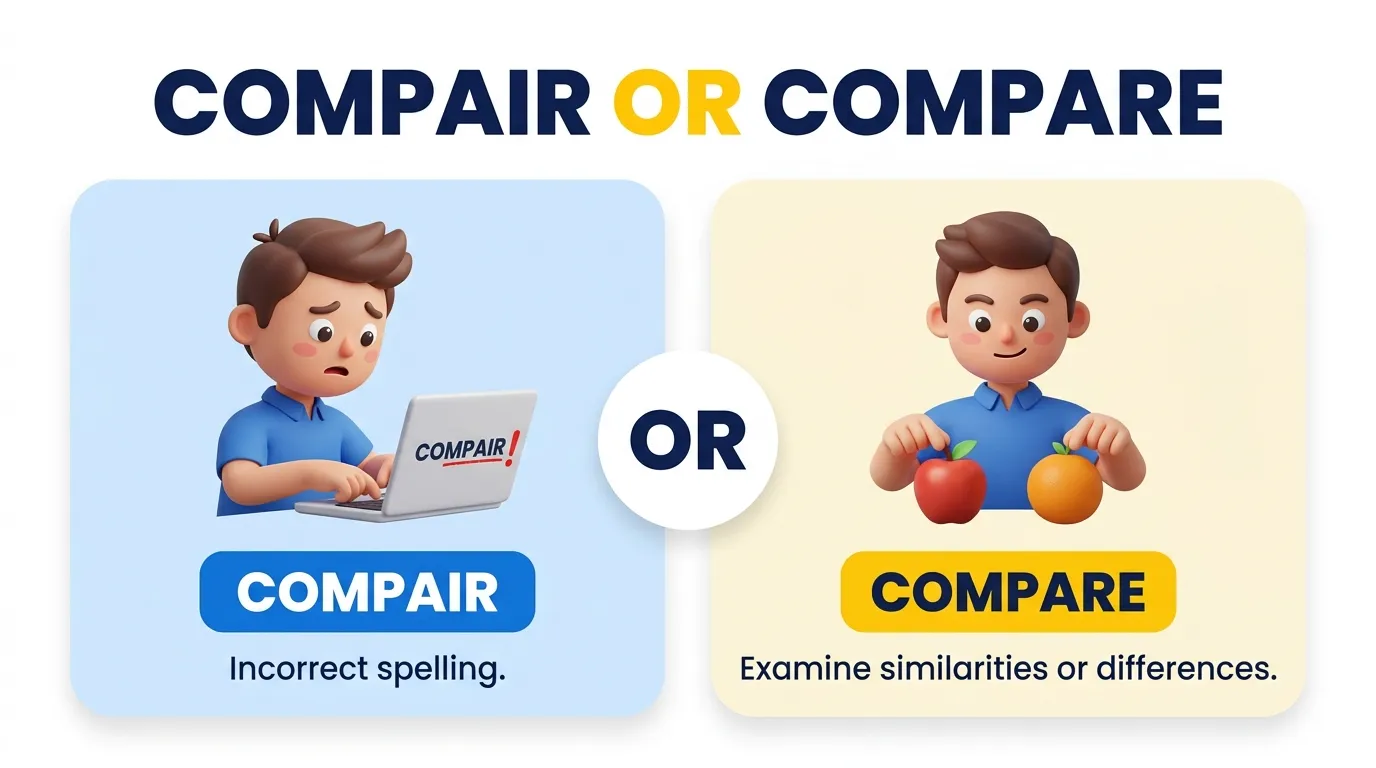
Compair or Compare: compare is the correct spelling. It means to look at two or more things and find their similarities or differences.
While writing an email, you type “Please compair these prices,” then that red spelling line appears under compair. The confusion is easy to understand because compare sounds like it ends with “pair.” However, the correct spelling is compare, not compair.
So, if you are writing an email, essay, report, or social post, choose compare. Once you learn the spelling pattern, this mistake becomes much easier to avoid.
Compair or Compare: Quick Answer
Compare is the correct spelling in standard English. Compair is a spelling mistake when you mean to examine two or more things.
For example:
- Correct: “Please compare the two prices.”
- Incorrect: “Please compair the two prices.”
Also, the same spelling stays in related forms such as compared, comparing, and comparison.
The Origin of Compair or Compare
The word compare has a long history. It comes from the Latin word comparare, which means to match or bring things together.
Over time, the word moved into French and then into English. The spelling settled around compar-, which is still seen in words such as comparison and comparable.
The spelling compair does not come from this word history. Instead, it likely feels natural because compare has a sound that is close to “pair.”
So, pronunciation can cause the mistake, but it does not change the spelling.
Compair or Compare Explained: Key Differences
The main difference is simple. Compare is the correct English word, while compair is an incorrect spelling when you mean “examine things side by side.”
| Term | Meaning | When to Use | Region/Context |
| Compare | Examine similarities or differences | Standard writing and speech | American and British English |
| Compair | Incorrect spelling of compare | Do not use for standard English | Not a standard regional form |
| Comparison | An examination of similarities or differences | When you need the noun form | American and British English |
| Compared | Past form of compare | When talking about a past comparison | American and British English |
| Comparing | -ing form of compare | When the action is happening | American and British English |
For example, you can say, “We need to compare the two plans.” However, you should not write, “We need to compair the two plans.”
The same rule applies in both American and British English. There is no standard British spelling called compair.
Which One Should You Use?
For most readers, the answer is easy: use compare.
- For students, use compare because it is the correct form in essays and assignments.
- For professionals, use compare because it is the standard spelling in emails, reports, and documents.
- For bloggers and writers, use compare because it keeps your writing clear.
- For social media, use compare when you mean to examine two things.
- For casual messages, use compare too, even though casual writing may contain more spelling errors.
In short, there is no normal English situation where compair should replace compare.
Common Mistakes with Compair or Compare
Several mistakes come from hearing the word instead of remembering how it is spelled.
Writing “compair” instead of “compare”
Mistake: “Can you compair these phones?”
Correction: “Can you compare these phones?”
This happens because the ending of compare sounds similar to “pair.”
Writing “compaired” instead of “compared”
Mistake: “We compaired the results.”
Correction: “We compared the results.”
Here, the wrong spelling carries over into the past form.
Writing “compairing” instead of “comparing”
Mistake: “She is compairing the two offers.”
Correction: “She is comparing the two offers.”
When compare takes -ing, the final e is dropped.
Confusing compare with pair
Pair is a real word. It means two things that belong together.
However, compare has a different meaning. It means to examine things to see how they are alike or different.
For example, “I bought a pair of shoes” is correct. Meanwhile, “I need to compare these shoes” is also correct.
Writing “compair” because it sounds right
English spelling does not always follow pronunciation. Therefore, a word may sound one way but use different letters when written.
Remember compare, comparison, and comparable. These words all help you remember the compar- spelling.
Compair or Compare in Real-World Examples
The correct spelling stays the same across different types of writing.
Professional Email
“Please compare the two quotes and let me know which one fits our needs.”
This sounds clear and professional.
News Headline
“Experts compare this year’s sales with last year’s results.”
Here, compare shows that two sets of information are being examined.
Social Media Post
“I tried both phones, so I can finally compare their cameras.”
The same spelling works in a casual post.
Formal Document
“The report compares the costs of both plans.”
In this sentence, compares is the correct third-person form.
Everyday Conversation
“Let’s compare our answers before we submit them.”
So, whether you are speaking casually or writing formally, compare remains the correct choice.
Compair or Compare: Data, Trends & Usage
The search intent behind compair or compare is mainly spelling-focused. People usually want a quick answer because they are unsure which form belongs in their writing.
Students may search the phrase while working on an assignment. English learners may check it while writing an email or message. Writers may also search it when a spelling checker flags compair.
The confusion is easy to explain because the spoken ending of compare can sound like “pair.” As a result, some people connect the sound with the spelling air.
That makes this a useful spelling topic because the searcher often needs the answer immediately. The clearest answer is still the same: use compare.
Compair vs Compare: Comparison at a Glance
| Term/Variant | Meaning | Region/Context | Best Used When |
| Compare | Examine similarities or differences | Standard English | Always use it for this meaning |
| Compair | Incorrect spelling | Nonstandard | Avoid it |
| Compared | Past form of compare | Standard English | Talking about a past comparison |
| Comparing | Present participle of compare | Standard English | Describing an ongoing comparison |
| Comparison | The act or result of comparing | Standard English | Referring to the comparison itself |
| Comparable | Similar enough to be compared | Standard English | Describing things that can be compared |
Frequently Asked Questions
Is compair or compare correct?
Compare is correct. Compair is an incorrect spelling when you mean to examine two or more things for similarities or differences.
What does compare mean?
Compare means to look at two or more things and see how they are similar or different. For example, you can compare prices, products, ideas, or test results.
Why do people spell compare as compair?
The mistake usually comes from pronunciation. Compare can sound like it ends with “pair,” so some people write compair instead.
Is compair accepted in formal writing?
No. Use compare in formal writing such as school assignments, business emails, reports, and applications.
Is compare spelled differently in British English?
No. Compare is the standard spelling in both British and American English. The word compair is not a normal regional spelling.
What is the past tense of compare?
The past tense is compared. For example, “We compared the two offers before choosing one.”
What is the difference between compare and comparison?
Compare is usually a verb, while comparison is a noun. For example, “We compare two products” and “We made a comparison of the two products.”
Final Thoughts on Compair or Compare
When choosing between compair or compare, remember that compare is the correct spelling. Use it when you want to examine two or more things and find their similarities or differences. The same compar- pattern appears in comparison, compared, and comparable.
Because the word sounds like it ends with “pair,” compair can look tempting. Still, that spelling is not the standard form. Whether you are writing a school paper, business email, report, or social post, choose compare.
Keep compare in mind whenever you need to put two things side by side. Then, you can write with confidence and avoid this common spelling mistake.
Curious about similar spelling mistakes? Explore Falter or Faulter.

I started writing about English word differences after years of teaching students who kept making the same mistakes. My focus is on making spelling rules feel simple and easy to remember. At WordsCombo, I turn confusing word pairs into clear comparisons.