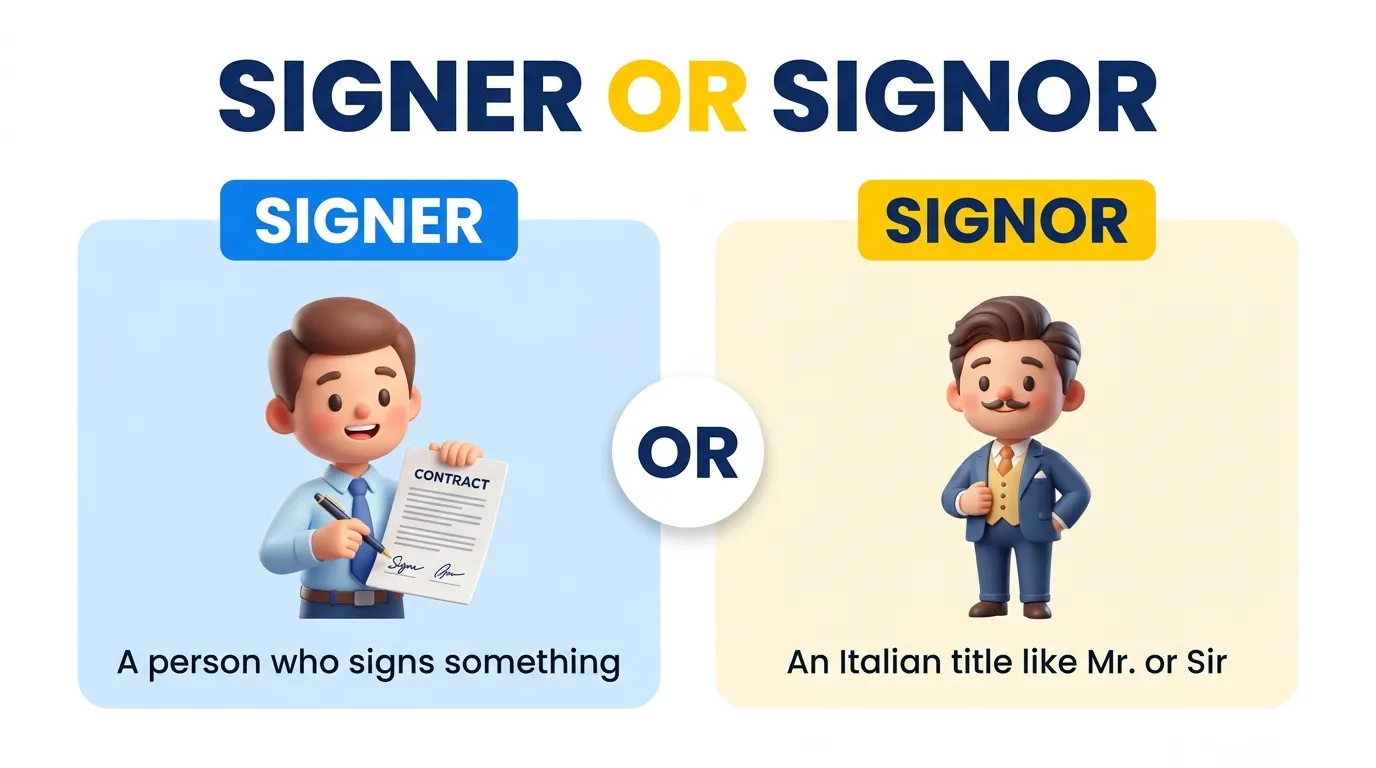
Signer means a person who signs something. Signor is an Italian title similar to “Mr.” or “Sir.”
You are filling out a contract when the red underline appears under signor. You meant the person who will sign the form, but the two words look so close that the choice feels easy to miss.
The difference is simple. Signer is used for someone who signs a document, check, form, or agreement. Signor is an Italian title for a man. Once you connect signer with the action “sign,” the choice becomes much easier.
Signer or Signor: Quick Answer
Signer is the right word when you mean a person who signs something. For example, “The signer must complete the form.”
Signor has a different meaning. It is a title used for a man in an Italian setting, similar to “Mr.” or “Sir.” For example, “Signor Rossi arrived early.”
The Origin of Signer or Signor
The word signer comes from the English verb sign. The ending -er often points to a person who does an action. So, a signer is simply a person who signs.
For example, a writer writes, a driver drives, and a signer signs. This makes the meaning fairly easy to remember.
Signor, however, comes from Italian. It is linked to the Italian title signore, which means “Mr.” or “Sir.” Therefore, it is not another spelling of signer.
Because both words start with sign, they can look like two forms of the same word. Still, their meanings are completely different.
Signer or Signor Explained: Key Differences
The easiest way to choose the right word is to look at the situation.
Signer is about an action. It describes someone who signs something. It can also describe a person who uses a sign language.
Signor is about a title. It is used before or with a man’s name in an Italian context.
| Term | Meaning | When to Use | Region/Context |
| Signer | A person who signs something | Contracts, forms, checks, letters, agreements | Standard English |
| Signor | An Italian title similar to Mr. or Sir | Addressing or referring to an Italian man | Italian or Italian-themed context |
| Signatory | A person or party that signs an official document | Formal agreements and legal writing | Formal English |
For example, “The signer of the contract must provide an ID” is correct.
On the other hand, “Signor Bianchi entered the room” uses the Italian title correctly.
Signer or Signor: Comparison at a Glance
| Term/Variant | Meaning | Region/Context | Best Used When |
| Signer | Someone who signs | English | Talking about signatures or signing |
| Signor | Italian title for a man | Italian context | Using an Italian form of address |
| Signatory | A person or party that signs an official document | Formal English | Discussing official agreements |
Which One Should You Use?
For most English writing about signatures, choose signer.
For contracts, use signer because it clearly means the person who signs the contract.
For bank forms and checks, use signer because the word relates to the person who signs or authorizes the transaction.
For general business writing, signer is also the natural choice.
For a formal agreement, signatory may fit better when you want a more formal term. However, signor is not a replacement for either word.
For an Italian man’s title, use Signor before his name. For example, “Good morning, Signor Romano.”
If the context is neutral and you mean someone who signs, signer is the safe choice.
Common Mistakes with Signer or Signor
Using signor for a person who signs
Mistake: The signor must sign the contract.
Correction: The signer must sign the contract.
This mistake happens because both words begin with “sign.” However, signor is a title, not the usual English word for a person who signs.
Writing contract signor
Mistake: The contract signor approved the terms.
Correction: The contract signer approved the terms.
A person who signs a contract is a contract signer. In formal writing, signatory can also work.
Writing check signor
Mistake: The check signor must approve the payment.
Correction: The check signer must approve the payment.
Here, the person is connected to the act of signing. So, signer fits the meaning.
Treating signor as a spelling mistake
Mistake: Signor is just a wrong spelling of signer.
Correction: Signor is a real word with a different meaning.
It is an Italian title. So, it can be correct when the context calls for that title.
Using signer before an Italian name
Mistake: Good morning, Signer Rossi.
Correction: Good morning, Signor Rossi.
In this sentence, the word is being used as a title. Therefore, Signor is the better choice.
Signer or Signor in Real-World Examples
Professional email
Please make sure every signer completes the form before Friday.
Here, signer means a person who needs to sign the form.
News headline
Signor Romano Opens a New Restaurant in Milan
In this headline, Signor works as an Italian title before a man’s name.
Social post
All signers must check their names before submitting the agreement.
Because the post talks about people signing an agreement, signers is correct.
Formal document
Each signer must provide a valid signature.
This sentence refers directly to the person who signs a document.
Italian setting
Signor Bianchi will meet us at the station.
Here, Signor is a respectful title for a man.
Signer or Signor: Data, Trends & Usage
The search intent behind signer or signor is mainly informational. People usually want to know which word fits a sentence and why the two words are different.
Business, banking, legal, and office writing creates much of the practical need for signer. People may see phrases such as “authorized signer,” “contract signer,” or “check signer” and want to confirm the spelling.
Meanwhile, signor matters more in Italian names, cultural writing, travel content, historical settings, and stories. The word can also appear when writers want to keep an Italian form of address.
The key insight is simple: this is not just a spelling choice. Signer and signor carry different meanings, so replacing one with the other can change the whole sentence.
FAQs About Signer or Signor
Is signer or signor correct?
Signer is correct when you mean a person who signs something. Signor is a separate word used as an Italian title for a man.
Is signor a misspelling of signer?
No, signor is not simply a misspelling of signer. It has a different meaning and is used as an Italian title similar to “Mr.” or “Sir.”
Should I use signer in a legal document?
Yes, signer is suitable when you mean a person who signs a document. However, signatory may also be used when a more formal term is needed.
What is the difference between signer and signatory?
A signer is someone who signs something. A signatory usually refers to a person or party that has formally signed an agreement or official document.
Is signor correct in English writing?
Yes, signor can appear in English writing when an Italian title is intended. It is not the normal word for someone who signs a document.
What does signor mean in Italian?
Signor is an Italian title similar to “Mr.” or “Sir.” It is used when addressing or referring to a man, often before his name.
Which word should I use for someone who signs a contract?
Use signer. For example, “The signer must review the contract before signing it.”
Final Thoughts on Signer or Signor
The main difference between signer or signor is easy to remember. A signer is a person who signs something, while Signor is an Italian title for a man.
For contracts, checks, forms, agreements, and signatures, choose signer. If you are addressing an Italian man or writing in an Italian setting, Signor may be the right choice. Also, remember signatory when a more formal word for a person who signs an official agreement is needed.
Keep one short rule in mind: a signer signs, while a Signor is a title. Save that rule, and you will be much less likely to mix up these two words. Keep reading our word guides to make tricky English choices easier.
Curious about similar words? Explore Wich or Witch.

I have been working with English language content for over six years. I specialize in word comparisons and spelling differences that most people overlook. At WordsCombo, I help readers choose the right word every time.