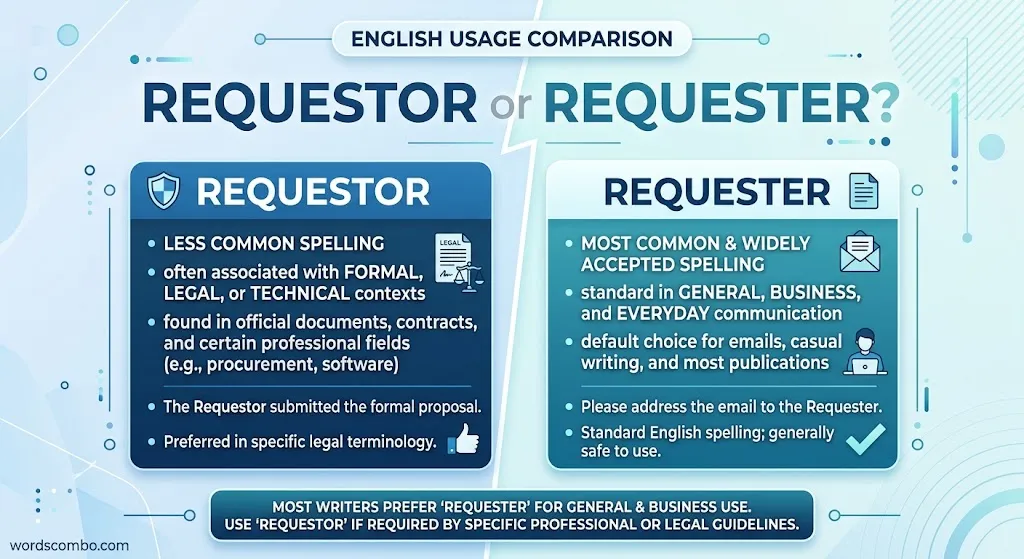
Both “requestor” and “requester” are correct. “Requester” is the better default for general and professional writing, while “requestor” is also used in legal, administrative, and technical contexts.
You’re writing an email, report, support message, or application when you pause over requestor or requester. Both forms look right, and both refer to someone who makes a request, so the choice can feel unclear. The difference is mainly about usage and preference, not meaning. In most everyday American English, requester is the more natural choice. Requestor remains a valid alternative, especially when you are following established terminology in a legal, administrative, or technical setting.
Why the Confusion Happens
The confusion comes from two accepted ways of forming a noun for someone who performs an action.
Requester follows the familiar -er pattern:
- request → requester
- teach → teacher
- write → writer
- manage → manager
Requestor uses the -or ending found in words such as actor, operator, and administrator.
Because both forms are established, you cannot treat requestor as a simple spelling mistake. The two words have essentially the same meaning. The main question is which form sounds more natural for your audience and situation.
This is also not a strict British English versus American English spelling difference. You should not assume that requestor is British and requester is American. Both forms can appear in different varieties of English.
For most readers, especially in everyday American writing, requester is the clearer default.
Meanings
Requester
A requester is a person, customer, employee, organization, or system user who makes a request.
You might use it when someone asks for information, access, approval, assistance, a service, or another action.
Examples include:
- The requester asked for additional information.
- Each requester receives a confirmation email.
- The requester must complete the application.
- We contacted the requester for clarification.
If you’re writing a general email, report, website, or customer service message, requester will usually feel natural.
Requestor
A requestor also means someone who makes a request.
The meaning does not substantially change from requester. However, requestor may feel more formal or specialized because it appears in some legal, administrative, organizational, and technical terminology.
For example:
- The requestor must submit the required documents.
- The system records the requestor’s information.
- The requestor may appeal the decision.
- The department contacted the requestor.
If a particular organization, form, software system, or legal document consistently uses requestor, keeping that terminology is often the best choice.
Correct Usage Examples
Requester in General Writing
- The requester will receive an email after the form is processed.
- Please contact the requester if you need more information.
- The customer became the requester after submitting the service request.
- Each requester must provide a valid email address.
Requester works especially well when you’re writing for a broad audience. It is familiar, straightforward, and easy to understand.
Requestor in Specialized Writing
- The requestor must provide all required documentation.
- The system automatically records the requestor of each access request.
- The requestor may submit an appeal within 30 days.
- The department notified the requestor of the final decision.
Requestor is also valid. If you encounter it in a technical system, official procedure, or specialized document, you do not need to assume it is misspelled.
Memory Trick
Think of the -er ending as your everyday default.
Request + er = requester
If you’re writing an ordinary email, article, report, customer message, or general business document, requester is usually the easiest choice.
For requestor, remember “official requestor.” The less common -or form may appear when the language is tied to a formal process, organization, legal document, or technical system.
The trick is not that requestor is wrong. It is that requester is your safer general-purpose choice.
Common Mistakes
Mistake 1: Calling Requestor Incorrect
| Mistake | Correction |
| “Requestor is always wrong.” | Requestor is correct, but less common in general writing. |
This mistake happens because requester is more familiar to many readers. Seeing requestor in a document can therefore look like a spelling error even when it is intentional.
Mistake 2: Assuming Requestor Means Something Different
| Mistake | Correction |
| “A requestor and requester are different types of people.” | Both words normally refer to someone who makes a request. |
The two forms do not normally represent different roles. The difference is mainly usage, style, and context.
Mistake 3: Treating It as a US vs UK Rule
| Mistake | Correction |
| “Requester is American, while requestor is British.” | Both forms can be used in both varieties of English. |
This confusion comes from the many genuine British-American spelling pairs in English. Requestor and requester do not fit that pattern neatly.
Mistake 4: Switching Forms Randomly
| Mistake | Correction |
| “The requester submitted the form. The requestor received an email.” | Choose one form and use it consistently unless a fixed term requires otherwise. |
Switching between forms can make your writing look inconsistent. If your document uses requester, stay with it throughout.
Mistake 5: Choosing the More Formal-Looking Word Automatically
| Mistake | Correction |
| “Requestor sounds more official, so it must be better.” | Use requester unless your context or terminology calls for requestor. |
Formal-looking language is not always clearer. Your goal should be accurate, natural communication.
Requestor or Requester in Real-World Examples
Professional Email
If you’re writing to a coworker or customer, requester is usually the smoother choice.
The requester has provided the information needed to process the application.
It sounds professional without making the sentence unnecessarily formal.
Workplace Report
In a report, either word can work. If your organization already uses one form in its procedures, follow that established wording.
The requester submitted three applications during the reporting period.
Consistency matters more than trying to make the sentence sound formal.
Technical System
Technical platforms sometimes use requestor as part of their established terminology.
The requestor’s account was verified before access was granted.
If you’re documenting an existing system, keep the terminology used by that system rather than changing it simply because requester is more familiar.
Legal or Administrative Document
A formal process may use requestor as its preferred label.
The requestor must submit the completed form before the review can begin.
Here, the terminology may be tied to the document or process itself. If you’re drafting such material, consistency with the relevant terminology is important.
Requester vs Requestor at a Glance
| Word | Status/Context | Why | Example |
| Requester | General and professional writing | More familiar and natural for most readers | The requester submitted the form. |
| Requestor | Legal, administrative, technical, or specialized contexts | Valid alternative that may fit established terminology | The requestor must provide documentation. |
The simplest rule is this: choose requester when you have no special reason to use requestor.
If you’re working inside a system or organization that already uses requestor, follow that terminology. You do not need to “correct” it to requester merely because it is less common.
Similar Word Pairs to Watch For
Adviser or Advisor
You’ll also see adviser and advisor, both of which are established forms. The preferred choice can depend on the organization, profession, or style being followed.
If you’re writing for a company with a fixed title such as financial advisor, keep its official wording consistent.
Canceled or Cancelled
This pair can cause a different kind of confusion because regional spelling plays a role. Canceled is common in American English, while cancelled is widely used in British English.
Unlike requester/requestor, this is a genuine regional spelling distinction.
Traveler or Traveller
The same pattern appears with traveler and traveller. American English generally uses one l, while British English commonly uses two.
This is a useful reminder that not every pair ending in a similar way represents the same type of spelling issue.
Submitter or Requester
These words can overlap in some contexts, but they are not exact substitutes.
A requester makes a request. A submitter is someone who submits something, such as a form, document, entry, or application.
Choose the word that describes the person’s actual role.
Applicant or Requester
An applicant usually asks to be considered for something, such as a job, program, permit, or admission.
A requester has a broader meaning. The person could simply be asking for information, access, assistance, or a service.
Origin/Background
Both forms are built from the verb request, which comes from a long-established English word meaning to ask for something.
English commonly creates nouns for people who perform actions by adding -er. That pattern gives us requester, just as write gives us writer and teach gives us teacher.
English also has many nouns ending in -or, especially words shaped by Latin and French influence. That broader pattern helps explain why requestor exists alongside requester.
The result is a pair with the same basic meaning but different levels of familiarity. Requester fits ordinary modern usage more naturally, while requestor remains established in certain formal and specialized settings.
Mini FAQ
Is requestor or requester correct?
Both are correct. Requester is generally the better default for everyday and professional writing, while requestor can be appropriate in specialized contexts.
Is requestor a misspelling of requester?
No. Requestor is an accepted word, not simply a typing mistake. It has the same basic meaning as requester.
Which is more common, requestor or requester?
Requester is generally more common in general English. It is the safer choice when you’re writing for a broad audience and have no required terminology to follow.
Should I use requester in a professional email?
Yes. Requester is a natural choice for professional emails, workplace communication, customer service, and general business writing.
For example: “The requester will receive an update by Friday.”
Is requestor used in legal writing?
It can be. Requestor appears in some legal, administrative, and formal terminology. If the document or organization already uses requestor, consistency is usually more useful than changing the established term.
Is requester American English?
No. Requester is not exclusively American English. It can be used in different varieties of English, so you should not treat requester and requestor as a simple American-British spelling pair.
What is the plural of requester and requestor?
The plural forms are requesters and requestors.
For example: “Several requesters submitted applications” and “The system records all requestors.”
Conclusion
Both requester and requestor are correct, but requester is the best general choice. Use it for most emails, reports, websites, customer communication, and everyday professional writing.
Keep requestor when it is part of established legal, administrative, or technical terminology. For more guidance on spelling and word usage, visit the Wordscombo Spelling and Word Usage section, and explore related guides such as Compliment or Complement and Fewer or Less.

I have been working with English language content for over six years. I specialize in word comparisons and spelling differences that most people overlook. At WordsCombo, I help readers choose the right word every time.