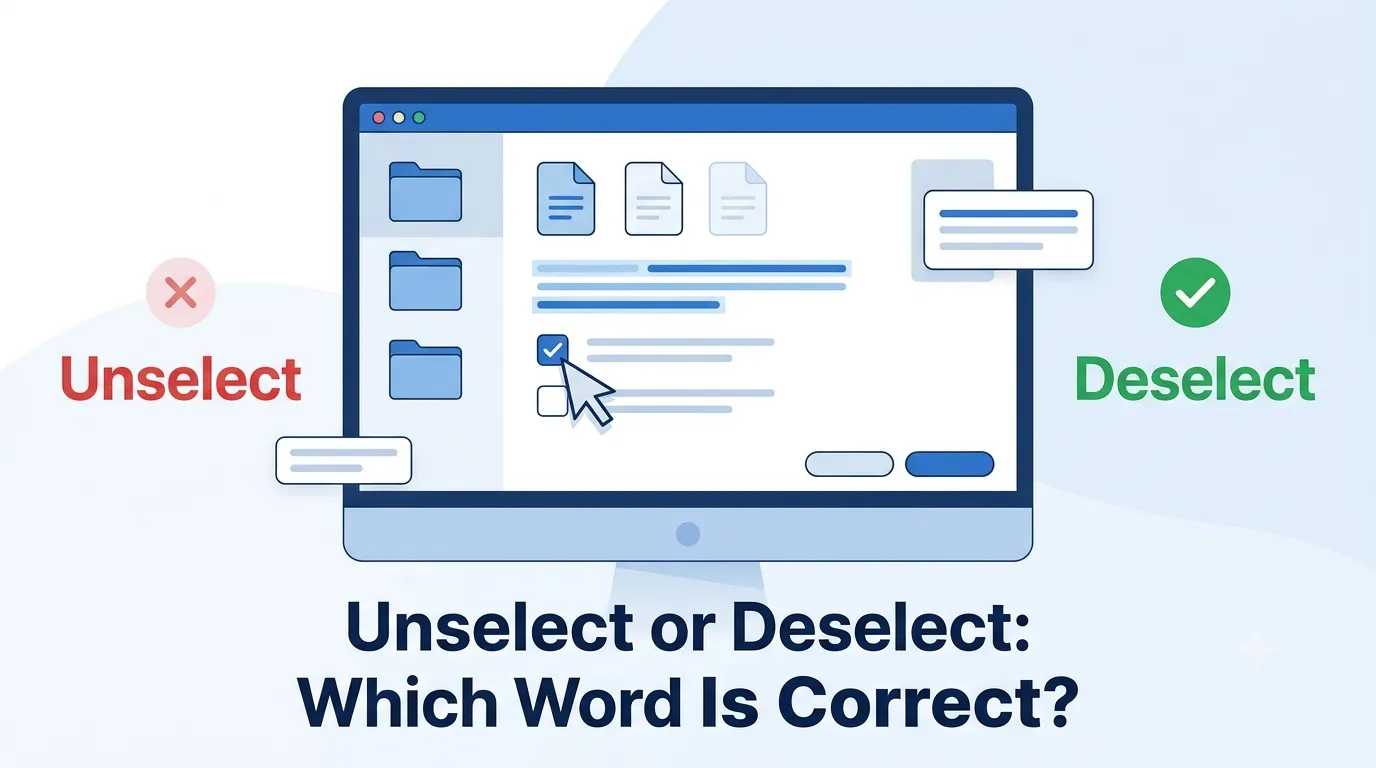
Unselect and deselect both mean to remove a selection. Deselect is the standard and most widely accepted term in software, while unselect appears in some applications but is much less common.
A few years ago, I was reviewing a software guide before it went live. Everything looked great until I noticed one instruction: “Click here to unselect the file.” It sounded a little strange. Most software I had used always said “deselect.”
That small detail started an interesting discussion with editors, developers, and technical writers. Was unselect actually wrong? Or was it simply less common?
If you have searched for “unselect or deselect,” you probably had the same question. Maybe you’re writing documentation, creating a website, building an app, or simply trying to choose the right word.
The good news is that the answer is simple once you understand how both words are used.
By the end of this guide, you’ll know which word sounds more natural, when each one is acceptable, and how to avoid a mistake that makes writing look less professional.
Unselect or Deselect: Quick Answer
Deselect is the preferred word in English. It means to remove a selected item from a list, document, or computer interface.
Unselect has the same basic meaning, but it is far less common. Some software products use it, but most style guides and technical writers recommend deselect.
Examples
- Click the checkbox to deselect the item.
- Press Ctrl and click to deselect multiple files.
Less common:
- Click here to unselect the item.
The Origin and Background of Unselect and Deselect
The word select comes from the Latin word selectus, meaning “chosen.”
English often creates opposite meanings by adding prefixes.
- De usually means remove, reverse, or undo.
- Un usually means not or reverse, depending on the word.
Because de commonly describes removing an action, deselect became the natural choice in computing.
As graphical user interfaces became popular during the 1980s and 1990s, software companies used deselect in menus, manuals, and help documents. Over time, it became the industry standard.
Some developers still use unselect, especially in internal tools or code, but it is much less common in user facing writing.
Unselect or Deselect Explained
Both words describe the same action.
They simply differ in popularity and style.
| Term | Meaning | When to Use | Region/Context |
|---|---|---|---|
| Deselect | Remove a selection | Software, documentation, websites | Worldwide standard |
| Unselect | Remove a selection | Rare interfaces or informal writing | Limited usage |
Example 1
You selected five files.
You click one again.
You deselect that file.
Example 2
You highlight text.
You click elsewhere.
The text becomes deselected.
Which Version Should You Use?
Your audience matters.
For Students
Use deselect.
It matches dictionaries and modern software.
For Technical Writers
Always choose deselect.
Readers expect this wording.
For Developers
Use deselect in documentation and UI labels.
Only use unselect if it matches existing software terminology.
For Global Audiences
Choose deselect.
It is understood almost everywhere English is used.
Recommendation: If you’re unsure, always write deselect.
Common Mistakes with Unselect or Deselect
Here are mistakes people often make.
| Mistake | Better Choice | Why |
|---|---|---|
| Unselect the checkbox. | Deselect the checkbox. | Standard English usage. |
| Please unselect all files. | Please deselect all files. | More natural in documentation. |
| The item is unselected. | The item is deselected. | Preferred software wording. |
| Mixing both words together | Choose one term | Keeps writing consistent. |
Why do these mistakes happen?
- People assume adding un always creates the opposite.
- Some apps use unselect, which causes confusion.
- Writers copy wording from older software.
Unselect or Deselect in Real World Examples
Professional Email
Please deselect the completed tasks before submitting the final report.
News Headline
New Software Update Lets Users Deselect Multiple Files Faster
Social Media Post
Tip: Hold Ctrl while you deselect items one by one.
Formal Report
Users were able to deselect records without affecting other selections.
Unselect or Deselect: Data, Trends & Usage
Search behavior shows that many people look for the difference between these two words because they see both in software.
Search Intent
Informational
People want to know which word is correct.
Who Searches Most?
- Students
- Technical writers
- Software developers
- UI designers
- English learners
Why Does It Matter Today?
More people write software guides, tutorials, and app interfaces than ever before.
Using the standard term makes instructions easier to understand and builds trust with readers.
Comparison Table
| Term/Variant | Meaning | Region/Context | Best Used When |
|---|---|---|---|
| Deselect | Remove a selected item | Global English | Nearly every situation |
| Unselect | Remove a selected item | Rare software usage | Only if matching existing software wording |
| Select | Choose an item | Universal | Making a selection |
| Clear Selection | Remove all selected items | Software interfaces | When removing every selection |
Frequently Asked Questions
Q: What does unselect or deselect mean?
Both mean removing a selected item. The preferred English word is deselect.
Q: How do you use deselect correctly?
Use it whenever you remove a selected file, checkbox, image, or piece of text.
Q: Unselect vs deselect what’s the difference?
Their meanings are almost identical. The main difference is that deselect is the accepted standard.
Q: Is unselect wrong?
Not exactly. It is understood by many people, but it sounds less natural and is rarely recommended in professional writing.
Q: Which version is correct for formal writing?
Choose deselect. Most editors, dictionaries, and software documentation use it.
Q: Where does deselect come from?
It combines the prefix de, meaning “remove” or “reverse,” with select.
Q: Can I use unselect in software documentation?
You can if your product already uses it consistently. Otherwise, deselect is the better choice.
Conclusion
Choosing between unselect and deselect is easier than it first appears.
Remember these key points:
- Deselect is the standard English word.
- Unselect has the same meaning but is much less common.
- Professional writers almost always choose deselect.
- Consistency matters, especially in software documentation and user guides.
When you use the familiar word, readers understand your instructions faster. That creates a smoother experience and makes your writing look polished.
The next time you write about checkboxes, files, menus, or selected text, you can confidently choose deselect.
Bookmark this guide so you never second guess “unselect or deselect” again, and share it with anyone who writes software documentation or technical content.

I have been working with English language content for over six years. I specialize in word comparisons and spelling differences that most people overlook. At WordsCombo, I help readers choose the right word every time.