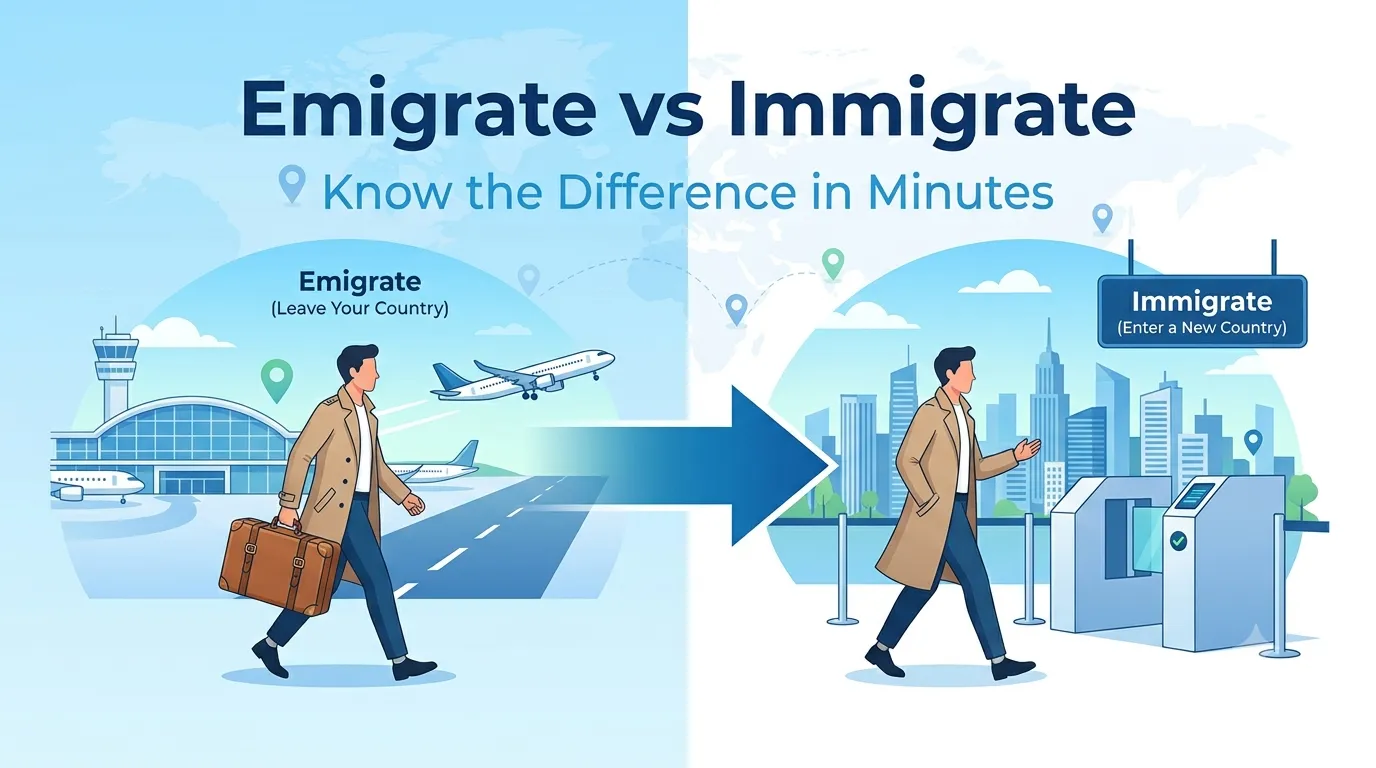
🌍 Emigrate means to leave your home country to live somewhere else, while 🏡 immigrate means to move into a new country to live there. Easy trick: 🚪 Emigrate = Exit, ➡️ Immigrate = Inter.
A few years ago, I edited an article written by a bright student. The story was great, but one sentence caught my eye: “My family immigrated from Canada.” I knew exactly what they meant, but the word was wrong. They should have written “emigrated from Canada.”
That small mistake is very common. I have seen it in school papers, business emails, blog posts, and even news articles. Many people know the two words are related, yet they are never sure which one fits.
The confusion happens because both words describe moving from one country to another. The difference is not the move itself. It is the direction you are looking at.
By the end of this guide, you will know the exact meaning of emigrate or immigrate, understand the difference, avoid common mistakes, and feel confident using both words in everyday writing and conversation.
Emigrate or Immigrate
The easiest way to remember the difference is this:
- Emigrate = Exit your country
- Immigrate = Into another country
Example 1
Maria emigrated from Brazil.
Maria immigrated to Canada.
Both sentences describe the same move. They simply use different viewpoints.
Example 2
Ahmed emigrated from Egypt.
Ahmed immigrated to Germany.
Think of emigrate as focusing on where someone leaves.
Think of immigrate as focusing on where someone arrives.
The Origin Background of Emigrate or Immigrate
Both words come from the Latin word migrare, which means to move.
The prefixes tell the story.
- E or ex means out of.
- Im means into.
That is why:
- Emigrate means move out of a country.
- Immigrate means move into a country.
Many English learners mix them up because the action is exactly the same. Only the perspective changes.
Governments also use these words differently.
A country often talks about immigration because it focuses on people entering.
Someone leaving their homeland usually talks about emigration because the focus is on departure.
Emigrate or Immigrate Explained: Key Differences
Although these words look alike, they serve different purposes.
| Term | Meaning | When to Use | Region/Context |
|---|---|---|---|
| Emigrate | Leave your own country | Talking about departure | Used worldwide |
| Immigrate | Enter another country | Talking about arrival | Used worldwide |
| Migration | General movement of people | Neutral discussions | Global |
| Migrant | A person who moves | General term | International |
Easy Examples
✅ She emigrated from India.
✅ She immigrated to Australia.
✅ Thousands of people migrate every year.
Notice how the first sentence looks backward while the second looks forward.
Which Version Should You Use?
Choosing the right word becomes simple once you know what you are describing.
For Students
Use emigrate when explaining where someone left.
Example:
“My grandparents emigrated from Italy.”
For Journalists
Use immigrate when reporting people entering a country.
Example:
“Thousands immigrated to Canada last year.”
For Business Writers
Think about your audience.
If discussing workers arriving, use immigrate.
If discussing workers leaving, use emigrate.
For Everyday Conversation
Ask yourself one question.
Am I talking about leaving or arriving?
- Leaving → Emigrate
- Arriving → Immigrate
That simple trick works almost every time.
Common Mistakes with Emigrate or Immigrate
Here are mistakes people often make.
| Mistake | Correct Version | Why It Happens |
|---|---|---|
| He immigrated from Spain. | He emigrated from Spain. | Focus should be on leaving. |
| She emigrated to Canada. | She immigrated to Canada. | Focus should be on arriving. |
| They immigrated out of France. | They emigrated from France. | Wrong direction. |
| He emigrated into America. | He immigrated to America. | Wrong viewpoint. |
| Immigration means leaving. | Immigration means entering. | Meanings are confused. |
Quick Memory Trick
E = Exit
I = Into
Most learners remember the words after learning this simple shortcut.
Emigrate or Immigrate in Real World Examples
Professional Email
“I recently immigrated to New Zealand and would like to update my employment records.”
News Headline
“More families emigrate from rural areas in search of better opportunities.”
Social Media Post
“After years of planning, we finally immigrated to Australia. Excited for our new chapter!”
Formal Report
“The report examines why skilled workers emigrate from developing nations each year.”
Each example matches the correct viewpoint.
Emigrate or Immigrate: Data, Trends & Usage
The topic attracts millions of online searches every year.
People usually search it because they:
- Write essays.
- Prepare for English exams.
- Fill out immigration forms.
- Apply for visas.
- Move abroad.
Search Intent
Primary Intent: Informational
Readers simply want to know which word is correct.
Regions with High Interest
- United States
- Canada
- United Kingdom
- Australia
- India
- Pakistan
- Philippines
These countries see strong interest because many people study English or move internationally.
Why It Matters Today
Global travel, remote work, and international education have become more common. As more people move across borders, understanding the difference between emigrate and immigrate becomes even more useful.
Standalone Comparison Table
| Term/Variant | Meaning | Region/Context | Best Used When |
|---|---|---|---|
| Emigrate | Leave your home country | Worldwide | Talking about departure |
| Immigrate | Enter a new country | Worldwide | Talking about arrival |
| Migration | General movement | Global | General discussions |
| Immigration | Entry into a country | Government, legal | Arrival policies |
| Emigration | Leaving a country | Government, legal | Departure statistics |
Frequently Asked Questions
Q: What does emigrate or immigrate mean?
A: Emigrate means leaving your country. Immigrate means entering another country to live there.
Q: How do you use emigrate correctly?
A: Use emigrate when talking about where someone left. Example: “They emigrated from Mexico.”
Q: How do you use immigrate correctly?
A: Use immigrate when talking about the country someone entered. Example: “They immigrated to Canada.”
Q: Emigrate vs immigrate: what’s the difference?
A: The difference is perspective. Emigrate focuses on leaving. Immigrate focuses on arriving.
Q: Is immigrate acceptable in formal writing?
A: Yes. It is widely used in legal documents, newspapers, government reports, and academic writing.
Q: Which version is correct emigrate or immigrate?
A: Both are correct. The right choice depends on whether you are describing departure or arrival.
Q: Can these words be used in everyday conversation?
A: Absolutely. Native English speakers use both words when discussing moving between countries, although many also use the broader word move in casual speech.
Conclusion
The difference between emigrate or immigrate is much easier than it first appears. Both words describe the same journey, but they look at it from opposite directions. Emigrate means leaving one country. Immigrate means entering another.
Remember the simple trick: E = Exit and I = Into. That tiny memory aid can save you from one of the most common English mistakes.
Whether you are writing an essay, completing immigration paperwork, preparing for an English exam, or simply talking about someone’s life story, choosing the correct word makes your writing clearer and more professional.
Now you know exactly how to use emigrate and immigrate with confidence. Bookmark this guide so you never second guess these words again, and share it with someone who has been confused by them.
Read more: Discreet or Discrete: The Complete Guide to Using the Right Word

I have been working with English language content for over six years. I specialize in word comparisons and spelling differences that most people overlook. At WordsCombo, I help readers choose the right word every time.