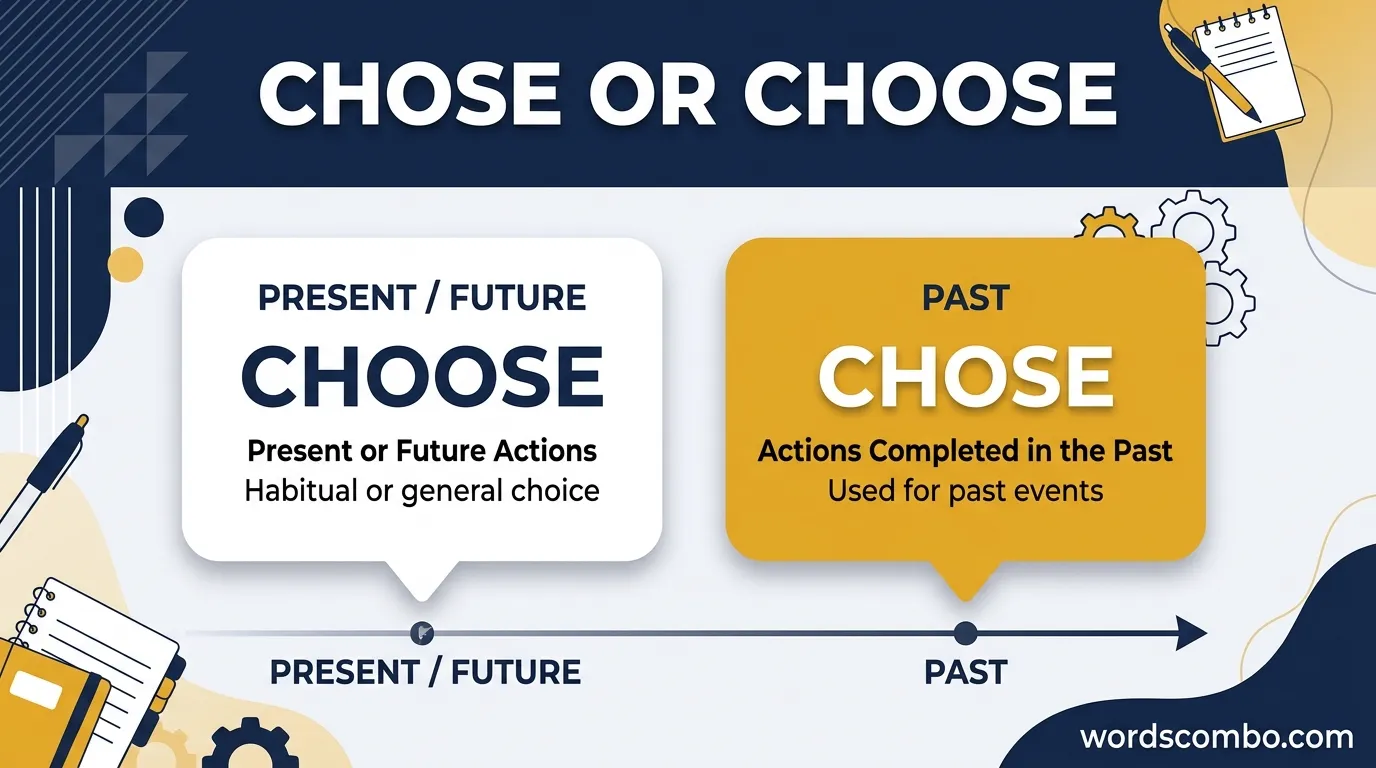
Choose is the present or base form of the verb. Chose is the past form. Use choose for a current or future choice, and chose for a choice that already happened.
You are writing an email when you stop before sending it. Should you write “I chose the blue option” or “I choose the blue option”? Both words look very similar, so this mistake is easy to make.
The difference between chose or choose is mainly about verb tense. Both words describe making a decision, but they show when that decision happens.
For example, “I choose the red one” describes a choice you make now. However, “I chose the red one yesterday” describes a choice you made in the past.
This small grammar point matters in school work, emails, social posts, and daily conversations. Using the wrong form can make a clear sentence sound incorrect.
Luckily, the rule is simple. Once you connect each word with time, you can quickly tell which one belongs in your sentence.
This guide explains when to use each form, shows common mistakes, and gives simple examples. You will also learn how choose, chose, and chosen work together.
Chose or Choose: Quick Answer
Choose is the present or base form of the verb.
- I choose tea every morning.
- You can choose any seat.
- We will choose a winner tomorrow.
Chose is the simple past form.
- I chose tea yesterday.
- She chose the blue dress.
- They chose the safest option last week.
A simple rule is:
Choose = now or later
Chose = already happened
There is also a third form, chosen. It is the past participle, as in “I have chosen the blue one.”
The Origin and Background of Chose or Choose
Choose has a long history in English. It comes from an Old English verb linked to selecting something from different options.
Over time, English developed different forms of the verb for different tenses. Modern English still uses this pattern:
choose → chose → chosen
Unlike regular verbs such as “walk,” the past form does not end in -ed.
For example:
- walk → walked
- play → played
- choose → chose
Therefore, choosed is not the standard past form.
The spelling may seem strange at first. Still, learning all three forms together makes the pattern much easier to remember.
Chose or Choose Explained: Key Differences
The main difference is the time of the action.
| Term | Meaning | When to Use | Example |
| Choose | Select or decide | Present, general, or future | I choose this option. |
| Chose | Selected or decided | Simple past | I chose this option yesterday. |
| Chosen | Selected or decided | Past participle with helping verbs | I have chosen this option. |
Choose
Use choose for the present or base form.
I choose honesty over convenience.
You also use it after words such as will, can, and should.
I will choose the restaurant tonight.
You can choose any color.
Chose
Use chose when the decision happened in the past.
She chose the window seat yesterday.
We chose the cheaper option last month.
The choice is finished, so the simple past form is correct.
Chosen
Do not confuse chose with chosen.
Use chosen with helping verbs such as have, has, or had.
I have chosen a new topic.
She has chosen the final design.
They had chosen their seats before the show began.
Which Version Should You Use?
The right form depends on when the choice happens.
- For U.S. English: Use choose for present or future actions and chose for completed past actions.
- For British English: Use the same rule. The tense does not change by region.
- For formal writing: Pick the form that matches the tense.
- For casual writing: The same grammar rule applies.
- For future decisions: Use choose, often after “will.”
For example:
I will choose the final design tomorrow.
Not:
I will chose the final design tomorrow.
After will, use the base form choose.
Common Mistakes with Chose or Choose
1. Using “choose” for a past action
Wrong: “I choose the red shirt yesterday.”
Correct: “I chose the red shirt yesterday.”
The word “yesterday” shows that the action happened in the past.
2. Using “chose” after “will”
Wrong: “She will chose a new topic tomorrow.”
Correct: “She will choose a new topic tomorrow.”
After will, use the base form choose.
3. Using “chose” after “have”
Wrong: “I have chose the best option.”
Correct: “I have chosen the best option.”
After have, you need the past participle chosen.
4. Writing “choosed”
Wrong: “They choosed the larger room.”
Correct: “They chose the larger room.”
Choose is an irregular verb. Therefore, its simple past form is chose, not “choosed.”
5. Confusing “chooses” with “choses”
Wrong: “She choses the same seat every day.”
Correct: “She chooses the same seat every day.”
For he, she, and it, the present form is chooses.
Chose or Choose in Real-World Examples
The correct form can change depending on when the choice happens.
Professional Email
We chose your proposal after reviewing the available options.
The decision has already been made.
For a future decision, write:
We will choose the final proposal tomorrow.
Headline
Customers Choose Flexible Payment Options
Here, choose describes a general or current action.
Social Post
I chose peace over another argument.
The choice happened in the past.
For a general statement, write:
I choose peace every day.
Formal Document
The committee chose the most practical solution.
The committee already made the decision.
Everyday Conversation
Which movie will you choose?
Or:
I chose the comedy last night.
The first sentence refers to a future choice. In contrast, the second refers to a past choice.
Chose or Choose: Data, Trends and Usage
The main search intent behind this phrase is grammar help. People often search for it when they are unsure which verb form belongs in a sentence.
This confusion is easy to understand because choose and chose look and sound similar. However, they have different forms and uses.
Learners often look up this pair while writing:
- School assignments
- Emails
- Work documents
- Social media posts
- Text messages
- English exercises
Another common question involves chosen. Many learners know that chose refers to the past, but they may use it where chosen is needed.
The easiest way to learn the full pattern is:
Choose → Chose → Chosen
Once you know the job of each form, most sentences become much easier to write.
Chose or Choose: Comparison at a Glance
| Term/Variant | Meaning | Region/Context | Best Used When |
| Choose | Select or decide | American and British English | Present, general, or future actions |
| Chose | Selected or decided | American and British English | Completed past actions |
| Chosen | Selected or decided | American and British English | With have, has, or had |
| Choosed | Not the standard form | Avoid in standard English | Never use as the past form |
A quick test can help. Ask yourself, “Has the choice already happened?”
If the answer is yes, chose is usually correct.
If the choice is happening now, happens often, or will happen later, choose is usually correct.
Frequently Asked Questions About Chose or Choose
What does chose or choose mean?
Choose means to select or decide between options. Chose has the same basic meaning, but it describes a completed past action.
Which form is correct, chose or choose?
Both are correct. Use choose for present, general, or future actions. Use chose for completed actions in the past.
Is choose present or past tense?
Choose is the base form and is used for present actions. It can also appear in future sentences, such as “I will choose.”
Is chose the past tense of choose?
Yes. Chose is the simple past form of choose.
For example:
I choose the blue one today.
I chose the blue one yesterday.
Can I say “I will chose”?
No. After will, use the base form choose.
The correct sentence is:
I will choose the blue one tomorrow.
Is “choosed” a correct word?
No. Choosed is not the standard past form of “choose.” The correct simple past form is chose.
What is the difference between chose and chosen?
Chose is the simple past form and can stand alone.
She chose the blue dress.
Chosen is the past participle and normally appears with a helping verb.
She has chosen the blue dress.
Final Thoughts on Chose or Choose
The difference between chose or choose becomes easy when you focus on time.
Use choose when the action happens now, happens regularly, or will happen later. For example, “I choose tea every morning” describes a habit, while “I will choose tomorrow” describes a future decision.
Use chose when the decision already happened. “I chose the blue shirt yesterday” clearly places the action in the past.
There is one more form to remember: chosen. Use it with helping verbs such as “have,” “has,” and “had.” For example, “I have chosen the final option.”
So, remember this pattern: choose → chose → chosen. It can help you avoid common mistakes such as “choosed” and “will chose.”
The next time you are unsure, ask yourself when the choice happened. That simple question will often give you the right answer.
With a little practice, these three forms become easy to use. You can then write emails, assignments, and everyday messages with more confidence.
Want to improve your English further? Explore common grammar and word-choice mistakes next Loose or Lose.

I have been working with English language content for over six years. I specialize in word comparisons and spelling differences that most people overlook. At WordsCombo, I help readers choose the right word every time.