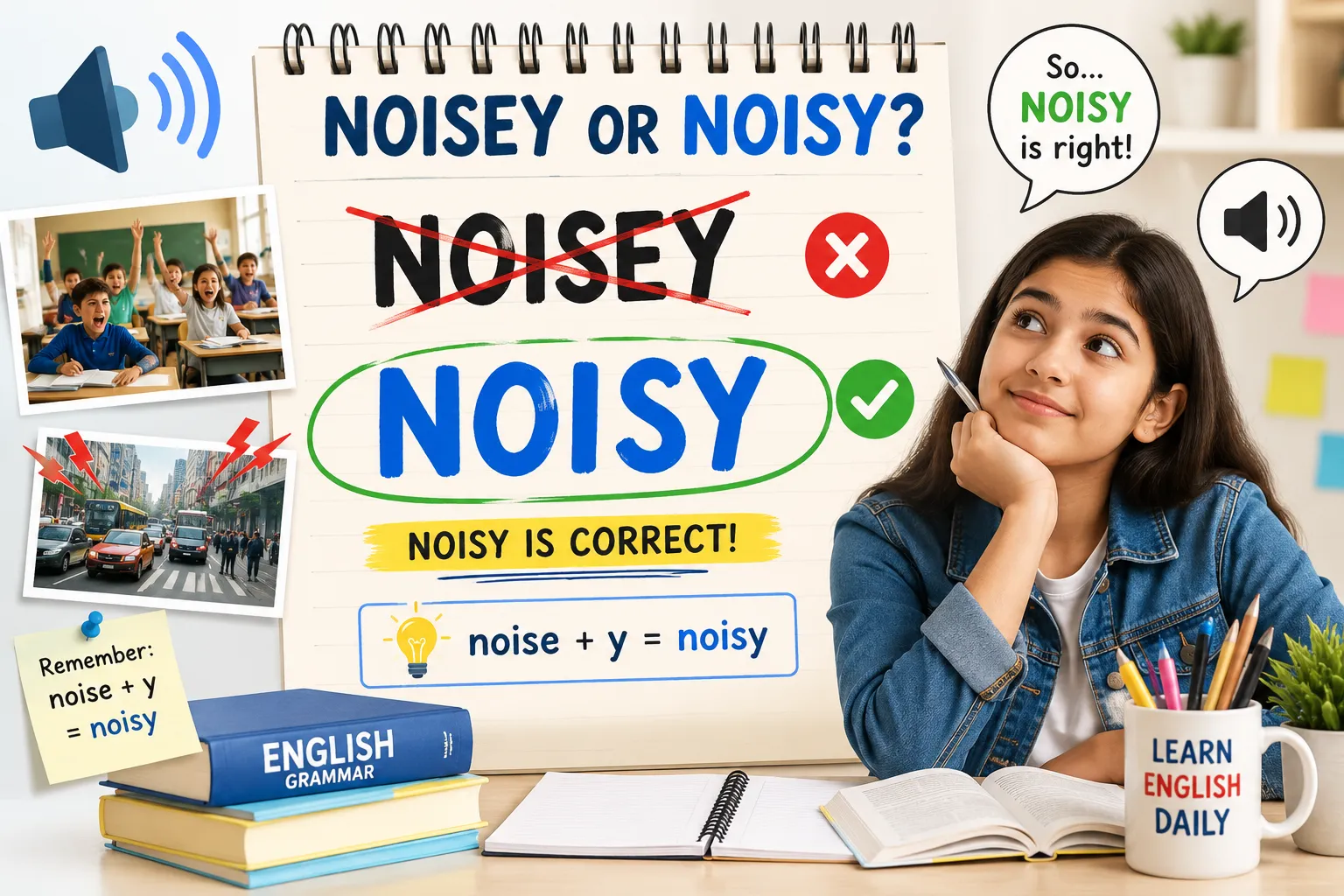
🔊 Noisy is the correct spelling. ❌ Noisey is a common misspelling. 💡 Easy trick: Noise + y = noisy.
Have you ever typed “noisey” and then stopped to wonder if it looked right?
You are not alone. This is a common spelling problem for English learners. The word noise ends in se, so adding y can feel like it should create noisey. But English does not work that way here.
I have seen this mistake many times in simple writing tasks. A student may write, “The classroom is very noisey,” even though the correct form is “The classroom is very noisy.” The difference is only one letter, but that small mistake can matter in school, work, and formal writing.
So, noisey or noisy? The answer is simple: noisy.
This guide explains why noisy is correct, why noisey looks tempting, and how to use the word naturally. You will also see real examples, common mistakes, and quick answers to the questions learners ask most.
Noisey or Noisy
The correct spelling is noisy.
Noisy is an adjective. It describes a person, place, object, or situation that produces a lot of sound.
Examples
- The classroom is noisy.
- The street becomes noisy at night.
- My neighbors have a noisy dog.
- The children were noisy during the break.
❌ Noisey is not the standard spelling.
✅ Noisy is the correct spelling.
A simple way to remember it is:
noise + y = noisy
Not:
noise + ey = noisey
Once you learn this pattern, the spelling becomes much easier.
The Origin and Background of Noisy
The word noisy comes from the noun noise.
The word noise has a long history in English. Over time, English speakers formed the adjective noisy by adding the suffix y. This creates a word that means “full of noise” or “making a lot of noise.”
You can see the same pattern in many other English words:
- rain → rainy
- sun → sunny
- cloud → cloudy
- dirt → dirty
- taste → tasty
- noise → noisy
The spelling mistake noisey happens because the pronunciation can make the extra e feel natural.
However, the standard spelling drops the final e before adding y:
noise → noisy
This is why you should use noisy in school work, emails, reports, websites, and other formal writing.
Noisey or Noisy Explained: The Key Difference
There is really only one standard choice in modern English.
| Term | Meaning | When to Use | Region/Context |
|---|---|---|---|
| Noisy | Making a lot of sound | Standard English writing | American, British, and international English |
| Noisey | Intended to mean “making a lot of sound” | Avoid in standard writing | Usually a spelling mistake |
1. Noisy
Noisy is the correct adjective.
For example:
The restaurant was very noisy.
Here, noisy tells us that the restaurant had a lot of sound.
You can also describe people:
The children were noisy.
Or things:
The old machine is noisy.
Or places:
The airport is often noisy.
2. Noisey
Noisey is generally considered a misspelling of noisy.
You may see it in casual online posts, usernames, informal comments, or other user generated content. That does not make it the standard spelling.
For correct English, choose noisy.
Which Version Should You Use?
The answer is easy.
For students
Use noisy.
It is the correct spelling for:
- Homework
- Essays
- Exams
- School projects
- Class assignments
For example:
The classroom became noisy after the teacher left.
For professionals
Use noisy in emails, reports, presentations, and business writing.
For example:
The office is too noisy for client calls.
For global English
Use noisy.
It is understood and accepted in both American English and British English.
You do not need to change the spelling depending on the country.
For social media
You may sometimes see noisey online. It can appear because people type quickly or use non standard spelling.
Still, if you want correct English, choose noisy.
Best rule: When in doubt, write “noisy.”
Common Mistakes With Noisy
Small spelling mistakes can be easy to repeat. Here are the most common ones.
| Mistake | Correction | Why? |
|---|---|---|
| The room is noisey. | The room is noisy. | Noisy is the standard spelling. |
| The street was very noise. | The street was very noisy. | Noise is a noun; noisy is an adjective. |
| The children made a noisy. | The children made a noise. | Noise names the sound; noisy describes something. |
| It was very noise outside. | It was very noisy outside. | Use the adjective after “was.” |
| This is a noisy sound. | This is a loud sound. | “Noisy sound” can be awkward or redundant. |
Mistake 1: Writing “noisey”
❌ The classroom is noisey.
✅ The classroom is noisy.
The extra e is the problem.
Mistake 2: Confusing noise and noisy
Noise is a noun.
I heard a strange noise.
Noisy is an adjective.
The room is noisy.
A useful question can help:
Are you naming the sound or describing something?
If you are naming it, use noise.
If you are describing something as full of sound, use noisy.
Mistake 3: Using “noisy” when you mean “loud”
These words are related, but they are not always identical.
Loud usually describes the volume of a sound.
The music is loud.
Noisy often suggests unwanted, disturbing, or continuous sound.
The neighbors are noisy.
A concert can be loud without being described as noisy. A barking dog, however, may be both loud and noisy.
Noisy in Real World Examples
Seeing a word in context is one of the best ways to remember it.
1. Professional Email
The meeting room is quite noisy today. Could we move the meeting to a quieter room?
Here, noisy describes the room.
2. News Headline
Noisy Traffic Causes Delays in City Center
The word works well in a headline because it quickly tells readers that traffic is creating a lot of sound.
3. Social Media Post
My street gets so noisy on Friday nights!
This is a natural, casual use of the word.
4. Formal Report
The study found that employees were less focused in noisy work environments.
This use is suitable for formal and academic writing.
5. Everyday Conversation
Why is the baby so noisy today?
That sounds natural in normal conversation.
Noisey or Noisy: Data, Trends and Usage
The search “noisey or noisy” has a clear informational purpose. People who search it are usually trying to settle a spelling question quickly.
The most common reason for the confusion is simple: noise + y looks as if it might become noisey. English spelling often creates this kind of doubt.
The question is especially useful for:
- English learners
- School students
- Parents helping children with homework
- Writers and bloggers
- People checking an email
- Anyone using English as a second language
The issue also matters because spelling errors can reduce trust. A single mistake in a school assignment may cost marks. In professional writing, repeated spelling errors can make a message look less polished.
The useful takeaway is simple:
Noisy is the standard spelling in modern English.
Noisey or Noisy: Standalone Comparison
| Term/Variant | Meaning | Region/Context | Best Used When |
|---|---|---|---|
| Noisy | Making a lot of sound | Standard English | Always use this in correct English |
| Noisey | Non standard spelling of noisy | Informal or user generated content | Avoid it in standard writing |
| Noise | A sound, often unwanted | All English varieties | Use it as a noun |
| Loud | Having high volume | All English varieties | Describe sound level |
| Silence | Absence of sound | All English varieties | Describe a quiet state |
This table shows an important point: noisy and noise are not the same type of word.
Compare:
The noise was annoying.
The neighbors were noisy.
The first sentence names the sound. The second describes the neighbors.
Noisy vs. Loud: What Is the Difference?
Learners often ask about noisy vs. loud.
They are close, but they focus on different ideas.
Loud describes the strength or volume of a sound.
The TV is too loud.
Noisy describes something that produces a lot of unwanted or noticeable sound.
The street is very noisy.
You can also use both words together:
The children were noisy, and their voices were very loud.
That sentence is perfectly natural.
How to Remember the Correct Spelling
Here is a quick memory trick:
Think: “Noise becomes noisy.”
Take:
NOISE
Add:
Y
You get:
NOISY
Do not add another E.
You can also compare it with these words:
- noise → noisy
- spice → spicy
- ice → icy
- grease → greasy
These examples show why noisy feels unusual at first but follows a useful spelling pattern.
FAQ: Noisey or Noisy
Q: What does noisy mean?
A: Noisy means making or producing a lot of sound. It can describe people, places, animals, machines, streets, and other things.
Q: How do you spell noisy correctly?
A: The correct spelling is noisy, not noisey. Remember the simple pattern: noise + y = noisy.
Q: Is noisey or noisy correct?
A: Noisy is correct. Noisey is a common misspelling and should be avoided in standard English.
Q: Is noisy acceptable in formal writing?
A: Yes. Noisy is a normal English adjective and is completely acceptable in formal writing. You can use it in reports, emails, essays, and academic work when the meaning fits.
Q: What is the difference between noise and noisy?
A: Noise is a noun that means a sound or collection of sounds. Noisy is an adjective that describes something that makes a lot of sound.
Q: Where does the word noisy come from?
A: Noisy comes from the word noise with the adjective forming ending y. The spelling developed as part of the history of English word formation.
Q: Can I use noisy to describe a person?
A: Yes. You can say, “The children are noisy.” You can also describe a place, animal, machine, street, or event as noisy.
Q: Is noisy American or British English?
A: Noisy is used in both American and British English. The spelling does not change between these varieties.
Q: Is loud the same as noisy?
A: Not always. Loud focuses on volume, while noisy often suggests a lot of unwanted or noticeable sound. The two words can overlap.
Q: Why do people spell noisy as noisey?
A: The spelling mistake is easy to make because the original word noise ends in e. People may think the e should remain before y. In standard English, however, the correct form is noisy.
Conclusion
If you only remember one thing, remember this:
Noisy is correct. Noisey is not the standard spelling.
The word noisy is an adjective. It describes something that makes a lot of sound. You can use it for a classroom, street, dog, machine, office, party, or group of people.
Also remember the difference between noise and noisy. Noise is a noun. Noisy is an adjective.
You should use noisy in school work, professional emails, reports, essays, websites, and other standard English writing. The spelling is the same in both American and British English.
The easiest memory trick is:
noise + y = noisy
So, the next time you stop and ask, “Noisey or noisy?”, you already know the answer.
Choose “noisy,” write with confidence, and bookmark this guide so you never second guess the spelling again.
Read more: Sync or Synch: Which Spelling Is Correct? Easy Guide

I started writing about English word differences after years of teaching students who kept making the same mistakes. My focus is on making spelling rules feel simple and easy to remember. At WordsCombo, I turn confusing word pairs into clear comparisons.