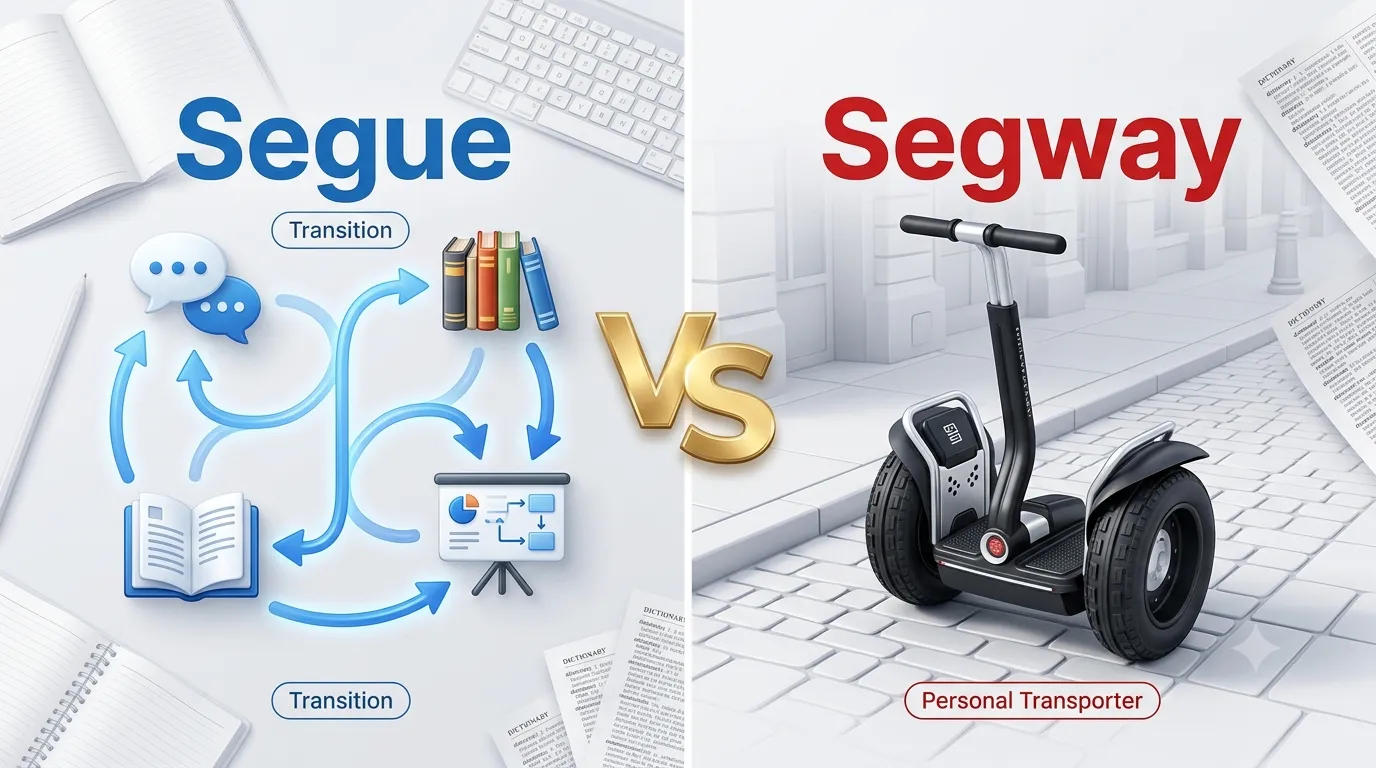
Segue means a smooth transition from one topic, scene, or idea to another. Segway is a brand name for a two-wheeled personal transportation device and should not be used when you mean “transition.”
A few years ago, I edited an article from a talented writer who had one small mistake repeated over and over. Every time they wanted to move from one idea to the next, they wrote “segway” instead of “segue.” It was easy to see why. Both words sound exactly the same. Most people hear them far more often than they see them in writing.
If you’ve ever stopped in the middle of an email, blog post, or school paper and wondered which spelling is correct, you’re not alone. Thousands of people search this question every month because the two words are pronounced the same but have very different meanings.
By the end of this guide, you’ll know exactly when to use segue and when to use Segway. You’ll also learn where the words came from, why people confuse them, and how to avoid this mistake forever.
Segue or Segway: Quick Answer
When you’re talking about moving smoothly from one idea, topic, or scene to another, always use segue.
Use Segway only when referring to the famous self-balancing electric vehicle.
Examples
- Let’s segue into the next topic. ✅
- The speaker used a smooth segue between sections. ✅
- We rode a Segway around the city. ✅
Remember this simple trick:
- Segue = Smooth transition
- Segway = Scooter brand
The Origin and Background of Segue
The word segue comes from Italian. It means “continues” or “follow on.”
It first became popular in music. Musicians used it to tell performers to continue into the next section without stopping.
Later, writers, speakers, teachers, and journalists adopted the word. Today it simply means a smooth change from one subject to another.
Segway, on the other hand, is much newer.
It is a registered trademark introduced in 2001 for the self-balancing personal transporter invented by Dean Kamen.
The confusion exists because:
- Both words sound identical.
- Many people hear “segue” before they ever see it written.
- Spellcheck may not always catch the mistake because Segway is a real word.
Segue Explained: Key Differences
Although they sound alike, their meanings are completely different.
| Term | Meaning | When to Use | Region/Context |
|---|---|---|---|
| Segue | Smooth transition | Writing, speaking, music | Worldwide |
| Segway | Electric personal transporter | Transportation | Brand name worldwide |
Examples
Segue
- Let’s segue into today’s lesson.
- The movie uses a clever segue between scenes.
Segway
- We rented a Segway during our city tour.
- She learned how to ride a Segway in ten minutes.
Which Version Should You Use?
Choosing the correct word is simple once you know what you’re talking about.
For Students
Use segue in essays, presentations, and assignments because it describes smooth transitions.
For Bloggers and Content Writers
Always use segue when connecting ideas or paragraphs. Search engines and readers expect the correct spelling.
For Business Professionals
Emails, reports, meetings, and presentations should always use segue when changing topics.
Example:
“Let’s segue into next quarter’s sales report.”
For Travelers
Use Segway only when referring to the transportation device.
Example:
“We booked a Segway city tour.”
Best Choice for Everyone
If you mean transition, choose segue.
If you mean the vehicle, choose Segway.
Common Mistakes with Segue
Here are the mistakes people make most often.
| Mistake | Correct |
|---|---|
| Let’s segway into the next topic. | Let’s segue into the next topic. |
| The article had a great segway. | The article had a great segue. |
| We rented a segue downtown. | We rented a Segway downtown. |
| The teacher rode a segue. | The teacher rode a Segway. |
| Can you Segway to chapter two? | Can you segue to chapter two? |
Why These Mistakes Happen
- Both words sound exactly alike.
- The vehicle became famous in popular culture.
- People often guess the spelling from pronunciation.
The easiest memory trick is:
Segue = Sequence of ideas
Both begin with “Seg.”
Segue in Real World Examples
Professional Email
“Before discussing the budget, I’d like to segue into last month’s performance.”
News Headline
“Mayor Smoothly Segues Into Economic Recovery Plan During Annual Address.”
Social Media Post
“Funny story… but first let me segue into what happened yesterday.”
Formal Report
“The following section segues into the project’s financial analysis.”
Each example shows segue as a transition, not a vehicle.
Segue: Data, Trends & Usage
Search interest for “segue or segway” stays steady because writers, students, and professionals often encounter this confusing pair.
Most Interested Audiences
- Students
- Bloggers
- Journalists
- Copywriters
- Business professionals
- English learners
Search Intent
Primary Intent: Informational
People want to know:
- Which spelling is correct
- What each word means
- How to avoid mistakes
Why This Matters Today
Good writing builds trust. Using the correct word makes your emails, articles, and reports look polished and professional. Even a small spelling mistake can distract readers or reduce credibility.
Standalone Comparison Table
| Term/Variant | Meaning | Region/Context | Best Used When |
|---|---|---|---|
| Segue | Smooth transition | Writing, speaking, music | Moving between ideas |
| Segway | Electric transporter | Transportation | Talking about the vehicle |
Frequently Asked Questions
Q: What does segue mean?
A: Segue means a smooth transition from one topic, idea, scene, or section to another without an awkward break.
Q: How do you use segue correctly?
A: Use segue whenever you move naturally from one subject to another in writing or speaking.
Example:
“Let’s segue into today’s lesson.”
Q: Segue vs Segway: what’s the difference?
A: Segue means transition. Segway is the brand name of a self-balancing personal transporter.
Q: Is segue acceptable in formal writing?
A: Yes. It is widely accepted in professional writing, journalism, business communication, and academic work.
Q: Which version is correct: segue or segway?
A: If you’re discussing transitions, segue is correct. If you’re talking about the vehicle, Segway is correct.
Q: Where does the word segue come from?
A: It comes from Italian and originally appeared in music. It later became common in everyday English to describe smooth transitions.
Q: Can segue be used in speeches and presentations?
A: Absolutely. Speakers often use segue when moving naturally between topics or sections.
Example:
“Now let’s segue into our final recommendation.”
Conclusion
At first glance, segue and Segway seem interchangeable because they sound exactly the same. Once you understand their meanings, though, the choice becomes simple.
Remember these key points:
- Segue means a smooth transition.
- Segway is the electric personal transporter.
- Writers, students, speakers, and professionals almost always need segue.
- Using the correct spelling makes your writing look more polished and trustworthy.
Whenever you’re changing from one idea to another, think about creating a smooth flow. That’s exactly what segue does. Save Segway for conversations about riding through parks or taking sightseeing tours.
Now you know exactly how to use segue correctly. Bookmark this guide so you never second-guess segue or Segway again. If you found it helpful, share it with someone who has made this common mistake.

I have been writing about English spelling and word usage for the past five years. My goal is to give readers a clear answer without overwhelming them with complicated rules. At WordsCombo, I focus on making everyday English easier for everyone.