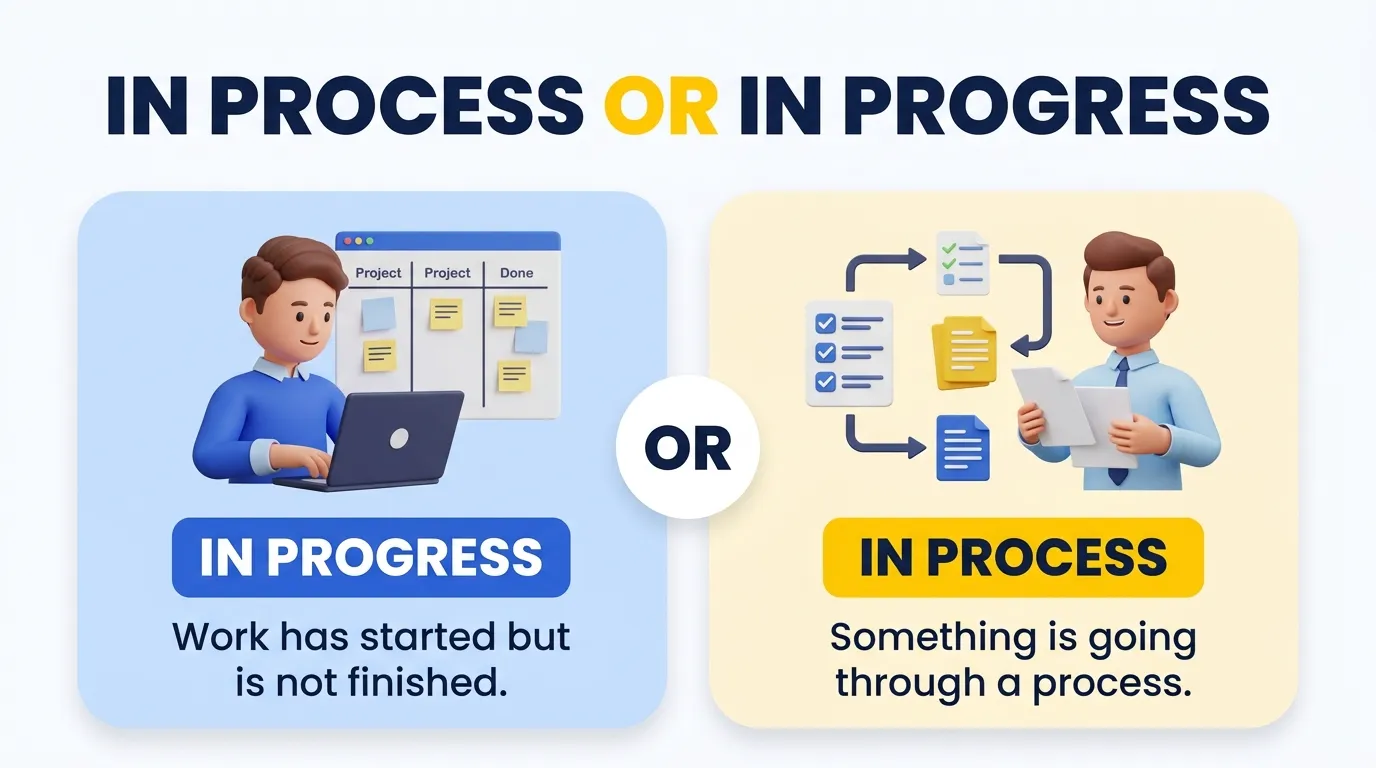
In progress means something has started and is still going on. In process means something is going through a set of steps or a work process. Both phrases are correct, but they are used in different situations.
When you are writing an email to your boss, you might pause before typing that a task is “in process” or “in progress.” Both sound right, so choosing one can feel tricky. However, there is a simple way to tell them apart. In process or in progress is a common English usage question, especially in work emails, project updates, and formal writing. Once you know what each phrase means, you can choose the right one with confidence.
In Process or In Progress: Quick Answer
Use in progress when an activity has started but is not finished. Use in process when something is going through a process or a set of steps.
- “The report is in progress.” The report is being worked on.
- “Your application is in process.” Your application is going through the required steps.
Both phrases are correct, but the best choice depends on what you want to say.
The Origin of In Process or In Progress
The phrases in process and in progress come from words that describe how things happen or change over time. Both relate to work that is not yet complete, which is why people sometimes mix them up.
The word process refers to a series of steps used to do something. For example, hiring a new employee involves reviewing applications, holding interviews, and making a choice.
The word progress, however, refers to movement toward a goal or a better result. When you make progress on a report, you are moving closer to finishing it.
Because both ideas involve ongoing work, the phrases can seem alike. Still, their main focus is different: process points to the steps, while progress points to the work moving forward.
In Process vs. In Progress: Key Differences
The easiest way to remember the difference is to ask yourself what you want to describe. Are you talking about a set of steps, or are you talking about work that is not finished yet?
What Does In Progress Mean?
In progress means that an activity has started and is still happening. It often suggests that someone is working toward finishing a task, project, or goal.
For example:
- The website redesign is in progress.
- My homework is still in progress.
- Repairs are in progress at the office.
In each example, the work has begun but is not complete. Therefore, this phrase is a good choice for project updates, schoolwork, and everyday conversations.
What Does In Process Mean?
In process means that something is going through a process or a series of steps. It often appears in settings where people follow set rules or procedures.
For example:
- Your visa application is in process.
- The payment is in process.
- The documents are in process for review.
Here, the focus is on the procedure rather than simply on unfinished work. However, some of these sentences may sound more natural with phrases such as “being processed” or “processing is underway,” depending on the context.
Comparison at a Glance
| Term | Meaning | When to Use | Region/Context |
| In progress | Started but not finished | Tasks, projects, activities | Common in US and UK English |
| In process | Going through a process or set of steps | Applications, procedures, administrative work | Used in business and formal settings |
| Being processed | Currently handled through a process | Payments, forms, orders | Common in customer service |
| Underway | Has started and is continuing | Events, plans, projects | Common in general and formal English |
Although the phrases can overlap, in progress is usually the safer choice when you mean that work is underway. On the other hand, being processed may be clearer when you are talking about an application, order, or payment.
Which One Should You Use?
The right phrase depends on your sentence, but in progress is usually the best choice for everyday English.
Here is how to choose the right expression in common situations.
- For students: Say “My assignment is in progress” because the work has started but is not finished.
- For office workers: Write “The report is in progress” when you are still working on it.
- For business owners: Use “The project is in progress” to give a clear update on ongoing work.
- For customer service: Say “Your order is being processed” when a team or system is handling an order.
- For technical workers: Use in-process when it is the accepted term for a stage in a production or work system.
However, remember that some workplaces use their own status labels. If your company uses “in process” in its system, follow that wording when reporting the status.
Common Mistakes With In Process or In Progress
These phrases are easy to mix up because they both relate to unfinished work. However, a few simple corrections can make your writing clearer.
Mistake 1: Using In Process for Every Project
Incorrect or less natural: “The new website is in process.”
Better: “The new website is in progress.”
A website project is an ongoing activity, so in progress is the more natural choice in general English.
Mistake 2: Using In Progress for Every Application
Less clear: “Your payment is in progress.”
Often clearer: “Your payment is being processed.”
The second sentence tells the reader that the payment is being handled. Still, “payment in progress” may be suitable when a system uses that exact status label.
Mistake 3: Treating Both Phrases as Identical
Less natural: “The meeting is in process.”
Better: “The meeting is in progress.”
A meeting is an event that is happening, not usually a procedure moving through set stages. Therefore, in progress is the better fit.
Mistake 4: Adding a Hyphen in the Wrong Place
Incorrect: “The project is in-progress.”
Correct: “The project is in progress.”
However, a hyphen can be used when the phrase describes a noun before it.
Example: “We reviewed the in-progress project.”
In normal sentences, keep the phrase open as two words.
Mistake 5: Using Formal Words When Simple Words Work
Less natural: “The report is in process.”
Clearer: “The report is in progress.”
For everyday work updates, the shorter and more familiar phrase is often easier to understand. Alternatively, you can write, “I am still working on the report.”
In Process or In Progress in Real-World Examples
The best way to learn the difference is to see how these phrases work in daily life.
In a Professional Email
Suppose your manager asks whether you have finished a report.
Subject: Report Update
Hi Alex,
The report is in progress, and I expect to finish it soon.
Best, Sam
This wording is clear because it tells your manager that the work has started but is not complete.
In a News Headline
A news website might use a headline such as:
Road Repairs in Progress After Heavy Rain
Here, the phrase tells readers that repair work is underway. As a result, they know that the work has started and may still affect traffic.
In a Social Media Post
A designer might post:
“New website design in progress! I can’t wait to share the finished version.”
This sounds natural because the designer is talking about ongoing creative work.
In a Formal Document
A company may write:
“The application is being processed by the review team.”
This sentence is clear and professional. Instead of using the less natural phrase “in process,” it explains what is happening.
In a Project Management Tool
A project board might show these statuses:
- In progress: The team is working on the task.
- In review: Someone is checking the work.
- Completed: The task is finished.
However, each organization may define its status labels differently. Always check the meaning of a label before using it in a report.
In Process or In Progress: Data, Trends, and Usage
People search for in process or in progress because the phrases look similar and both can describe unfinished work. The confusion often appears when people write emails, update project boards, or check the status of an application.
Three common search needs explain why the distinction matters.
- Meaning: Readers want a simple explanation of both phrases.
- Correct usage: Writers want to know which phrase sounds natural in a sentence.
- Professional writing: Employees and customers need clear status updates about projects, applications, payments, and orders.
In general American English, in progress is the more useful choice for ordinary tasks and activities. Meanwhile, in process has a narrower role when the focus is on a process or a particular stage in a system.
The key lesson is that clear wording matters more than using formal-sounding words. When a more direct phrase such as “being processed” explains the situation better, use it.
In Process vs In Progress: Comparison at a Glance
| Term or Variant | Meaning | Region/Context | Best Used When |
| In progress | Started but unfinished | General English, US and UK | Describing tasks, events, and projects |
| In process | Within a process or procedure | Formal or specialized settings | Referring to a defined workflow |
| In-process | At a stage within a process | Technical and manufacturing settings | Describing items or materials in production |
| Being processed | Currently being handled | Customer service and administration | Explaining application, order, or payment status |
| Underway | Started and continuing | General and professional English | Describing an event, plan, or activity |
For most everyday sentences, choose in progress. If you are describing a formal procedure, consider in process or a more exact phrase such as “under review” or “being processed.”
Frequently Asked Questions
What is the difference between in process and in progress?
In progress means something has started but is not finished. In process usually refers to something moving through a set of steps or a procedure.
Is in process grammatically correct?
Yes, in process can be correct in the right context. However, in progress is usually more natural when you are talking about a task, project, or event that is still happening.
Should I write in process or in progress in an email?
Use in progress when giving an update about work you are doing. For example, “The report is in progress” sounds natural, while “Your application is being processed” works well for an application update.
Which is correct, project in process or project in progress?
Project in progress is usually the better choice in everyday English. It tells the reader that the project has started and is still being worked on.
Can I use in process in formal writing?
Yes, you can use in process in formal writing when the context involves a defined process or system. However, phrases such as “being processed,” “under review,” and “in progress” may be clearer in many situations.
What is the difference between in-process and in progress?
In progress is normally written as two words when it follows a verb, as in “The work is in progress.” In-process can be hyphenated when it acts as a describing word before a noun, especially in technical settings.
Is work in process or work in progress correct?
Both expressions exist, but work in progress is the usual phrase for work that has started but is not finished. In some US manufacturing and accounting contexts, work in process refers to goods that are still being made.
Final Thoughts on In Process or In Progress
Choosing between in process or in progress becomes easier when you focus on what you mean. Both phrases can be correct, but they do not always fit the same situations.
Remember these simple rules:
- Use in progress for ongoing tasks, projects, and events.
- Use in process when the focus is on a process or set of steps.
- Choose being processed when a person or system is handling an application, order, or payment.
- Follow your workplace’s wording when it uses specific status labels.
For most everyday and professional writing, in progress is the safest choice when you mean that something has started but is not finished. Next time you write an email or project update, choose the phrase that gives your reader the clearest meaning. Keep your sentences simple, and your message will be easier to understand.
Curious about similar words? Explore Teeth or Teeths to learn more about confusing English phrases.

I started writing about English word differences after years of teaching students who kept making the same mistakes. My focus is on making spelling rules feel simple and easy to remember. At WordsCombo, I turn confusing word pairs into clear comparisons.