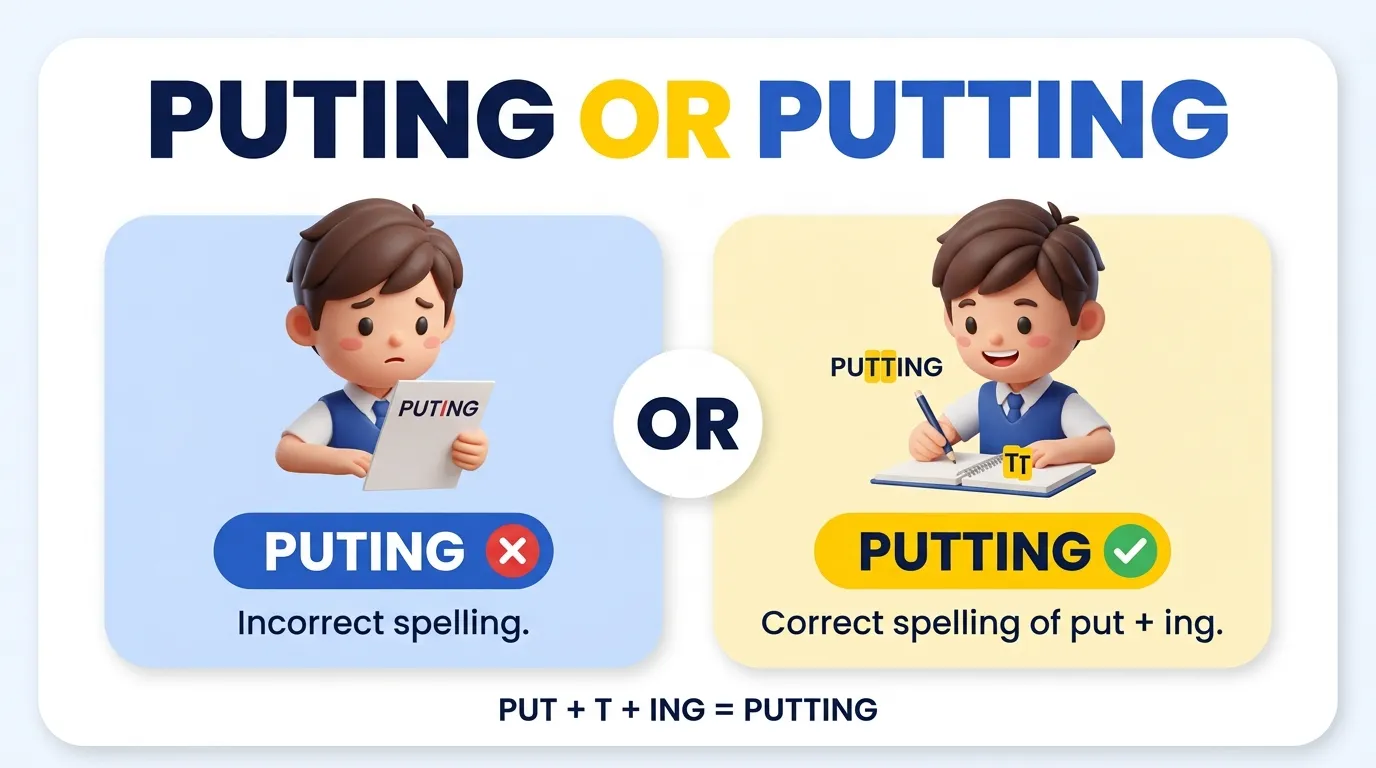
Putting is the correct spelling of the verb put with -ing. Puting is a misspelling because you must double the final t before adding -ing.
When you type a work email or finish a school assignment, a red spelling line under puting can make you pause. The correct form is putting, as in “I am putting my books away.”
However, the spelling rule is easy to remember once you know how it works. This guide explains why the final t doubles, how to use putting in a sentence, and which mistakes to avoid.
Puting or Putting: Quick Answer
Putting is the only correct spelling in standard English when you mean the action of placing something somewhere. The word comes from the verb put, and you double the final t before adding -ing.
- Correct: She is putting her bag on the chair.
- Incorrect: She is puting her bag on the chair.
The Origin of Putting
The word putting comes from the verb put, which means to place or move something to a certain spot. When you add -ing, you turn the verb into a form used for an action that is happening or continuing.
English spelling has a rule for many short verbs that end in a consonant after a single vowel. For these verbs, the last consonant often doubles before -ing is added. For example, sit becomes sitting, and run becomes running.
Likewise, put becomes putting, not puting. The spelling may look unusual at first, but the extra t is needed.
Putting Explained: Key Differences
The difference between putting and puting is simple. One follows the correct spelling rule, while the other does not.
Putting
Putting is the correct form. You use it when someone is placing something somewhere or taking part in an action described by put.
Examples:
- Dad is putting the food on the table.
- I am putting my shoes away.
Puting
Puting is incorrect in standard English. It leaves out one t, so you should not use it in schoolwork, emails, reports, or other formal writing.
For example, write “She is putting the baby to bed,” not “She is puting the baby to bed.”
| Term | Meaning | When to Use | Region/Context |
| Putting | The correct -ing form of put | Everyday, school, and professional writing | Standard English worldwide |
| Puting | A misspelling of putting | Do not use it as the standard spelling | Incorrect in standard English |
Which One Should You Use?
Use putting in every standard English context because it is the correct spelling.
- For students: Write putting in homework, essays, and exams because spelling errors can cost marks.
- For professionals: Use putting in emails, reports, and business messages to keep your writing clear.
- For English learners: Remember to double the final t when adding -ing to put.
- For social media users: Even in casual posts, putting is the correct form.
If you are unsure, remember this simple rule: put + ing = putting.
Common Mistakes with Puting or Putting
Writers often make this mistake because they add -ing without doubling the final letter. However, a few simple checks can help you avoid it.
– Mistake: I am puting my phone away. Correction: I am putting my phone away. Why: The final t must double before adding -ing.
– Mistake: He is puting on his jacket. Correction: He is putting on his jacket. Why: The same spelling rule applies to common phrases.
– Mistake: We are puting together a report. Correction: We are putting together a report. Why: The word keeps both t letters in every use.
– Mistake: She enjoys puting things in order. Correction: She enjoys putting things in order. Why: The correct spelling stays the same when the word names an activity.
– Mistake: I was puting the books away. Correction: I was putting the books away. Why: The spelling does not change in the past continuous tense.
Putting in Real-World Examples
The word putting works in everyday conversations, school assignments, and professional writing. Here are some examples of how to use it naturally.
Professional email: “I am putting together the final report and will send it this afternoon.”
News headline: “Local School Is Putting Student Safety First.”
Social media post: “Just putting my thoughts into words and sharing them with you.”
Formal document: “The team is putting the new plan into action.”
School assignment: “The teacher is putting the test papers on each desk.”
Everyday conversation: “I am putting the milk back in the fridge.”
In each example, putting has two t letters. This spelling stays the same whether you are placing an object, preparing something, or making an idea clear.
Putting: Data, Trends and Usage
People search for puting or putting when they want to check a spelling mistake or learn an English grammar rule. The main goal is usually to find out which form is correct and why the letters double.
Several groups may look for this answer:
- English learners want to understand how to add -ing to short verbs.
- Students need the right spelling for homework, tests, and essays.
- Writers and professionals want to avoid errors in emails and documents.
- Everyday readers may want to check a word before sending a message.
The key point is that putting is correct in both American and British English. Although people may type puting by mistake, that does not make it an accepted spelling. No verified search-volume figures are provided here, so the exact popularity of this query cannot be stated.
Puting vs Putting: Comparison at a Glance
| Term/Variant | Meaning | Region/Context | Best Used When |
| Putting | Placing something or carrying out an action | American and British English | Writing the correct form of put with -ing |
| Puting | Misspelling of putting | Not standard English | Never use it as the standard spelling |
| Put | To place or move something | Standard English | Using the base verb or its simple past form |
| Putt | To hit a golf ball gently toward a hole | Golf | Talking about a golf shot |
| Putting | The act or skill of making short golf shots | Golf | Discussing golf practice or performance |
Frequently Asked Questions
Is it puting or putting?
Putting is correct, while puting is a misspelling. Always use two t letters when adding -ing to put.
Why does put become putting?
The verb put ends in one vowel followed by one consonant. Therefore, you double the final t before adding -ing, making putting.
Is puting ever correct in English?
No, puting is not the standard spelling of the -ing form of put. Even in casual messages, putting is the correct choice.
Is putting correct in American and British English?
Yes, putting is correct in both American and British English. There is no regional spelling difference for this word.
Can I use putting in formal writing?
Yes, putting is suitable for formal writing when it fits the sentence. You can use it in reports, school essays, business emails, and other professional documents.
What is the origin of the word putting?
Putting comes from the verb put, which means to place or move something into a position. The ending -ing forms a word used for an ongoing action or an activity.
How do you spell putting in golf?
The spelling is putting, with two t letters. In golf, putting means hitting a ball gently across the green toward the hole.
Final Thoughts on Puting or Putting
The correct spelling is putting, not puting. Whenever you add -ing to the short verb put, double the final t. This rule also appears in words such as sitting, running, and getting.
Remember that putting works in both American and British English. You can use it when placing objects, preparing a report, or talking about golf. The spelling does not change with the meaning.
Before sending your next email or finishing an assignment, check for that second t. Practice using putting in your own sentences, and this common spelling mistake will become much easier to avoid. Keep learning, and write with confidence!
Curious about similar spelling mistakes? Explore In Process or In Progress.

I started writing about English word differences after years of teaching students who kept making the same mistakes. My focus is on making spelling rules feel simple and easy to remember. At WordsCombo, I turn confusing word pairs into clear comparisons.