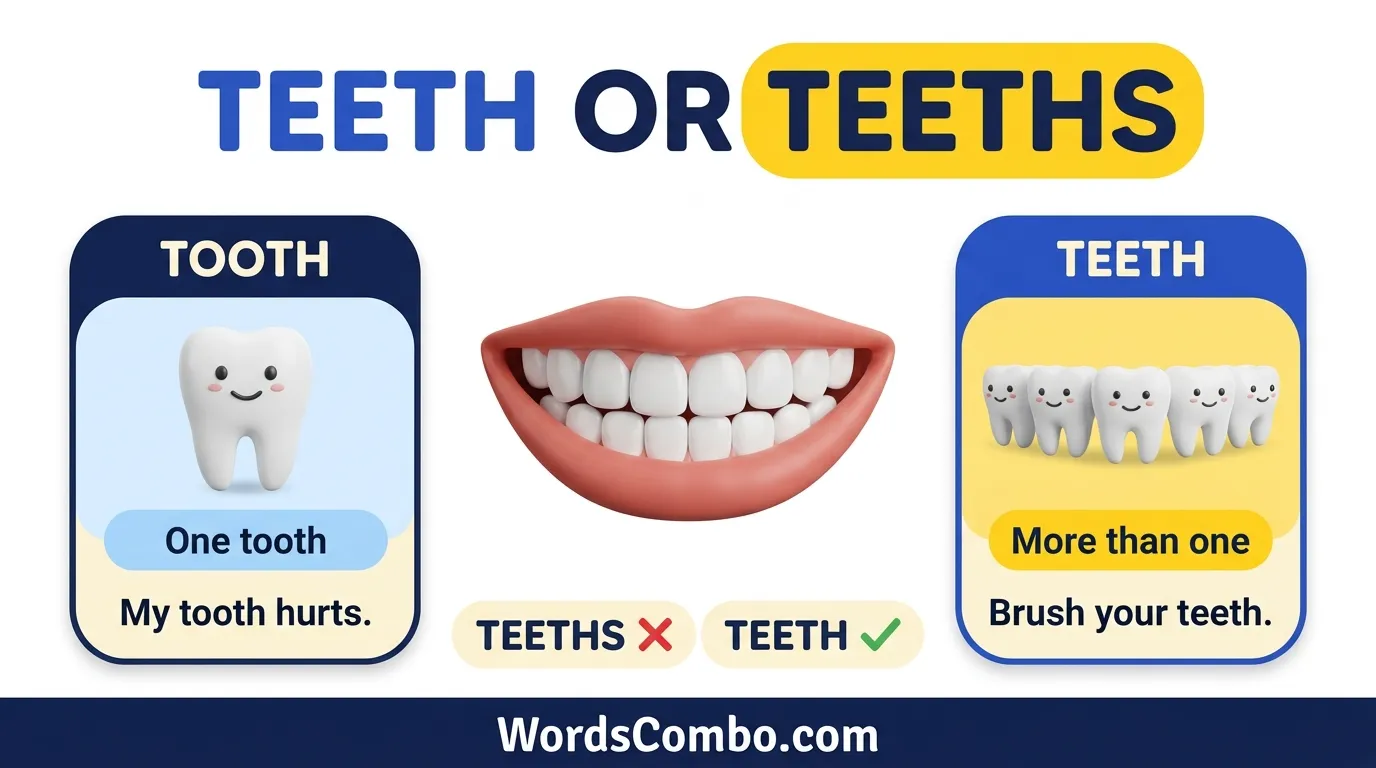
Teeth is the correct plural of tooth. Teeths is not standard English. For example, say “I brush my teeth twice a day,” not “I brush my teeths.”
English has many irregular plurals. These are words that do not form their plural by adding -s or -es. The word tooth is one example. Its plural form is teeth, which can confuse English learners and even people who use English every day.
So, should you write teeth or teeths in a school assignment, email, or everyday message? The answer is simple: use teeth when talking about more than one tooth. In this guide, you will learn the difference between teeth and teeths, understand the grammar rule, and see how to use the correct word in real sentences.
Teeth or Teeths: Which Spelling Is Correct?
Teeth is the correct plural form of tooth. The word teeths is not accepted as a standard plural in modern English.
A single tooth is one tooth. Two or more are teeth.
Examples:
- I have a loose tooth.
- The dentist checked my teeth.
- My baby is getting two new teeth.
- She brushes her teeth every morning.
Notice that the word changes from tooth to teeth. You do not need to add an s at the end.
Why Is Teeth Correct?
The word tooth belongs to a group of English nouns with irregular plural forms. These words change their spelling instead of following the usual plural rule.
For example:
- One tooth, two teeth
- One foot, two feet
- One goose, two geese
- One man, two men
- One woman, two women
These plural forms must be learned because they do not follow the regular rule of adding -s or -es.
Is Teeths Ever Correct?
No. In standard modern English, teeths is not the correct plural of tooth.
You may see it in a spelling mistake, a learner’s sentence, or a joke. However, you should use teeth in schoolwork, professional writing, emails, and everyday conversation.
For example:
Incorrect: The dentist cleaned my teeths.
Correct: The dentist cleaned my teeth.
Tooth vs. Teeth vs. Teeths
These three forms may look similar, but only two have standard uses in English: tooth and teeth.
| Word | Meaning | Correct Use |
| Tooth | One tooth | I have a sore tooth. |
| Teeth | More than one tooth | My teeth look clean. |
| Teeths | Not a standard plural | Do not use it for multiple teeth. |
The easiest way to remember the difference is to focus on the number of teeth you mean.
- Use tooth for one.
- Use teeth for two or more.
- Avoid teeths in standard English.
How to Use Tooth in a Sentence
Use tooth when you mean one of the hard parts in the mouth that help you bite and chew food.
Examples:
- My front tooth is loose.
- The dentist removed a damaged tooth.
- A piece of food is stuck between one tooth and another.
- The child lost a baby tooth.
- I have a toothache on the left side.
When you use tooth, you may also need words such as a, one, or each to show that you mean a single tooth.
How to Use Teeth in a Sentence
Use teeth when you mean more than one tooth.
Examples:
- Brush your teeth before bed.
- Her teeth are very white.
- The dentist checked all my teeth.
- The baby has four small teeth.
- He needs braces to straighten his teeth.
You can use teeth for baby teeth, adult teeth, and the teeth of animals. The plural form stays the same.
For example, you can say, “The dog showed its teeth” or “The shark has sharp teeth.”
Why Is the Plural of Tooth Teeth?
Most English nouns form their plural by adding -s or -es. For example, book becomes books, and box becomes boxes.
However, some nouns follow a different pattern. These are called irregular plural nouns.
The word tooth is one of them. Its plural changes the vowel sound and spelling from oo to ee.
Here are some other common examples:
| Singular | Plural |
| Tooth | Teeth |
| Foot | Feet |
| Goose | Geese |
| Man | Men |
| Woman | Women |
| Mouse | Mice |
You cannot apply one simple spelling rule to all these words. Instead, learn each plural form as part of your everyday English vocabulary.
Is Teeth a Regular or Irregular Plural?
Teeth is an irregular plural because it does not follow the usual rule of adding -s or -es.
Compare these examples:
- Regular: one cat, two cats
- Regular: one dish, two dishes
- Irregular: one tooth, two teeth
- Irregular: one foot, two feet
This difference matters when you write sentences. Saying “two tooths” applies the regular plural rule to a word that does not follow it.
Common Grammar Mistakes With Tooth and Teeth
Knowing the correct spelling is only part of the rule. You also need to use the right verb and other words in your sentence.
Mistake 1: Using Teeths Instead of Teeth
Incorrect: I brush my teeths every night.
Correct: I brush my teeth every night.
The plural form is already teeth. Adding -s creates a nonstandard form.
Mistake 2: Using Tooth for More Than One
Incorrect: She has three tooth.
Correct: She has three teeth.
The number three tells you that you need the plural form.
Mistake 3: Using Teeth for One Tooth
Incorrect: My teeth hurts.
Correct: My tooth hurts.
When you mean one tooth, use the singular noun tooth.
Mistake 4: Using the Wrong Verb With Teeth
Incorrect: My teeth is clean.
Correct: My teeth are clean.
Teeth is plural, so it usually takes a plural verb. Use are, were, and other forms that agree with a plural subject.
More examples:
- My tooth is sensitive.
- My teeth are sensitive.
- One tooth was missing.
- Two teeth were missing.
Mistake 5: Adding an Extra S to Tooth’s Possessive Form
Sometimes, you need to show that something belongs to a tooth or to several teeth.
Use tooth’s for a singular possessive and teeth’s for a plural possessive when the context calls for it.
Examples:
- The tooth’s surface was damaged.
- The dentist examined the teeth’s condition.
In everyday writing, you can often avoid an awkward plural possessive by rewriting the sentence. For example, “the condition of the teeth” may sound more natural than “the teeth’s condition.”
Real-Life Examples of Tooth and Teeth
The best way to learn a grammar rule is to see it in common situations.
Everyday Conversation
- “I have a toothache.”
- “You should brush your teeth.”
- “One of my teeth feels loose.”
- “The dentist says I need to clean my teeth better.”
School and English Exams
- A child has lost one baby tooth.
- Adults usually have more teeth than young children with only some baby teeth.
- The correct plural of tooth is teeth.
- The sentence “I have two teeths” contains a grammar mistake.
Emails and Professional Writing
- Please schedule an appointment to check my tooth.
- The dentist examined my teeth during the visit.
- The patient reported pain in one tooth.
- The report lists the condition of the patient’s teeth.
These examples show that the correct form does not change with the level of formality. Use tooth for one and teeth for more than one.
Teeth in Objects and Tools
The word teeth does not refer only to parts of a mouth. It can also describe pointed parts on objects.
Examples:
- The comb has several broken teeth.
- The saw’s teeth are sharp.
- The zipper’s teeth are stuck.
- The gear’s teeth are worn.
Even in these examples, teeths is not the standard plural.
Useful Expressions With Tooth and Teeth
Some common English expressions use tooth or teeth in a special way. Learning these phrases can help you understand everyday speech.
Sweet Tooth
A sweet tooth means that someone enjoys sweet foods, such as cakes, sweets, and chocolate.
Example: I have a sweet tooth, so I love chocolate cake.
Although the person may enjoy many sweet foods, the expression uses the singular form tooth.
By the Skin of Your Teeth
This phrase means that you have managed to do something by a very small amount or with great difficulty.
Example: She passed her driving test by the skin of her teeth.
It does not refer to the literal skin of a tooth. It is an idiom with a special meaning.
Get Your Teeth Into Something
This expression means to become deeply involved in a task or activity.
Example: I am ready to get my teeth into this new project.
These expressions show why it is helpful to learn words in context, not just as separate vocabulary items.
How to Remember the Correct Plural
If you often confuse teeth and teeths, use a simple memory trick.
Remember this pair:
One tooth, two teeth.
Then compare it with another common pair:
One foot, two feet.
Both words change their vowel sound when they become plural. Practising them together can help you remember the pattern.
You can also use a quick number test:
- If you mean one, write tooth.
- If you mean more than one, write teeth.
- If you are about to write teeths, stop and check the sentence.
Quick Practice: Tooth or Teeth?
Choose the correct word for each sentence.
- I need to brush my ___ before bed.
- The dentist removed one damaged ___.
- My baby has two new ___.
- One of my ___ hurts.
- The comb has several broken ___.
Answers: 1. teeth, 2. tooth, 3. teeth, 4. teeth, 5. teeth.
In sentence 4, teeth is correct because the phrase “one of my” refers to one item from a group of several teeth. However, if you simply say “My tooth hurts,” you are referring to one tooth directly.
Frequently Asked Questions
1. Is it teeth or teeths?
Teeth is correct. It is the plural of tooth, while teeths is not standard English.
2. What is the plural of tooth?
The plural of tooth is teeth. For example, you say “one tooth” but “two teeth.”
3. Is teeths ever a real word?
Teeths may appear as a spelling error or an unusual nonstandard form, but it is not the standard plural of tooth. Use teeth in normal English writing and speech.
4. Why does tooth change to teeth?
Tooth is an irregular noun. Its plural form changes the vowel instead of adding -s or -es, as many other English nouns do.
5. Should I say my tooth hurts or my teeth hurt?
Use “my tooth hurts” when one tooth hurts. Use “my teeth hurt” when you mean more than one tooth.
6. Is teeth singular or plural?
Teeth is plural. The singular form is tooth, and the plural form usually takes verbs such as are and were.
7. Do British and American English use different forms?
No. Both British and American English use tooth for one and teeth for more than one. The correct plural does not change between these varieties of English.
Conclusion
When choosing between teeth or teeths, remember that teeth is the correct plural of tooth. Use tooth when talking about one and teeth when talking about two or more. Unlike regular nouns, this word does not form its plural by adding -s. The same pattern appears in words such as foot and feet. With a little practice, you can avoid this common grammar mistake in conversations, schoolwork, and professional writing. Keep practising irregular plurals to make your English clearer and more accurate.
Read more: Won or Win: What Is the Difference?

I started writing about English word differences after years of teaching students who kept making the same mistakes. My focus is on making spelling rules feel simple and easy to remember. At WordsCombo, I turn confusing word pairs into clear comparisons.