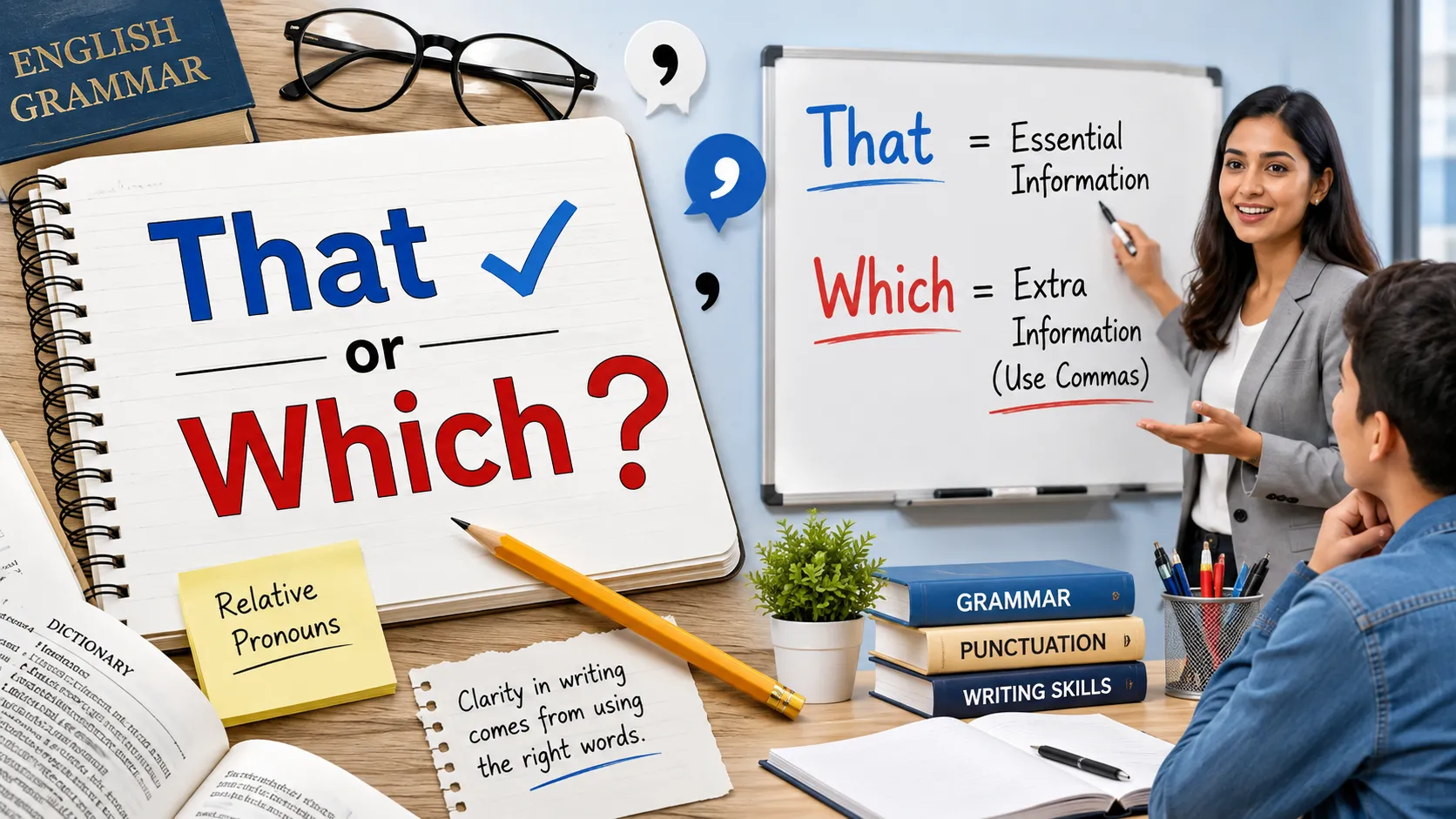
That and which are both relative pronouns, but they are used differently. That introduces essential information, while which introduces extra information, usually set off by commas.
I still remember grading my first stack of student essays more than ten years ago. One mistake appeared again and again. Students kept asking whether they should write that or which. Even advanced writers made the same error. The sentences sounded fine, but the meaning often changed without them noticing.
You may have faced the same problem. You write a sentence, pause for a second, and wonder if that or which is the better choice. A grammar checker may even suggest changing it, leaving you even more confused.
The good news is that the rule is much easier than many people think. Once you understand the difference, choosing the correct word becomes natural. It also helps your writing become clearer and more professional.
In this guide, you’ll learn what that and which mean, when to use each one, the history behind the rule, common mistakes to avoid, and plenty of real world examples. By the end, you’ll never second guess this grammar choice again.
That or Which
The simplest rule is this:
- Use that for information your sentence needs.
- Use which for extra information that can be removed without changing the main meaning.
Example 1
✅ The book that I borrowed is excellent.
(The sentence needs this information.)
Example 2
✅ My laptop, which is five years old, still works perfectly.
(The sentence still makes sense without the extra detail.)
The Origin and Background of That or Which
Both that and which have been part of English for hundreds of years.
Old English used many different words to connect ideas. Over time, that became the preferred word for introducing essential clauses. Which gradually became common for adding extra information.
Interestingly, many famous writers, including Shakespeare and Jane Austen, sometimes used which where modern style guides recommend that. The strict distinction became popular much later, especially in American English.
Today:
- American style guides usually follow the that/which rule.
- British English is often more flexible.
- Both forms are understood worldwide.
This history explains why people still disagree about the rule.
That or Which Explained: Key Differences
The biggest difference is whether the information is essential.
| Term | Meaning | When to Use | Region/Context |
|---|---|---|---|
| That | Essential information | Identifies exactly which person or thing | Preferred in American English |
| Which | Extra information | Adds additional detail | Common in both American and British English |
Example using that
The phone that has a broken screen belongs to Sarah.
There are many phones. The clause tells us which one.
Example using which
The phone, which has a broken screen, belongs to Sarah.
There is only one phone. The broken screen is simply extra information.
Which Version Should You Use?
Here is a simple guide.
For students
Use that when the sentence cannot work without the information.
For business professionals
Follow your company’s style guide. Many organizations prefer the American rule because it avoids confusion.
For academic writing
Use whichever style your university requires. Be consistent throughout your paper.
For global readers
The traditional distinction works well everywhere.
Quick tip:
- No commas → usually that
- Commas → usually which
Common Mistakes with That or Which
Mistake 1
❌ The car which I bought yesterday is blue.
✅ The car that I bought yesterday is blue.
Reason: The information identifies the car.
Mistake 2
❌ My teacher that lives nearby is retiring.
If you only have one teacher:
✅ My teacher, which… ❌
Actually:
✅ My teacher, who lives nearby, is retiring.
Reason: Use who for people.
Mistake 3
❌ The movie, that I watched last night, was funny.
✅ The movie that I watched last night was funny.
Reason: No commas with essential clauses.
Mistake 4
❌ My house that was built in 1980 needs repairs.
If there is only one house:
✅ My house, which was built in 1980, needs repairs.
Mistake 5
Adding commas where they are not needed.
Always ask yourself:
Can I remove this information?
If yes, use which with commas.
If no, use that.
That or Which in Real World Examples
Professional Email
The report that you requested is attached.
News Headline
Scientists discover a planet that may support life.
Social Media Post
This is the recipe that everyone keeps asking for!
Formal Report
The equipment, which was inspected last week, meets all safety standards.
That or Which: Data, Trends & Usage
People search for that or which because English grammar can be confusing.
Search Intent
Informational
Most users want to know:
- Which word is correct
- When to use each one
- Whether commas matter
- Which rule appears in exams
Regions with High Interest
- United States
- United Kingdom
- Canada
- Australia
- India
Who Searches Most?
- Students
- Teachers
- Writers
- Bloggers
- Editors
- ESL learners
Why It Matters Today
Clear writing builds trust. Whether you’re writing emails, reports, essays, or website content, choosing the correct relative pronoun makes your message easier to understand.
Comparison Table
| Term/Variant | Meaning | Region/Context | Best Used When |
|---|---|---|---|
| That | Essential clause | Mostly American English | Identifying someone or something |
| Which | Non essential clause | International English | Adding extra information |
| Who | Refers to people | All English varieties | Talking about people |
| Whose | Shows possession | All English varieties | Showing ownership |
Frequently Asked Questions
Q: What does “that or which” mean?
A: It refers to choosing the correct relative pronoun in a sentence. The choice depends on whether the information is essential or additional.
Q: How do you use “that” correctly?
A: Use that for information that identifies the noun. Do not place commas around the clause.
Q: What is the difference between “that” and “which”?
A: That introduces essential information. Which adds extra information and usually appears between commas.
Q: Is “which” acceptable in formal writing?
A: Yes. It is perfectly correct when introducing non essential information. Many professional style guides recommend this distinction.
Q: Which version is correct: “that” or “which”?
A: Both are correct. The right choice depends on the sentence and whether the information is essential.
Q: Where do these words come from?
A: Both words have roots in Old English and have been used for centuries. Modern grammar guides later defined their current roles more clearly.
Q: Can I use “that” and “which” in academic writing?
A: Yes. Follow your institution’s style guide and use the chosen style consistently.
Conclusion
Choosing between that and which does not have to be difficult. The main rule is simple. Use that when the information is necessary to identify the noun. Use which when you are adding extra information that readers can remove without changing the sentence main meaning.
Remember these key points:
- That introduces essential information.
- Which introduces extra information.
- Commas usually signal which clauses.
- Consistency makes your writing stronger.
Once you practice this rule, you’ll notice it everywhere—in books, newspapers, emails, and professional writing. Small grammar choices like this make a big difference in how clearly you communicate.
Now you know exactly how to use that or which. Bookmark this guide so you never second guess this grammar rule again, and share it with someone who still finds these two words confusing.
Read more: Can or May: What’s the Difference? Easy Guide to Usage

I have been writing about English spelling and word usage for the past five years. My goal is to give readers a clear answer without overwhelming them with complicated rules. At WordsCombo, I focus on making everyday English easier for everyone.