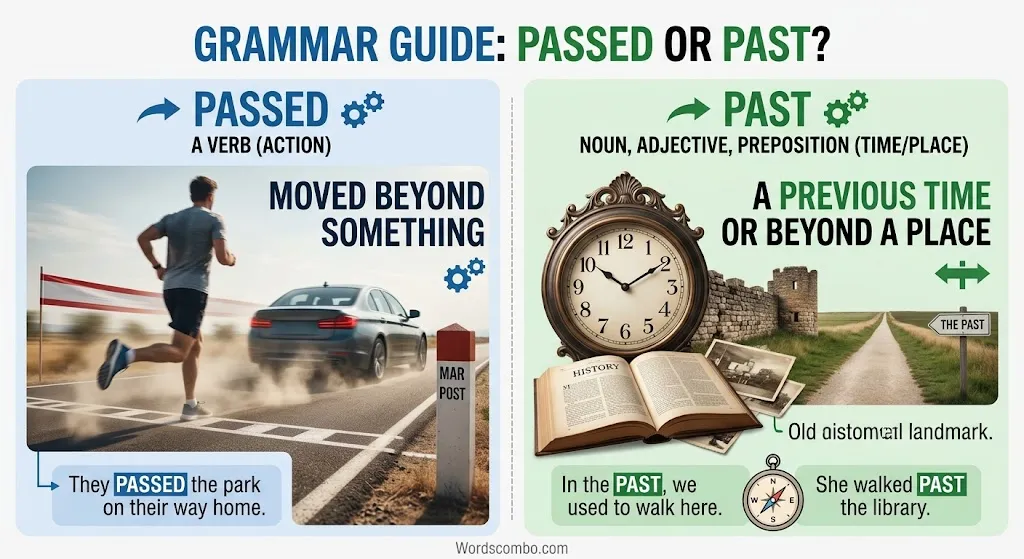
Both past and passed are correct, but they are used differently. Passed is the past tense or past participle of the verb pass. Past refers to an earlier time, something previous, or a position beyond a particular point.
Simple rule: Use passed for the action of passing. Use past when you mean earlier time, something previous, or “beyond.”
Past or passed is a common pair of confusing words because both words sound the same but have different meanings and grammatical roles. Choosing the right one becomes much easier when you know whether your sentence needs the verb pass or the word past.
For example, She passed the store describes an action, while She walked past the store describes where she walked. The two words may sound identical, but they cannot always replace each other.
Why the Confusion Happens
The main reason people confuse past and passed is pronunciation. In everyday speech, they sound alike, so it is easy to choose the wrong spelling when writing.
The grammatical difference is the best way to separate them. Passed is a form of the verb pass. It tells us that someone or something performed an action.
Past, on the other hand, is not a verb. It can refer to an earlier time, a previous event, or something located beyond a particular point.
For example:
She passed the house.
She walked past the house.
In the first sentence, passed is the verb. In the second, walked is the verb, and past tells us where she walked.
This simple distinction explains most cases of past vs passed.
Meanings of Past and Passed
What Does Passed Mean?
Passed is the past tense and past participle of pass. It is used when someone or something has completed the action of passing.
It can describe several situations, including:
- moving beyond someone or something
- going by
- succeeding in a test
- handing something to another person
- approving or accepting something
- reaching or going beyond a particular point
- time going by
For example:
Maria passed her driving test.
Here, passed means Maria succeeded in the test.
For example:
The car passed the truck.
Here, passed describes the car moving beyond the truck.
For example:
Two hours passed before they arrived.
Here, passed means that two hours went by.
What Does Past Mean?
Past commonly refers to an earlier time, something that happened before now, or a position beyond something.
It can also describe something former or previous.
For example:
We should learn from the past.
Here, past refers to earlier events or time.
For example:
He walked past the school.
Here, past means beyond the school.
For example:
She has changed a lot over the past year.
Here, past refers to the previous year.
Unlike passed, past does not function as the main verb meaning “move beyond” or “go by.”
Past and Passed in Time Expressions
Time expressions are another area where these words are often confused.
Use past when referring to a time on a clock.
For example:
It is ten past five.
The train arrives at twenty past eight.
But use passed when talking about time moving by.
For example:
Ten minutes have passed.
Several years have passed since we last met.
The difference is straightforward:
Ten past five = a clock time.
Ten minutes have passed = time has gone by.
Correct Usage Examples
Examples With Passed
Here are four common ways to use passed correctly.
For example:
She passed her English examination.
For example:
The bus passed our house at noon.
For example:
He passed the message to his colleague.
For example:
Several minutes passed before anyone spoke.
In all four examples, passed represents an action connected to the verb pass.
Examples With Past
Here are four common ways to use past correctly.
For example:
We drove past the supermarket.
For example:
The difficult experience is now in the past.
For example:
She has learned from her past mistakes.
For example:
The restaurant is just past the bridge.
In these examples, past refers to previous time, previous experiences, or a position beyond something.
Passed or Past a Place?
This is one of the most common points of confusion.
Use passed when it is the main verb.
For example:
The cyclist passed the park.
Use past after another verb when it means “beyond.”
For example:
The cyclist rode past the park.
The same pattern works with many other verbs.
For example:
We walked past the station.
For example:
They drove past the hotel.
For example:
The dog ran past me.
For example:
She moved past the entrance.
You would use passed when pass itself is the action.
For example:
We passed the station.
For example:
They passed the hotel.
Passed or Past a Deadline?
When something goes beyond a deadline or due date, past is normally used in expressions such as past the deadline and past due.
For example:
The payment is past due.
For example:
We are already past the deadline.
But if pass is the verb, use passed.
For example:
The deadline passed without any decision.
The first examples describe something being beyond a point. The last example describes the deadline reaching its end.
Memory Trick
Use this easy memory trick:
Passed = Pass + ED = an action.
Past = Time or beyond.
There is also a useful letter trick:
Past has a T, and T can remind you of Time.
So if you are talking about time before now, think past.
If you are describing an action that someone did, think passed.
For example:
The years have passed.
The word is passed because pass is the action.
For example:
The past few years have been difficult.
The word is past because it describes previous time.
Past vs Passed at a Glance
| Word | Status/Context | Why | Example |
| Past | Earlier time | Refers to time before now | We cannot change the past. |
| Past | Previous period | Describes something that happened before | The past year was busy. |
| Past | Beyond a place | Shows a position beyond something | Walk past the school. |
| Past | Beyond a point | Shows that something has gone beyond a limit | It is past the deadline. |
| Passed | Action of passing | Past form of pass | She passed the exam. |
| Passed | Moving beyond | Describes an action | The car passed the bus. |
| Passed | Time going by | Pass means to go by | Three hours passed quickly. |
| Passed | Giving something | Describes handing something over | He passed me the book. |
The biggest difference in this past vs passed comparison is that passed can act as the verb, while past generally describes time, position, or something previous.
Similar Word Pairs to Watch For
Affect or Effect
Affect is commonly used as a verb meaning to influence something. Effect is commonly used as a noun meaning a result.
For example:
The weather affected our plans.
For example:
The decision had a major effect.
Accept or Except
Accept means to receive or agree to something. Except means excluding someone or something.
For example:
She accepted the offer.
For example:
Everyone attended except James.
Complement or Compliment
A complement completes or enhances something, while a compliment is an expression of praise.
For example:
The curtains complement the furniture.
For example:
She gave me a lovely compliment.
Then or Than
Then is generally connected with time or sequence. Than is used when making comparisons.
For example:
We finished dinner and then left.
For example:
This book is better than the other one.
Lay or Lie
Lay generally takes an object, while lie usually describes someone or something resting in a position.
For example:
Please lay the papers on the desk.
For example:
I need to lie down.
These pairs are worth learning because understanding the difference between similar-sounding words can make your writing much clearer.
Mini FAQ
Is past or passed correct?
Both past and passed are correct. The right choice depends on what you mean and how the word functions in the sentence.
Is it past the store or passed the store?
Both can be correct, depending on the verb. She passed the store uses passed as the verb. She walked past the store uses past to mean beyond the store.
Is it past tense or passed tense?
The correct expression is past tense. It refers to a grammatical tense used for actions or situations that occurred earlier.
Is it time has past or time has passed?
The correct expression is time has passed. Here, passed is the verb meaning that time has gone by.
Is it past due or passed due?
The standard expression is past due. It means that something is beyond the date or time when it was supposed to be completed or paid.
Conclusion
Past and passed are both correct, but they have different jobs. Use passed when you need the past form of pass, and use past for earlier time, previous events, or something beyond a particular point.
Remember: passed is an action, while past is about time, what came before, or what lies beyond. For another useful comparison, see Affect or Effect and Accept or Except.

I have been working with English language content for over six years. I specialize in word comparisons and spelling differences that most people overlook. At WordsCombo, I help readers choose the right word every time.