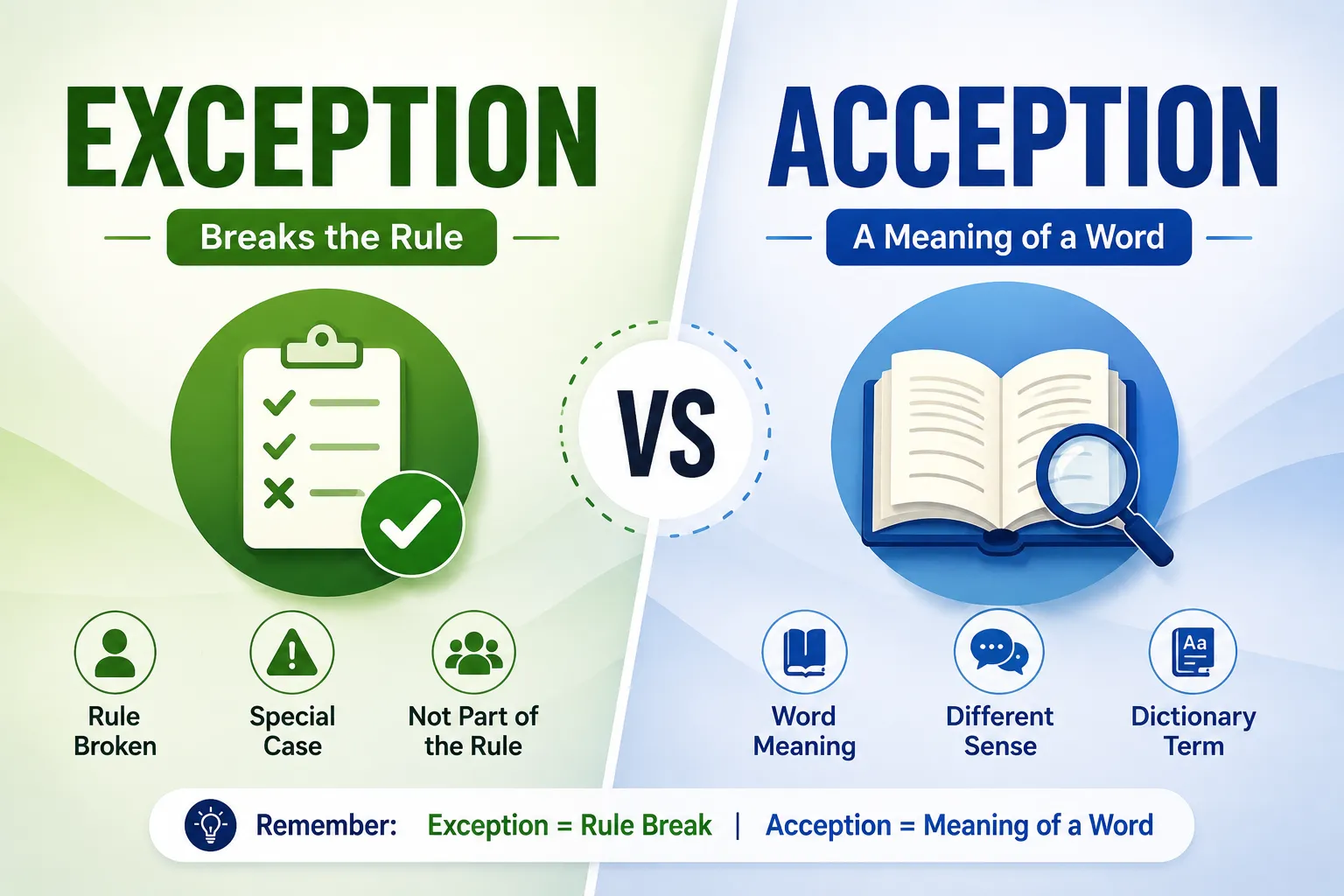
📘 Exception means something that does not follow a rule, while acception is a rare word meaning a particular meaning or accepted sense of a word. 💡 In most everyday writing, you’ll almost always use exception.
Have you ever typed exception into a search bar and wondered if acception was also a real word? You’re not alone. I remember proofreading an article years ago where a writer used acception instead of exception. At first glance, the mistake looked small. Yet it completely changed the meaning of the sentence.
That moment stayed with me because English has many words that look alike but mean very different things. Even experienced writers can mix them up. Spell check tools do not always explain the difference. They only tell you if a word exists.
If you have searched for exception or acception, you are likely asking one simple question: Which word should I use? The answer depends on what you want to say.
In this guide, you’ll learn the meaning of both words, why people confuse them, and when each one is correct. You’ll also see easy examples that you can use in everyday writing. By the end, you will know exactly which word fits your sentence.
Exception
An exception is a person, thing, or situation that does not follow a general rule.
Think of it as the one case that is different.
Simple examples
- Everyone must wear a uniform. The principal made one exception for the new student.
- Birds usually fly, but penguins are an exception.
- No phones are allowed, with one exception for emergencies.
In each example, the rule stays the same. Only one case is treated differently.
An acception, on the other hand, is not about breaking a rule. It is about the meaning of a word. That is why most English learners and writers almost always need exception.
The Origin and Background of Exception and Acception
Words often make more sense when you know where they came from.
The origin of exception
The word exception comes from the Latin word exceptio, which means taking something out.
That idea still exists today.
When you make an exception, you take one person or one thing out of the normal rule.
For example:
- Every employee works on Friday.
- Sarah is sick.
- Sarah becomes the exception.
The rule stays. Sarah is simply removed from it.
The origin of acception
The word acception also comes from Latin, but through a different path. It developed from a word meaning acceptance of a meaning or sense.
Today, it is mainly used in:
- dictionaries
- linguistics
- language research
- historical writing
Outside these fields, very few people use it.
Many native English speakers never hear or use acception during everyday conversation.
Why do people confuse these words?
There are several reasons.
- They look almost identical.
- Both end with ception.
- Auto correct may not explain the difference.
- Many people mistake acception for acceptance.
The confusion becomes even greater because acceptance is a common word, while acception is rare.
That is why thousands of people search online to check which spelling is correct.
Exception vs Acception Explained
Although these words look similar, they describe completely different ideas.
| Term | Meaning | When to Use | Region/Context |
|---|---|---|---|
| Exception | Something that does not follow a rule | Daily writing, school, business, conversations | Used worldwide |
| Acception | A particular meaning of a word | Dictionaries, linguistics, academic language | Rare and specialized |
What is an exception?
Use exception whenever you talk about rules, limits, or situations that are different.
Examples:
- Every child received a gift except one. That child was the exception.
- The library closes at six, with one exception during exam week.
- Nobody is perfect. There are very few exceptions.
This is the meaning most people need.
What is an acception?
Use acception only when talking about the meaning of a word.
Example:
The dictionary lists several acceptions of the word bank.
Here, bank can mean:
- the side of a river
- a financial institution
Each meaning is a different acception.
Unless you are discussing language itself, you probably do not need this word.
A simple trick to remember
Think of it this way:
- Exception = Exit from the rule.
- Acception = Accepted meaning of a word.
This memory trick helps many students remember the difference in just a few seconds.
Everyday comparison
Imagine your teacher says:
“Everyone must submit homework by Friday.”
If one student is sick and gets extra time, that student is an exception.
Now imagine you open a dictionary and look up the word light.
It may mean:
- brightness
- not heavy
Each of these meanings is an acception of the word.
One word deals with rules.
The other deals with meanings.
Knowing this difference makes it much easier to choose the correct word every time.
Which Version Should You Use?
Choosing the right word is easier than it seems. Ask yourself one simple question:
Am I talking about a rule or the meaning of a word?
If the answer is a rule, use exception.
If the answer is the meaning of a word, use acception.
For students
Use exception in essays, homework, and exams unless your teacher is discussing language or dictionaries.
Example:
- There was one exception to the school rule.
For writers and bloggers
Almost every article, blog post, or social media update should use exception.
Use acception only if you are writing about language, grammar, or dictionary definitions.
For teachers and researchers
Teachers may use both words, but for different reasons.
- Use exception when explaining rules.
- Use acception when explaining different meanings of a word.
For business professionals
Business emails, reports, and company policies nearly always require exception.
Example:
No refunds will be issued without prior approval, with one exception for damaged products.
Best choice for global English
If you are unsure, choose exception.
It is the standard word used in everyday English across the world.
Common Mistakes with Exception and Acception
Many people confuse these words because they look almost the same. Here are the mistakes you should avoid.
| Mistake | Correct Form | Why It Happens |
|---|---|---|
| This rule has one acception. | This rule has one exception. | People confuse the spellings. |
| The dictionary shows several exceptions of this word. | The dictionary shows several acceptions of this word. | They use the common word instead of the technical one. |
| Everyone came with no acception. | Everyone came with no exception. | The sentence is about a rule, not word meanings. |
| The word has two exceptions. | The word has two acceptions. | Different meanings are called acceptions. |
| I use acception in daily writing. | I use exception in daily writing. | Acception is rarely used outside language studies. |
Tips to avoid mistakes
- Exception = Think about rules.
- Acception = Think about dictionary meanings.
- If you’re writing an email or report, you almost certainly need exception.
- When in doubt, read the sentence aloud. Ask yourself what you’re really talking about.
Exception and Acception in Real World Examples
Seeing words in context makes them much easier to remember.
Professional Email
Dear Team,
There will be one exception to our usual meeting schedule this week. Friday’s meeting has been moved to Thursday.
Here, exception refers to a change in the normal rule.
News Headline
Weather Alert: One Exception to the Heatwave Expected Along the Coast
The headline talks about one area that does not follow the general weather pattern.
Social Media Post
Everyone loved the movie. The only exception was my little brother, who preferred cartoons.
This is natural, simple everyday English.
Formal Report
The policy applies to all departments without exception unless approved by senior management.
Business reports often use this phrase because it sounds clear and professional.
Dictionary or Linguistics Example
The dictionary lists three acceptions of the word spring.
The word spring can mean:
- a season
- a source of water
- a coiled piece of metal
Each meaning is an acception.
This is one of the few situations where acception is the correct choice.Exception vs Acception — Data, Trends & Usage
Search behavior tells an interesting story.
Search intent
The keyword “exception or acception” has a clear informational search intent.
People are trying to understand:
- Which spelling is correct.
- Whether both words exist.
- When each word should be used.
- How to avoid making mistakes.
Who searches this topic?
This topic is popular among:
- English learners
- Students
- Teachers
- Bloggers
- Content writers
- Editors
- Copywriters
- Non native English speakers
Many users discover the question while proofreading documents or writing emails.
Where is it most searched?
Interest is strongest in countries where English is widely learned as a second language, including:
- India
- Pakistan
- Bangladesh
- Nigeria
- The Philippines
It is also searched by students and writers in English speaking countries who want to check the correct usage.
Why does this matter today?
People rely more than ever on online communication.
A small word choice can affect:
- Professional credibility
- Academic writing
- Website content
- SEO performance
- Reader trust
Using the correct word shows attention to detail and improves the quality of your writing.
Standalone Comparison Table
| Term/Variant | Meaning | Region/Context | Best Used When |
|---|---|---|---|
| Exception | Something that does not follow a rule | Everyday English worldwide | Talking about rules, policies, or unusual cases |
| Acception | A particular meaning or sense of a word | Linguistics, dictionaries, academic writing | Discussing word meanings |
| Acceptance | Agreement, approval, or receiving something | Everyday English worldwide | Talking about approval or receiving offers |
| Exemption | Freedom from a duty, rule, or payment | Legal, education, business | When someone is officially excused from a requirement |
Quick summary
- Exception → Different from the rule.
- Acception → Meaning of a word.
- Acceptance → Approval or agreement.
- Exemption → Official release from a requirement.
Remember this simple rule:
If you’re writing about everyday life, “exception” is almost always the right choice. “Acception” belongs mainly in dictionaries and language studies.
Frequently Asked Questions (FAQs)
Q: What does exception mean?
A: An exception is something that does not follow a general rule. It refers to a person, thing, or situation that is treated differently from the rest.
Q: What does acception mean?
A: Acception is a rare English word. It means a particular meaning or sense of a word. It is mainly used in dictionaries, linguistics, and academic writing.
Q: How do you use exception correctly?
A: Use exception whenever you are talking about rules, policies, habits, or situations where something is different from the normal pattern.
Example:
Everyone attended the meeting with one exception.
Q: Exception vs acception: what’s the difference?
A: The difference is simple. Exception refers to something outside a rule, while acception refers to one meaning of a word. Although they look similar, they have completely different uses.
Q: Is acception acceptable in formal writing?
A: Yes, but only in the right context. If you are writing about language, dictionaries, or word meanings, acception is correct. For most formal documents, reports, and emails, exception is the word you need.
Q: Which version is correct exception or acception?
A: Both are correct English words. However, exception is used far more often in everyday English. Acception is a specialized term that appears mostly in linguistic and academic contexts.
Q: Can acception be used in everyday conversation?
A: Technically, yes. In practice, almost never. Most native English speakers use exception or meaning instead because acception is uncommon and may confuse readers or listeners.
Conclusion
Words that look alike can easily cause confusion, but exception and acception have very different meanings. Once you understand that difference, choosing the correct word becomes simple.
Here are the key points to remember:
- Exception means something that does not follow a rule.
- Acception means a particular meaning or sense of a word.
- Exception is the word used in everyday English, business writing, school assignments, and conversations.
- Acception is a rare, technical term used mainly in dictionaries and linguistic discussions.
When you’re unsure, ask yourself one question: Am I talking about a rule or about the meaning of a word? If it’s about a rule, choose exception. If it’s about a word’s meaning, acception is the right choice.
The more you practice, the more natural the distinction will become. Small improvements like this make your writing clearer, more accurate, and more professional.
Now you know exactly how to use exception and acception. Bookmark this guide so you never second guess these words again, and share it with someone who has been confused by them.
Read more: Nosy or Nosey: The Complete Guide to the Correct Spelling

I started writing about English word differences after years of teaching students who kept making the same mistakes. My focus is on making spelling rules feel simple and easy to remember. At WordsCombo, I turn confusing word pairs into clear comparisons.