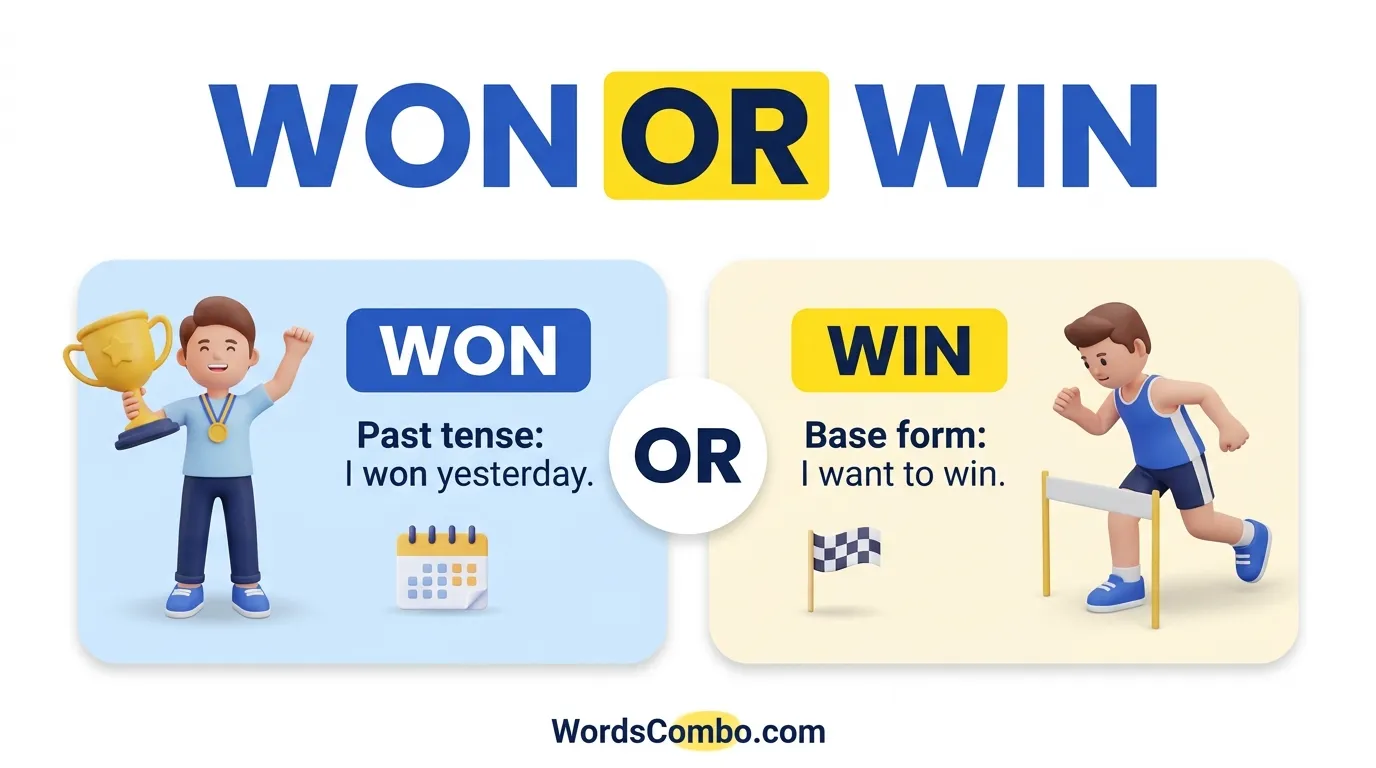
Win is the present-tense form of the verb, while won is its past-tense form and past participle. Use win for something that happens now or in the future, and won for something that has already happened.
When writing an email, school assignment, or social media post, choosing between won or win depends on the time of the action. For example, you might say, “I hope we win the game,” but “We won the game yesterday.” Both words are correct, but they fit different sentences. Learning when to use each form will help you write clear, natural English and avoid common grammar mistakes.
The Difference Between Won and Win
The main difference between win and won is verb tense. Both words describe getting a victory, success, or a prize, but they refer to different times.
- Win: The base form of the verb. Use it for the present, future, commands, and after certain helping verbs.
- Won: The simple past tense and past participle of win. Use it for past actions and with helping verbs such as have, has, and had.
For example:
- I want to win the race.
- She won the race yesterday.
- They have won three games this week.
Notice how the correct form changes with the sentence. Therefore, you should check the tense and the helping verb before choosing between win and won.
What Does Win Mean?
Win means to get a victory, succeed in a contest, or receive a prize because of success. It can also mean gaining someone’s support or achieving a good result.
Use win when talking about the base form of the action or something that happens in the present or future.
Examples:
- I hope we win the match.
- You can win a prize in the contest.
- She wants to win the race.
- Good ideas can win people’s support.
The word also appears after modal verbs such as can, will, may, and might.
For example, “Our team will win tomorrow” is correct because will takes the base form of the verb.
What Does Won Mean?
Won is the past tense and past participle of win. It tells you that someone achieved a victory or success, or it appears in a perfect-tense sentence.
Use won when the sentence refers to a completed action in the past or follows a helping verb that requires a past participle.
Examples:
- Our team won the match yesterday.
- He won first place in the contest.
- She has won several awards.
- They had won before the final round began.
However, won does not always appear alone. In sentences such as “She has won,” the helping verb has works with the past participle to form the present perfect tense.
Key Differences Between Won and Win
The following table shows how the two forms differ.
| Feature | Win | Won |
| Verb form | Base form | Simple past and past participle |
| Main use | Present, future, and other base-form uses | Past actions and perfect tenses |
| Example | I want to win. | I won yesterday. |
| With will | I will win. | I will won. is incorrect. |
| With have | I have win. is incorrect. | I have won. |
| With did | Did you win? | Did you won? is incorrect. |
The most useful rule is simple: use win after will, can, and did. Use won when describing a past victory or after have, has, or had.
When Should You Use Win or Won?
The correct choice depends on the sentence structure and the time of the action.
Use Win for Present or Future Actions
Use win when talking about a general fact, a goal, a possibility, or a future event.
Examples:
- I want to win the competition.
- Our school can win the tournament.
- They will win if they play well.
- Practice helps you win more games.
Use Won for Past Actions
Use won when the victory happened in the past.
Examples:
- We won the game last night.
- Maria won the school competition.
- My team won its last match.
- He won the prize two days ago.
Words such as yesterday, last week, and two days ago often point to the simple past. Therefore, won is usually the right choice in these sentences.
Use Won With Have, Has, or Had
The past participle won is used in perfect tenses.
Examples:
- I have won two awards.
- She has won the match.
- They had won before the rain started.
By contrast, do not use the base form win after these helping verbs when forming perfect tenses.
Use Win After Did
Although did refers to the past, it must be followed by the base form of the main verb in questions and negative statements.
Correct examples:
- Did you win the game?
- We did not win the match.
- Why did he win the award?
Avoid “Did you won?” because the past tense is already shown by did. The main verb stays in its base form.
Common Mistakes With Won and Win
These mistakes are common among English learners. Fortunately, a few simple rules can help you avoid them.
Mistake 1: Using Won After Will
Incorrect: I will won the competition.
Correct: I will win the competition.
After will, use the base form of the verb. The same rule applies to shall, can, and might.
Mistake 2: Using Won After Did
Incorrect: Did your team won?
Correct: Did your team win?
Although did refers to the past, it takes the base form of the main verb.
Mistake 3: Using Win After Have or Has
Incorrect: She has win three awards.
Correct: She has won three awards.
Use the past participle won after have, has, or had when forming perfect tenses.
Mistake 4: Writing Winned Instead of Won
Incorrect: He winned the race.
Correct: He won the race.
Win is an irregular verb, so its past form is won, not winned.
Mistake 5: Using Win for a Finished Past Action
Incorrect: We win the game yesterday.
Correct: We won the game yesterday.
The word yesterday tells you that the action happened in the past. Therefore, use won.
Real-World Examples of Won and Win
Here are examples from everyday situations to help you choose the correct word.
| Situation | Example sentence |
| School competition | Our class hopes to win the quiz. |
| Sports report | The home team won the match last night. |
| Work email | We hope to win the client’s trust. |
| Award announcement | Maya won first prize in the contest. |
| Future plan | I will win if I keep practicing. |
| Personal achievement | He has won several awards. |
| Everyday question | Did you win the game? |
| Negative statement | They did not win the final. |
Notice that the helping verbs and time words make the choice easier. For example, will takes win, while has takes won in a perfect-tense sentence.
Is Win or Won More Common?
Both win and won are common English words, but they serve different grammatical purposes. Neither is a regional spelling of the other, and the distinction is the same in American and British English.
Use win for the base form of the verb, including after will and can. However, use won for the simple past and past participle.
The verb win also has an -ing form, winning, and a third-person singular present form, wins. Therefore, the full pattern is:
- Base form: win
- Present with he, she, or it: wins
- Past tense: won
- Past participle: won
- -ing form: winning
Learning these forms together makes it easier to use the verb correctly in conversations, essays, and professional writing.
Frequently Asked Questions
1. Is it win or won?
Both words are correct, but they have different uses. Use win for the base form of the verb and won for the past tense or past participle.
2. Is won the past tense of win?
Yes, won is the simple past tense of win. For example, “Our team won the game yesterday” describes a completed action.
3. Should I say I win or I won?
Use “I win” for a present-tense statement, such as “I win most of my games.” Use “I won” when talking about a past victory, such as “I won yesterday.”
4. Is it correct to say will won?
No, will won is grammatically incorrect. The correct phrase is will win because will must be followed by the base form of the main verb.
5. Should I use win or won after did?
Use win after did. For example, “Did you win the match?” is correct, while “Did you won the match?” is incorrect.
6. Do American and British English use win and won differently?
No, American and British English use the same verb forms. In both varieties, win is the base form, and won is the past tense and past participle.
7. Is winned a correct word?
No, winned is not the standard past tense of win. Use won instead, as in “She won the race.”
Final Thoughts on Won or Win
The difference between won or win becomes easy when you look at the verb tense. Use win for the base form, including after will, can, and did. On the other hand, use won for a completed past action and after have, has, or had in perfect tenses.
Remember these examples: “I want to win,” “I won yesterday,” and “I have won before.” They show the three most useful patterns.
Both forms are correct in American and British English, so you do not need to worry about regional spelling differences. Instead, check the helping verb and the time of the action before choosing a form. With practice, you will use both words naturally in your writing.
Curious about another confusing word? Read our guide to Grammar or Grammer.

I started writing about English word differences after years of teaching students who kept making the same mistakes. My focus is on making spelling rules feel simple and easy to remember. At WordsCombo, I turn confusing word pairs into clear comparisons.