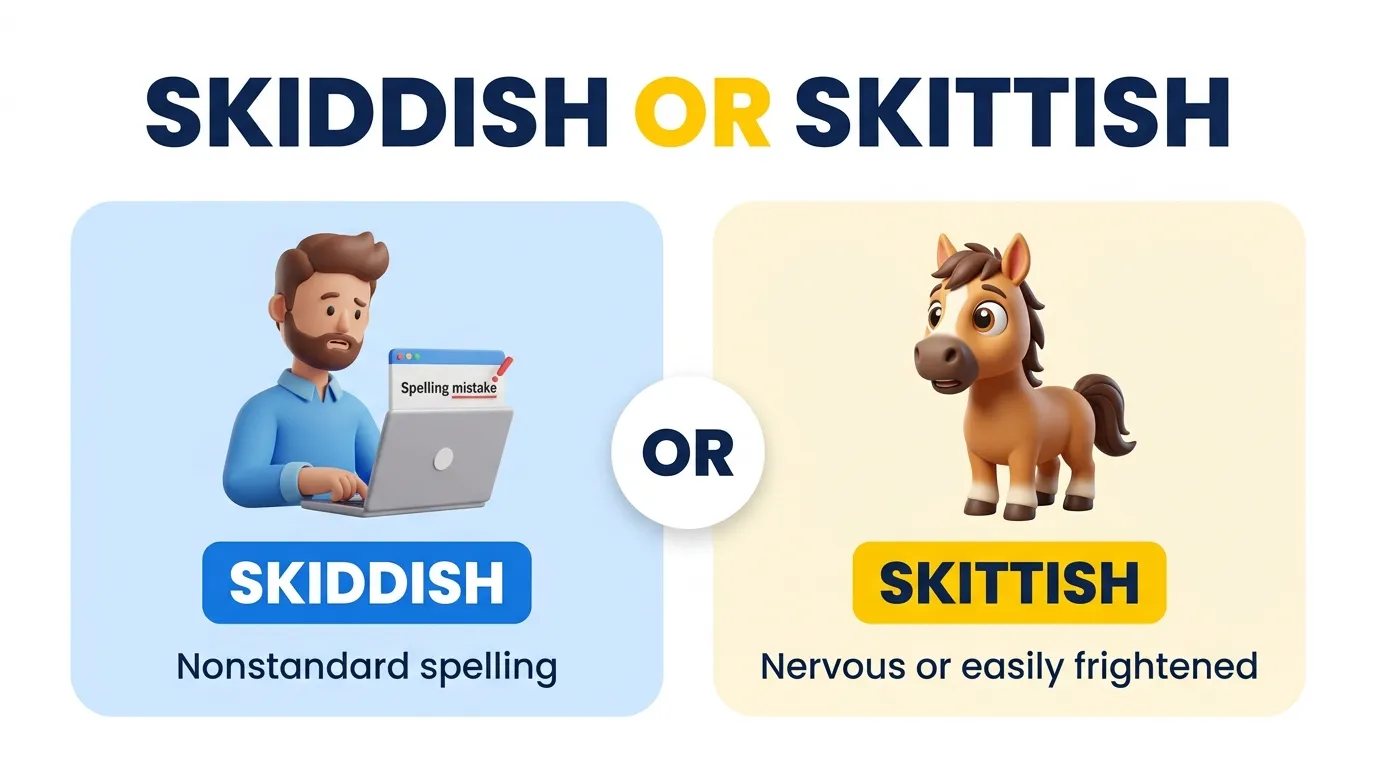
Skiddish or skittish has a simple answer: skittish is the correct standard spelling. It means nervous, easily frightened, or quick to react.
When I typed “skiddish” into a work message, the red spelling line made me stop before sending it. The word looked right, but skiddish or skittish had me second-guessing the spelling. The correct form is skittish, not skiddish. It describes someone or something that is nervous, easily scared, or quick to react.
However, the confusion makes sense because the two forms sound close. So, if you need the word for an email, essay, post, or formal document, use skittish.
Skiddish or Skittish: Quick Answer
Skittish is the correct spelling. Skiddish is generally a misspelling when the intended meaning is nervous, easily frightened, or jumpy.
For example, you can write, “The horse is skittish around loud noises.” You can also say, “Investors became skittish after the sudden change.”
The word is an adjective. It can describe animals, people, moods, markets, and situations.
The Origin of Skiddish or Skittish
The word skittish has been used in English for many centuries. Its exact early root is not fully settled, but it is linked to older English forms and may have a Scandinavian connection.
Over time, the word developed meanings linked to lively, playful, nervous, or easily frightened behavior. Today, the nervous or easily startled meaning is very common.
So why does skiddish look so natural?
One reason is sound. When people say “skittish” quickly, the middle sounds can be hard to hear clearly. As a result, some people connect the word with skid and write “skiddish.”
Still, the standard spelling has two T’s:
S-K-I-T-T-I-S-H
That small spelling detail is the key to remembering the word.
Skiddish or Skittish Explained: Key Differences
The main difference is simple. Skittish is the standard word, while skiddish is not the standard spelling for this meaning.
Also, skittish has several related uses. It can describe an animal that gets scared easily, a person who feels nervous, or even investors who feel unsure about a situation.
For example, a horse may become skittish after hearing a loud sound. Likewise, a person may feel skittish before a difficult meeting.
Skiddish vs Skittish: Comparison at a Glance
| Term/Variant | Meaning | Region/Context | Best Used When |
| Skittish | Nervous, easily frightened, jumpy, or uncertain | Standard English | Writing and speaking |
| Skiddish | Usually an incorrect spelling of skittish | Nonstandard usage | Avoid in polished writing |
| Skittishly | In a nervous or jumpy way | Standard English | Describing an action |
| Skittishness | A state of being nervous or easily frightened | Standard English | Talking about the quality or behavior |
British English and American English
Both British and American English use skittish.
There is no standard British spelling called skiddish. Likewise, American English does not use skiddish as the standard spelling.
Therefore, you do not need to choose between two regional spellings here. The same spelling works in both varieties.
For example:
- British English: The dog is skittish around strangers.
- American English: The dog is skittish around strangers.
The spelling stays the same in both cases.
Which One Should You Use?
If you mean nervous, easily frightened, jumpy, or uncertain, use skittish.
For students, use skittish because it is the standard spelling taught in English writing.
For professionals, use skittish because it is clear and accepted in formal writing.
For teachers and writers, use skittish when explaining nervous or easily startled behavior.
For social media or casual messages, skittish is still the safest choice.
For neutral English, choose skittish every time. You do not need to change the spelling for British or American readers.
Common Mistakes with Skiddish or Skittish
Writing “skiddish” instead of “skittish”
Mistake: The puppy was skiddish around visitors.
Correction: The puppy was skittish around visitors.
The error often comes from how the word sounds. However, the standard spelling uses tt, not dd.
Writing “skitish” with one T
Mistake: The horse became skitish after the loud noise.
Correction: The horse became skittish after the loud noise.
The middle of the word needs two T’s. So, remember skit + tish when spelling it.
Treating skiddish as a British spelling
Mistake: I thought “skiddish” was the British form.
Correction: British and American English both use skittish.
There is no British-American spelling change here. The same standard form works in both varieties.
Using skittish only for animals
Mistake: She is a person, so she cannot be skittish.
Correction: She became skittish when the topic changed.
The word can describe people too. It can show that someone feels nervous, uneasy, or ready to react.
Using skittish to mean angry
Mistake: He was skittish because he was angry.
Correction: He was skittish because he felt nervous.
Skittish usually points to fear, nervousness, excitement, or uncertainty. It does not simply mean angry.
Skiddish or Skittish in Real-World Examples
The word often appears in everyday writing because it can describe both people and things.
Professional Email
“The client seems skittish about signing the contract.”
Here, skittish means the client feels unsure or nervous.
News Headline
“Investors Remain Skittish as Market Concerns Grow”
In this setting, skittish means uncertain and ready to react to changes.
Social Post
“My new puppy is still skittish around strangers, but she is getting better.”
Here, the word describes a nervous animal that is not yet comfortable.
Formal Document
“The animal became skittish after repeated exposure to loud sounds.”
This use is clear and suitable for formal writing.
Everyday Conversation
“My cat gets skittish whenever someone rings the doorbell.”
The meaning is easy to understand because the cat reacts quickly to something unexpected.
What Does Skittish Mean?
Skittish usually means nervous, easily frightened, easily startled, or jumpy.
It is often used for animals. A skittish horse may move away when it hears a strange sound. A skittish cat may hide when a new person enters the room.
However, the word also works for people. Someone may feel skittish before an interview, difficult talk, or new experience.
The meaning can also be wider. For example, a market can be called skittish when people react quickly because they feel unsure about what may happen.
In some contexts, skittish can also suggest behavior that is lively, changeable, or hard to predict.
Is Skittish the Same as Shy?
Not quite.
Shy usually focuses on discomfort around people, attention, or social situations. Skittish focuses more on nervousness, sudden reactions, or being easily startled.
For example, a shy child may avoid talking to new people. A skittish child may jump when someone enters the room suddenly.
So, the words can overlap. However, they do not always mean the same thing.
How Do You Spell Skittish?
The correct spelling is:
S-K-I-T-T-I-S-H
A simple memory trick is two T’s.
Think:
Skittish = TT
Do not write:
Skiddish ❌
Do not write:
Skitish ❌
Write:
Skittish ✅
Once you remember the double T, the spelling becomes much easier.
How Do You Pronounce Skittish?
Skittish is pronounced roughly like SKIT-ish.
The first part sounds like “skit.” Then comes “ish.”
In normal speech, the middle sounds may blend together. Because of that, some people may hear a D sound and write skiddish.
Still, pronunciation does not change the spelling. The written form remains skittish.
Skittish in Different Contexts
The meaning of skittish can change slightly based on what it describes.
With animals, it usually means easily frightened or startled.
With people, it can mean nervous, uneasy, or quick to react.
With investors, it often means uncertain or cautious.
With plans or behavior, it can suggest something changeable or unpredictable.
So, context matters. The core idea is usually that someone or something is not calm, steady, or fully comfortable.
Skiddish or Skittish: Data, Trends & Usage
Current search intent around skiddish or skittish is mainly a spelling question. People usually want to know which form is correct before using the word in writing.
Students and English learners are likely to search the phrase because the two spellings sound similar. Writers may also search it when a spelling checker flags skiddish.
Meanwhile, people who already know the word may search for its meaning, pronunciation, or use with people and animals.
The confusion matters because skittish has uses beyond simple spelling. It can describe animals, people, investors, markets, moods, and uncertain behavior.
As a result, learning the correct spelling also helps you understand the word more fully.
FAQs About Skiddish or Skittish
Which is correct, skiddish or skittish?
Skittish is the correct standard spelling. Skiddish is generally a misspelling when the intended meaning is nervous, easily frightened, or jumpy.
What does skittish mean?
Skittish means nervous, easily frightened, easily startled, or jumpy. It can also describe something uncertain, changeable, or hard to predict.
Is skiddish a real word?
In standard English, skiddish is not the usual spelling for this meaning. So, when you mean nervous or easily frightened, use skittish instead.
Is skittish British or American English?
Skittish is used in both British and American English. Therefore, you can use the same spelling for readers in either variety of English.
Can you use skittish for a person?
Yes, you can use skittish for a person. For example, “She became skittish when the conversation turned serious” means she became nervous or uneasy.
Is skittish the same as shy?
No, the meanings are not exactly the same. Shy often describes social discomfort, while skittish suggests nervousness, jumpiness, or a quick reaction.
Where does the word skittish come from?
Skittish is an old English word with a history that goes back several centuries. Its exact early root is not fully certain, but older forms were linked with lively, playful, or changeable behavior.
Final Thoughts on Skiddish or Skittish
The answer to skiddish or skittish is clear: choose skittish. It is the standard spelling for someone or something that is nervous, easily frightened, jumpy, or uncertain.
Remember the most useful spelling tip: skittish has two T’s. Also, the word works in both British and American English, so you do not need a different regional form.
Finally, use skittish in emails, school work, professional writing, social posts, and everyday speech. Keep that spelling in mind, and you will avoid one of the most common mistakes with this word. Save this simple rule and use skittish with confidence.
Curious about similar words? Explore Excellant or Excellent.

I started writing about English word differences after years of teaching students who kept making the same mistakes. My focus is on making spelling rules feel simple and easy to remember. At WordsCombo, I turn confusing word pairs into clear comparisons.





1 thought on “Skiddish or Skittish: Correct Spelling Made Easy”