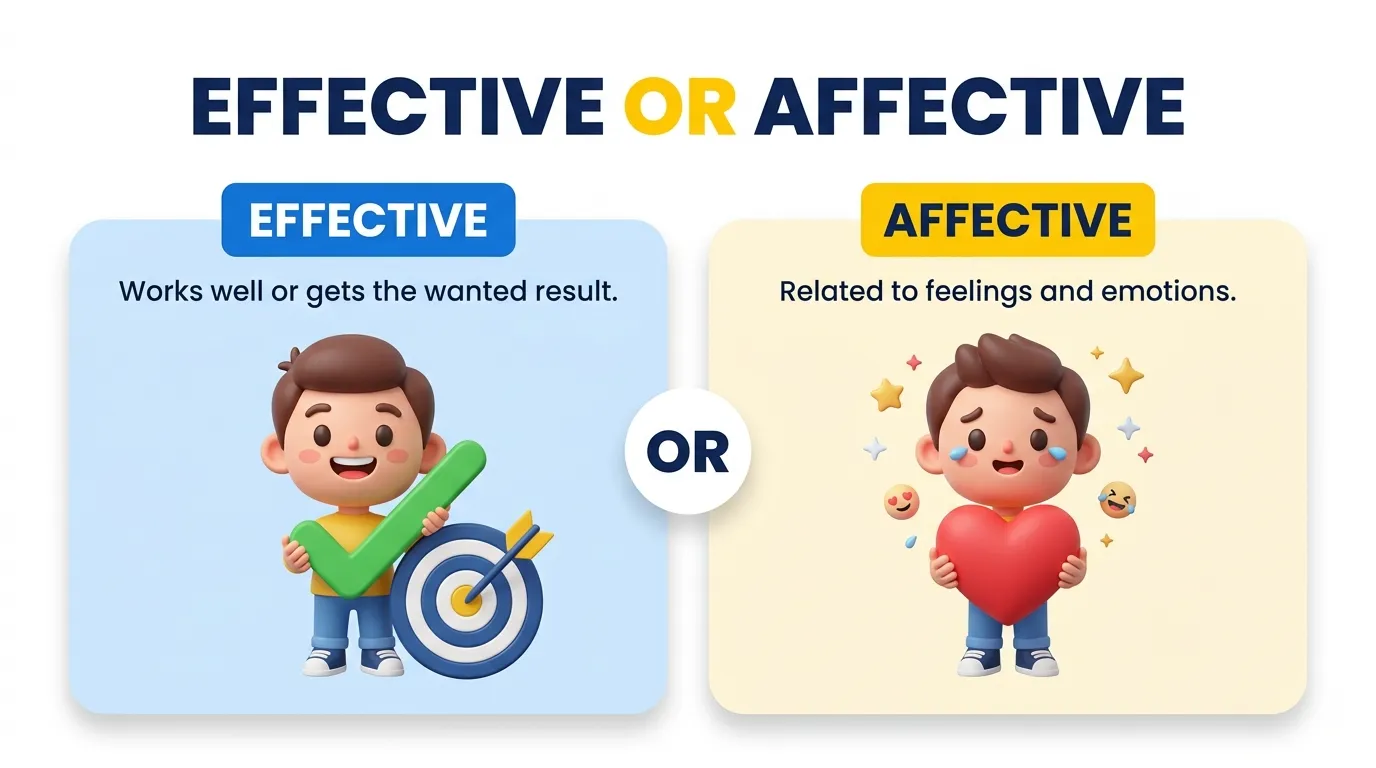
Effective means successful or able to produce a wanted result. Affective relates to feelings, emotions, or moods.
Your email is ready, but one word has a red line under it: “The new plan was affective.” You pause because effective and affective look almost the same. So, the right choice is effective when you mean that something works or gets the result you want.
However, affective is used when the sentence is about feelings or emotional responses. So, once you know whether your sentence focuses on results or emotions, the choice becomes much easier.
Effective or Affective: Quick Answer
In short, effective means that something works well or produces the result you want. By contrast, affective means that something relates to feelings, moods, or emotions.
For example, “The new study plan was effective” means the plan worked. In contrast, “The lesson had an affective goal” means the lesson focused on feelings or attitudes.
The Origin of Effective or Affective
Still, the two words have old roots, but their meanings took different paths. Effective is tied to effect, which means a result or change caused by something.
Also, affective is tied to affect, a word used for a person’s emotional state or the way emotion is shown. Because both words start with similar letters and end with “ective,” they can look easy to mix up.
Over time, effective became a common word in everyday English, so it appears in many common settings. Affective stayed more common in fields such as psychology and education, where feelings, moods, and attitudes need clear labels.
Effective or Affective Explained: Key Differences
The main difference is simple. In simple terms, effective focuses on results, while affective focuses on emotions.
For example, effective can describe a plan, tool, treatment, message, rule, or method. Meanwhile, affective usually describes an emotional response, state, skill, or part of learning.
| Term | Meaning | When to Use | Region/Context |
| Effective | Works well or produces a wanted result | Results, success, action, performance | Everyday, work, school, formal writing |
| Affective | Related to feelings, moods, or emotions | Emotional responses and attitudes | Psychology, education, health, academic writing |
For example, “The training was effective” says the training worked. Meanwhile, “The training supported affective development” points to emotions, attitudes, or values.
Then connect effective with effect, meaning a result. A useful memory trick is to connect affective with affect, meaning an emotional state.
Which One Should You Use?
For everyday writing, use effective when you mean that something works or gets the result you want, so it fits most normal sentences. That choice fits emails, reports, school work, business writing, and normal conversation.
For psychology or education, use affective when you are talking about emotions, moods, attitudes, or emotional responses. For example, “The course supports affective learning” points to feelings and attitudes rather than test scores.
On the other hand, in a neutral sentence about a successful plan, use effective. If your sentence is about how a person feels, however, affective may be the right word.
Common Mistakes with Effective or Affective
Often, writers choose the wrong word because the spellings are so close. Here are the mistakes that matter most.
- Mistake: “The new system was affective.”
Correction: “The new system was effective.”
Why: The sentence says the system worked, so effective is the right choice. - Another mistake: “The study measured effective responses.”
Correction: “The study measured affective responses.”
Why: The sentence focuses on emotional responses, so affective fits. - A third mistake: “She gave an effective response of sadness.”
Correction: “She gave an affective response of sadness.”
Why: The focus is on an emotional response, not success. - One more mistake: “The treatment was affective.”
Correction: “The treatment was effective.”
Why: A treatment that works is effective. - Finally: “The class focused on effective development.”
Correction: “The class focused on affective development.”
Why: Affective development concerns feelings, attitudes, and related personal growth.
Effective or Affective in Real-World Examples
In a professional email, you might write, “The new schedule is effective because it saves time.” Here, the word describes a useful result.
In a news headline, you might see, “New rules prove effective at cutting delays.” Again, the focus is on whether the rules worked.
For a social post, you could write, “This simple study method is effective for busy students.” The sentence talks about a method that gets a useful result.
In a formal document, you might read, “The program supports affective learning.” This wording points to emotions, attitudes, and personal responses.
A psychology paper may use both words in one sentence. For example, “The program was effective and improved students’ affective responses.” The first word describes the result, while the second describes emotions, so both words keep their own job.
Effective or Affective: Data, Trends & Usage
In everyday writing, effective is the word most people need. It appears often in work, school, business, health, technology, and general communication because people regularly talk about what works.
By comparison, affective has a narrower use. It appears more often when the topic involves psychology, education, behavior, emotions, or mood.
Often, searches for this pair come from people who are writing a sentence and stop at the spelling. As a result, the search intent is clear: they want a fast meaning check and a simple rule they can remember.
Most importantly, this is not just a spelling problem. The two words describe different ideas. So checking the meaning of the sentence is more useful than looking only at the letters.
Effective vs Affective: Comparison at a Glance
| Term/Variant | Meaning | Region/Context | Best Used When |
| Effective | Successful or producing a wanted result | All major English varieties | Something works or reaches a goal |
| Affective | Connected to feelings or emotions | Often psychology and education | The topic is emotional experience |
| Effect | A result or change | General English | You mean the result of an action |
| Affect | An influence, or emotional state in psychology | General English and specialist use | You mean influence or emotional state |
FAQs About Effective or Affective
Is effective or affective correct?
Both words are correct, but they do not mean the same thing. So, use effective for success or results, and use affective for feelings, moods, or emotional responses.
What does effective mean?
Effective means that something works or produces the result you want. For example, “This method is effective” means the method works well.
What does affective mean?
Affective means related to feelings, moods, emotions, or emotional responses. Also, it is more common in psychology, education, and other fields that discuss human feelings.
Is “effective immediately” correct?
Yes, effective immediately is correct when a rule, order, job change, or other action starts at once. Affective does not fit because the phrase is about when something takes effect.
Is affective a formal word?
Yes, affective can sound formal or technical because it is common in areas such as psychology and education. Still, it is a normal word when the subject truly involves emotions or emotional responses.
Can something be both effective and affective?
Yes, a program can be effective and affective at the same time. For example, a class can produce strong learning results while also improving students’ attitudes or emotional responses.
How can I remember effective vs. affective?
Think of effective as connected to effect, or a result. Then, think of affective as connected to affect, or emotion, so the meaning guides the spelling.
Final Thoughts on Effective or Affective
The choice between effective and affective depends on one simple idea. Effective is about results, success, or something that works. Affective is about feelings, moods, emotions, or emotional responses.
For everyday writing, effective will usually be the word you need when you mean that something works. However, choose affective when your sentence deals with emotional states or attitudes, especially in psychology or education.
Before you press send, check what your sentence is really describing. If it is about a result, choose effective. If it is about emotion, choose affective. Keep that rule in mind, and this confusing pair becomes much easier to handle.
Curious about similar words? Explore Signer or Signor.

I have been working with English language content for over six years. I specialize in word comparisons and spelling differences that most people overlook. At WordsCombo, I help readers choose the right word every time.